Maersk Eyes Direct Investment in Bangladesh Shipbuilding and Ship Recycling Sectors
Star Business Report, Dhaka — Danish shipping and logistics giant AP Moller-Maersk Line, one of the world's largest container shipping operators, has formally expressed interest in directly investing in Bangladesh's shipbuilding industry — a move that could mark the single largest foreign direct investment (FDI) commitment in the country's maritime industrial sector to date.
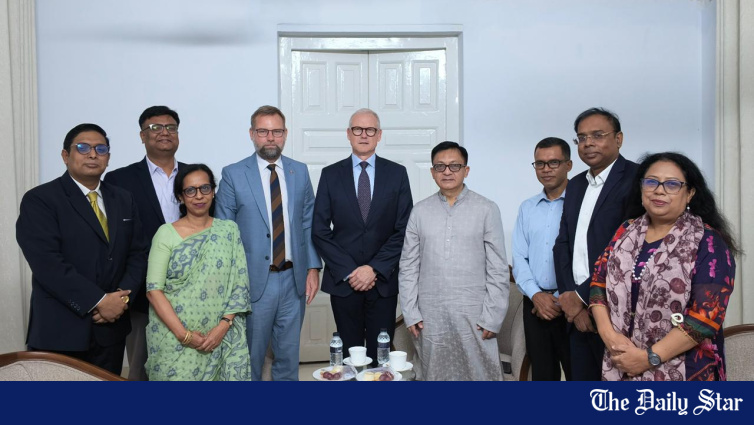
The investment proposal was discussed at a high-level meeting between Commerce Minister Khandakar Abdul Muktadir, Denmark's Ambassador to Bangladesh Christian Brix Møller, and AP Moller Singapore Pte Ltd's Managing Director René Pihl Pedersen, held at the minister's residence in Dhaka on Saturday. The commerce ministry said in a statement that Maersk's interest spans both shipbuilding and ship recycling, opening the door to a multi-pronged maritime investment footprint in Bangladesh.
🚢 Maersk's Strategic Interest
The Danish envoy told the meeting that Maersk Line is keen to invest directly in Bangladesh's shipbuilding sector, leveraging the company's longstanding global reputation in ship operations, shipping and logistics. Maersk operates a fleet of more than 700 vessels globally, including some of the world's largest container ships, and the company's annual newbuild and recycling requirements represent a significant pipeline of potential work for any partner country.
Commerce Minister Muktadir, in turn, urged Maersk to expand its investment beyond shipbuilding to also cover Bangladesh's ship recycling industry — a sector in which Bangladesh already ranks among the top three global destinations by volume, alongside India and Pakistan, but which has long faced international scrutiny over environmental and labour standards.
🌏 Bangladesh as a Maritime Hub
"Bangladesh could emerge as a promising hub not only for the recycling of old vessels but also for the construction of new ships," Minister Muktadir said, according to the commerce ministry statement. He emphasised that Maersk operates a large fleet of vessels globally, making the company's potential investment particularly significant for Bangladesh's maritime industries.
The minister highlighted Bangladesh's "deep-rooted" experience and growth potential across both shipbuilding and recycling. The country has developed substantial experience in both sectors over the years: Bangladeshi shipyards have delivered container feeders, ferries, and offshore supply vessels to European and African buyers, while the country's ship recycling yards at Sitakunda supply roughly half of Bangladesh's domestic steel requirement through scrapped vessel imports.
👥 Economic Impact
The meeting noted that greater participation by global companies like Maersk could help Bangladesh attract capital, technology and skills while strengthening supporting industries — including marine engineering, steel fabrication, port logistics, classification services, and maritime training. The commerce ministry framed the potential investment as a strategic boost to the country's industrialisation drive, with knock-on effects for the broader blue economy.
"Such investment could also play a key role in generating employment, transferring technology and skills, and developing related industries," the meeting observed, according to the FE report. The reference to technology transfer is particularly significant for the shipbuilding segment, where Bangladeshi shipyards have struggled to move up the value chain from feeder-class vessels to larger Panamax and post-Panamax class ships.
⚖️ Context: Ship Recycling Compliance
The Maersk approach comes at a pivotal moment for Bangladesh's ship recycling sector. The country's yards have, for years, faced pressure from the European Union and the International Maritime Organization (IMO) to comply with the Hong Kong International Convention for the Safe and Environmentally Sound Recycling of Ships, which entered into force in June 2025. Several Bangladeshi yards have, in recent years, obtained HKC compliance certifications, but a large share of the country's recycling capacity remains non-compliant.
Maersk's interest in investing in compliant ship recycling capacity in Bangladesh could therefore serve a dual commercial and regulatory purpose: providing the company with a guaranteed stream of HKC-compliant recycling capacity for its own end-of-life vessels, while accelerating Bangladesh's broader compliance upgrade ahead of LDC graduation in November 2026.
🏛 Diplomatic and Trade Mission Context
The meeting also carries broader diplomatic significance. Denmark has been an active development partner for Bangladesh in the maritime sector, and the Laldia terminal construction project at Chattogram Port — launched on Sunday with Danish support — represents another strand of Danish investment in the country's maritime infrastructure. The Maersk investment proposal, if it materialises, would significantly deepen the Denmark-Bangladesh commercial relationship.
For Bangladesh's Commerce Ministry, the Maersk approach is a strategic win on multiple fronts: it dovetails with the new Import Policy Order 2026–2029, which explicitly introduces free trade zones and central bonded warehouses to position Bangladesh as a regional trade and logistics hub; it complements the ongoing expansion of Chattogram Port capacity; and it aligns with the broader policy push to attract export-oriented FDI ahead of the LDC graduation transition.
💰 What Comes Next
The commerce ministry did not disclose the size of the potential investment or a timeline for any formal commitment. Maersk's investment decisions for shipbuilding and recycling typically involve extensive technical due diligence on yard infrastructure, environmental compliance, workforce capability, and regulatory stability — a process that can take 12 to 24 months from initial expression of interest to a final investment decision.
Industry observers in Bangladesh's shipbuilding sector said the next steps will likely involve site visits by Maersk's technical teams to shortlisted Bangladeshi shipyards, including those in the Anwara and Kutubdia shipbuilding clusters, as well as to compliant ship recycling facilities at Sitakunda. The government's ability to offer competitive fiscal incentives through the BEPZA and BEZA economic zone framework will be a key determinant of whether the investment materialises at scale.
If realised, Maersk's direct investment would represent a step-change in Bangladesh's maritime industrial ambition — transforming the country from a low-cost recycling destination into a full-cycle maritime manufacturing and services hub for one of the world's largest shipping operators.
This news was originally published by The Daily Star / The Financial Express. For the full original report, please visit: https://www.thedailystar.net/business/economy/news/maersk-wants-invest-bangladeshs-shipbuilding-4259641
Related on BangladeshExport
📬 Get Bangladesh Trade News in your inbox
Weekly digest of export industry news, policy updates, and market analysis.
📰 Related Stories