Dozens Injured As Islami Bank Clash Erupts Between Sacked Staff And Customer Forum
Clash outside Islami Bank Tower in Motijheel highlights ongoing governance crisis at Bangladesh's largest Shariah-compliant bank, with sacked S Alam-era employees demanding reinstatement
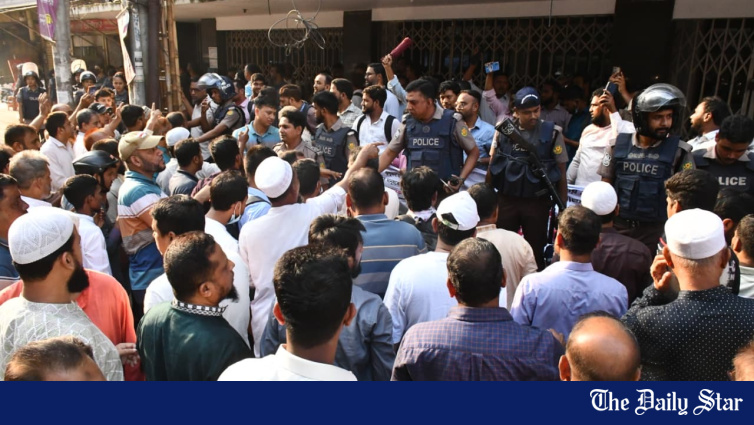
⚠ Dozens of people were injured yesterday in a clash between members of a customer forum and former employees of Islami Bank Bangladesh PLC outside the bank's head office in Dhaka. The violence — the latest escalation in the ongoing governance crisis at Bangladesh's largest Shariah-compliant bank — highlights the unresolved tensions created by the S Alam Group takeover of the bank in 2017 and the subsequent dismissal of S Alam-era employees by the interim government.
📊 The two groups took up positions outside Islami Bank Tower in Motijheel yesterday morning to hold programmes announced the previous day. They later got into a scuffle that escalated into a clash. The sacked employees were allegedly recruited after the controversial conglomerate S Alam Group took over the country's largest shariah-based bank in 2017. They were terminated during the interim government and have since been demanding reinstatement.
📜 Competing Narratives
The clash erupted over the sacked employees' demand for reinstatement, which the customers' forum opposed, alleging they were illegally recruited. Members of the "Sachetan Grahak Forum" have been opposing the demand. Both sides blamed each other for yesterday's violence. Shahidul Islam, one of the sacked employees, claimed 25 of their members were injured in the attack.
"We were standing in front of the bank for the second day demanding reinstatement. About 20 minutes after we arrived, members of the consumer forum attacked us. Police later removed us from the spot," he said. He added that 20 to 25 injured employees had been admitted to Dhaka Medical College Hospital.
Countering the claim, Nuru-Un-Nabi Manik, president of Sachetan Grahak Forum, claimed around 30 of its members were injured, including five seriously. He alleged the sacked employees had attacked forum members during a peaceful demonstration. "Those recruited illegally have no connection with the bank. They are trying to create fresh instability at the bank," he said, alleging the attack was carried out under police protection. The officer-in-charge of Motijheel Police Station could not be reached for comment despite repeated attempts.
- 🏛 Location: Islami Bank Tower, Motijheel, Dhaka
- 👥 Sacked employees injured: ~25 (their claim)
- 👥 Customer forum members injured: ~30 (their claim)
- 💰 Seriously injured forum members: 5
- 🏛 S Alam Group takeover: 2017
- 📅 Sackings: During interim government tenure
- 📜 Customer forum name: Sachetan Grahak Forum
- 📜 Customer forum president: Nuru-Un-Nabi Manik
- 👥 Dismissed employees' hospitalisation: 20-25 at DMCH
🏛 S Alam Group Takeover Legacy
The reference to S Alam Group's 2017 takeover of Islami Bank provides critical context for the clash. The 2017 takeover — executed with political backing from the previous Awami League government — was followed by aggressive related-party lending that has resulted in over Tk 98,914 crore in non-performing loans at the bank alone. S Alam Group itself was among the largest beneficiaries of this related-party lending, with substantial portions of the group's borrowing from Islami Bank subsequently classified as non-performing.
The interim government's dismissal of S Alam-era employees — reportedly around 5,000 officials who lost their jobs after refusing to take re-evaluation exams — represents the structural response to the S Alam legacy. The sacked employees argue that they were recruited through legitimate channels and should not be held responsible for the lending decisions made by senior management under political direction. The customer forum, by contrast, argues that the recruitments were politically motivated and that the employees were effectively political appointees rather than merit-based hires.
🤝 Customer Forum: Defending Bank Reform
The Sachetan Grahak Forum's position — opposing reinstatement of sacked employees — reflects the perspective of depositors and customers who have borne the cost of the S Alam-era mismanagement. With NPLs at 52.15% of Islami Bank's loan portfolio (Tk 98,914 crore as of June 2026) and the bank's capital position severely weakened, customers have a direct interest in ensuring that the bank's restructuring is not reversed through the re-employment of officials associated with the period of mismanagement.
The forum's president, Nuru-Un-Nabi Manik, has emerged as a public voice for customer interests in the banking sector reform process — advocating for depositor protection, accountability for S Alam-era lending decisions, and the implementation of structural reforms that would prevent similar capture of bank management in the future. The forum's engagement in the clash reflects the depth of customer frustration with the slow pace of accountability for the S Alam-era banking sector abuses.
📜 Sacked Employees: Demand For Reinstatement
The sacked employees' demand for reinstatement is grounded in their argument that they were recruited through legitimate channels and should not be held collectively responsible for the actions of senior management. Many of the dismissed officials had years of service at the bank and lost their livelihoods without individual adjudication of their cases. Their protest — organised in front of Bangladesh Bank last week and now in front of Islami Bank Tower — represents a structural feature of post-regime-change accountability processes in Bangladesh.
The interim government's approach to the S Alam-era dismissals has been collective rather than individual — treating all employees recruited during the S Alam period as presumptively politically motivated. This approach has the advantage of speed (avoiding case-by-case adjudication of 5,000+ employment disputes) but creates the disadvantage of penalising employees who may have been recruited through legitimate channels even during the S Alam period. The dismissed employees' demand for individual review reflects the tension between collective accountability and individual due process.
🌏 Broader Implications For Bangladesh's Banking Sector Reform
For Bangladesh's broader banking sector reform agenda, the Islami Bank clash carries several strategic implications. First, the violence underscores the political sensitivity of bank reform — particularly when reform involves large-scale dismissals of employees associated with the previous regime. The interim government will need to manage this sensitivity while maintaining the credibility of its reform agenda.
Second, the emergence of the Sachetan Grahak Forum as an organised customer voice reflects the growing politicisation of depositor interests in Bangladesh's banking sector reform. Customer forums have historically been weak in Bangladesh — but the depth of the banking sector crisis has mobilised depositors to organise, advocate and protest in ways that have not been seen in previous reform cycles. This customer mobilisation provides political support for reform, but also creates risks of vigilantism if not channelled through institutional processes.
Third, the clash highlights the operational fragility of Islami Bank itself — Bangladesh's largest Shariah-compliant bank with millions of depositors and billions in assets. The bank's ability to maintain operations during the ongoing governance crisis is critical for the broader banking system's stability, given the bank's significant share of Bangladesh's Islamic banking deposits and its role in Shariah-compliant trade finance.
🤝 What Comes Next
The coming days will reveal whether the clash escalates into sustained conflict or whether the government can mediate between the competing interests of sacked employees, customer forum members and the bank's management. The intervention of Motijheel Police — and any subsequent law enforcement response — will shape the immediate trajectory of the confrontation.
For the longer term, the underlying issue of S Alam-era employee dismissals will require a structural resolution — whether through individual case review, voluntary separation schemes, retraining and redeployment, or some combination of these approaches. Without such resolution, the dismissed employees' protests are likely to continue — creating ongoing operational disruption at Islami Bank and sustained political pressure on the interim government's banking sector reform agenda.
The Islami Bank clash is symptomatic of the broader challenge Bangladesh faces in implementing banking sector reform — the need to hold accountable those responsible for past abuses while protecting the rights of employees, customers and the broader financial system. The coming months will reveal whether the government can navigate this complex balance and translate the structural reform agenda into measurable improvements in banking sector health.
This news was originally published by The Daily Star. For the full original report, please visit: https://www.thedailystar.net/business/economy/news/dozens-injured-islami-bank-clash-4272926
Related on BangladeshExport
📬 Get Bangladesh Trade News in your inbox
Weekly digest of export industry news, policy updates, and market analysis.
📰 Related Stories