Lessons From Eight Graduates: What Awaits Bangladesh After LDC Status Ends
UN ESCAP study shows outcomes hinge on export structure, trade deals and diversification, with manufacturing-led Asia far more exposed
🌍 Bangladesh is seeking to defer its LDC graduation even as it prepares for the transition, amid concerns over export competitiveness and preferential market access. How have the eight countries that graduated before it fared, and what lessons do their experiences hold for Bangladesh? A study by the United Nations Economic and Social Commission for Asia and the Pacific (UN ESCAP) provides the most systematic answer yet — and its findings cut against both complacency and panic.
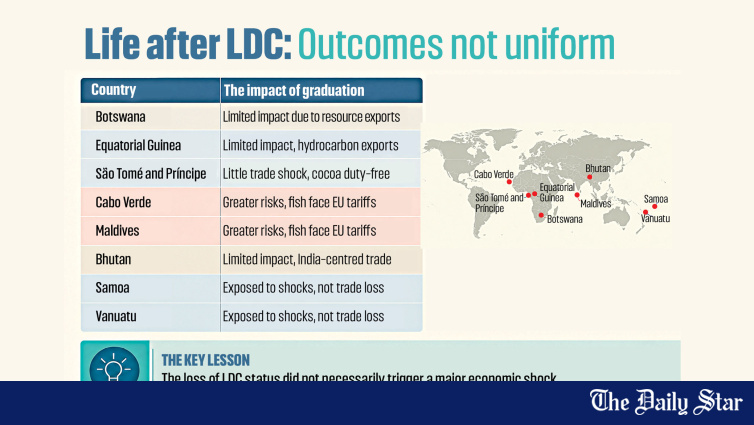
📊 The study found that post-graduation outcomes varied widely across the eight countries, depending largely on their economic structures, reliance on trade preferences and sources of development finance. The headline finding is reassuring: the loss of LDC status did not necessarily trigger a major economic shock. The impact was limited in countries whose exports relied little on LDC-specific preferences — particularly those exporting minerals, hydrocarbons and cocoa, or products already entering major markets at zero or low most-favoured-nation (MFN) tariffs.
⛰ Botswana and Equatorial Guinea faced limited exposure to preference erosion because their exports were dominated by natural resources. Botswana had built domestic fiscal capacity through diamond revenues, while Equatorial Guinea's high hydrocarbon income had reduced its reliance on concessional finance and grant-based official development assistance. Both, however, remained dependent on natural resources — highlighting the limits of graduation without economic diversification. São Tomé and Príncipe was also expected to face little direct trade shock because cocoa already entered many markets duty-free, though it remained reliant on cocoa, external finance and an emerging tourism sector.
🐟 By contrast, Cabo Verde and the Maldives faced greater risks from preference erosion because fish and processed fish products faced positive MFN tariffs in the European Union market. Even in these cases, the overall impact was mitigated by the small share of merchandise exports in total external earnings and the dominance of services, particularly tourism. Transition periods, alternative preference schemes, flexible rules of origin, certification and market positioning also helped cushion the effects — though both remained exposed to tourism-related risks, with Cabo Verde also vulnerable to disruptions in fisheries, remittances and climate shocks.
🌊 Samoa and Vanuatu retained access to Australia and New Zealand through regional trade arrangements that were not conditional on LDC status, and the serious external disruptions they experienced after graduation stemmed mainly from natural disasters, the Covid-19 pandemic and the collapse of tourism — rather than the loss of trade preferences. Bhutan's trade and development finance profile was anchored largely in its relationship with India, limiting its direct dependence on LDC-specific support, though it continued to rely on hydropower and India-centred trade. Changes in development finance, the study found, did not generally lead to sudden withdrawal of support: graduation typically involved a longer transition in which some measures were phased out, replaced or extended.
📘 The study's synthesis deserves quoting closely: graduation mattered more where countries actively used LDC-specific support in sectors exposed to tariff preference erosion or in areas such as climate finance and Aid for Trade. Its effects were less pronounced where exports already entered markets duty-free, regional agreements preserved market access, or aid allocations depended mainly on income, vulnerability, bilateral ties or small-island considerations. The study identified limited productive transformation before graduation as a more persistent challenge than the loss of LDC benefits alone.
⚖ Why Bangladesh is a different case
⚠ The study explicitly cautioned against drawing direct parallels between past graduates and countries preparing to graduate now. Asian LDCs with manufacturing-led economies and deep integration into global production networks — such as Bangladesh and Cambodia — generally have much higher trade preference utilisation rates than small island economies dependent on services or countries driven by natural resources. For countries heavily reliant on the Generalised System of Preferences (GSP) or duty-free market access, losing preferential access could create a significant competitiveness shock, particularly where labour-intensive textiles and garments underpin the economy — the precise description of Bangladesh's export profile.
💬 Mohammad Abdur Razzaque, chairman of Dhaka-based think tank Research and Policy Integration for Development (RAPID), was one of the researchers involved in the study. Speaking to The Daily Star, he noted that two of the eight graduated countries were rich in natural resources but could not export those resources — while Bangladesh's situation is different, as it will need to sustain export growth after graduation. Bangladesh should follow the government's Smooth Transition Strategy (STS) for LDC graduation, he said, which emphasises retaining preferential market access through trade agreements with major trading partners.
🤝 The policy translation is concrete. Trade agreements are the substitute for lost preferences: the EU's Everything-but-Arms successor terms, the GSP negotiations with the United States, the Economic Partnership Agreement with Japan, free-trade talks with partners from Indonesia to the Gulf, and continued duty-free access where Bangladesh's MFN exposure is low. Each signed deal converts a preference that was conditional on LDC status into one anchored in law.
🚧 The second translation is productive transformation. If the study's most persistent warning — that limited pre-graduation transformation hurts more than lost benefits — applies anywhere, it applies to an economy whose garments concentration is among the highest in the world. Diversification into pharmaceuticals, leather, agri-processing, ICT services and light manufacturing is not industrial-policy decoration; it is the primary insurance the ESCAP evidence says matters most.
🔭 The eventual outcomes, the study concludes, will depend on the mitigation measures adopted before graduation, the quality of domestic reforms and the broader external environment. Bangladesh's request for a deferral buys time; the eight-country record suggests time only pays off if spent signing agreements, moving up the value chain, and building the fiscal and institutional base that makes graduation an earned promotion rather than a cliff-edge. The countries that treated graduation as a finish line drifted; those that treated it as a starting gun adapted. Which example Bangladesh follows is, on the evidence of this study, entirely a choice.
This news was originally published by The Daily Star. For the full original report, please visit: https://www.thedailystar.net/business/economy/news/what-happens-after-ldc-graduation-4307286
📬 Get Bangladesh Trade News in your inbox
Weekly digest of export industry news, policy updates, and market analysis.
📰 Related Stories