PKSF, IAB Launch Contest for Climate-Resilient Rural Housing Designs
Open architectural competition to pick 10 field-ready models for coastal, haor, char, floodplain, hill and Barind regions
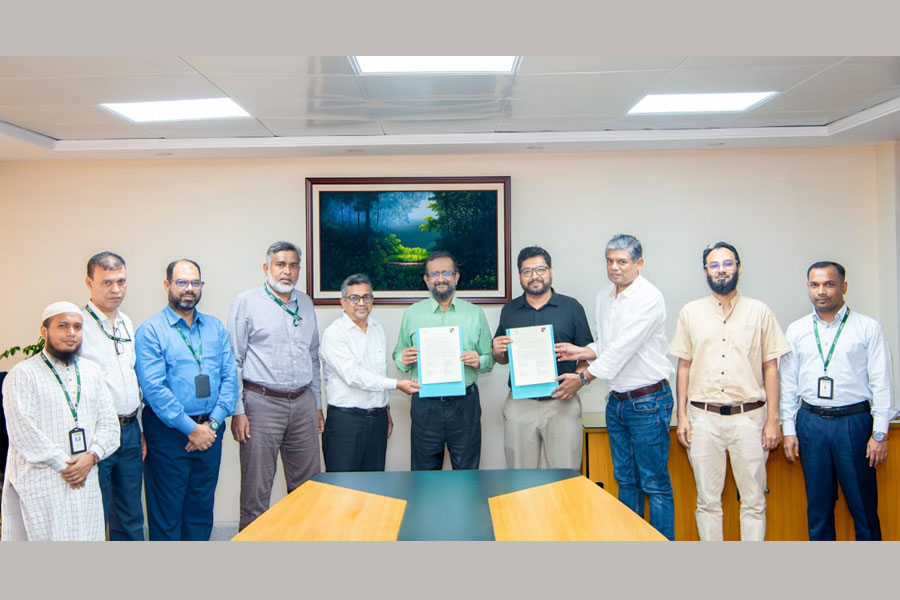
🏠 Palli Karma-Sahayak Foundation (PKSF), in collaboration with the Institute of Architects Bangladesh (IAB), is set to launch an Open Architectural Competition for the Design of Climate-Resilient Rural Housing — an initiative aimed at promoting resilient and affordable housing solutions in climate-vulnerable areas of Bangladesh, according to a media release. A Memorandum of Understanding (MoU) to this end was signed between PKSF and IAB at PKSF Bhaban-1 in Agargaon, Dhaka, in a ceremony presided over by PKSF Managing Director Md. Fazlul Kader, with Deputy Managing Director Md. Hasan Khaled signing for PKSF and IAB General Secretary Architect Dr. Masud Ur Rashid signing for the architects' institute.
🏗 The competition's brief is practical, not theoretical: develop affordable, safe, environmentally friendly and practical rural housing designs for disaster- and climate-vulnerable areas of the country. Design proposals will be invited with explicit attention to the geographical and environmental characteristics of Bangladesh's coastal areas, haor wetlands, chars, floodplains, hilly terrain and the Barind tract — effectively a national map of climate exposure zones, each demanding a different answer to water, wind, salinity and soil.
🎯 The selection is deliberately field-oriented: from among the submitted designs, PKSF will select the 10 best housing models suitable for practical application at the field level — prototypes intended for replication rather than exhibition walls.
💪 Building on a proven platform
✅ The pedigree behind the contest is what makes it credible. Under the Resilient Homestead and Livelihood Support (RHL) project, implemented by PKSF with funding from the Green Climate Fund (GCF), more than 3,500 climate-resilient houses have already been constructed across seven coastal districts of Bangladesh. Building on that experience, the new collaborative initiative is expected to contribute to more effective measures to improve housing conditions and strengthen the overall resilience and adaptive capacity of marginalised communities, the release adds — meaning the competition is a scale-up mechanism for a delivery system that already works, not a first experiment.
🌍 Why housing design is climate policy
📊 In Bangladesh's climate geography, the house is the first line of defence — and often the first casualty. Cyclones, storm surges, riverbank erosion and seasonal flooding destroy or damage tens of thousands of rural homes in a bad year, pushing households into debt cycles from which recovery can take a decade. Engineering that loss away — plinth heights matched to flood memory, corrosion-resistant framing, cross-ventilation that reduces the need for cooling, rainwater harvesting for saline zones — costs far less at the design stage than the disaster-driven replacement that otherwise follows. International adaptation assessments have repeatedly identified resilient settlement design as one of the highest-return climate investments available to delta countries.
🚀 The open-competition format also widens the talent pipeline. By inviting the country's architects — including its younger practices, students and regional firms who know the haor or the Barind first-hand — PKSF taps design intelligence far beyond any single consultancy, while the IAB partnership lends the professional credibility and technical jury structure that a national competition requires. Ten selected models, each tuned to a distinct vulnerability zone, would collectively form the most comprehensive open-source catalogue of climate-resilient rural housing designs the country has produced.
💰 The financing model is equally worth watching. Green Climate Fund money built the RHL demonstration; competition-winning designs give that investment a multiplier, since standardised, costed, field-tested models are exactly what government housing programmes, NGO projects and even private remittance-funded home builders can adopt at scale. If the 10 selected designs carry transparent bill-of-quantities and construction manuals — the difference between a design and a buildable design — the competition could quietly set the national standard for climate-resilient rural construction for years to come.
🔭 The contest timeline and award details will follow with the formal launch, but the direction is already significant: Bangladesh is treating adaptation not only as embankments and shelters but as architecture — and it is asking its designers to compete for the privilege of protecting its most exposed households.
🏔 The regional menu embedded in the brief deserves a closer look, because it is effectively a checklist of Bangladesh's distinct climate challenges. Coastal districts need salt-tolerant materials and surge-resistant anchoring; haor communities need homes that can live with months of standing water; chars need structures light enough to relocate as riverbeds shift; floodplains need raised plinths and wet-proof ground floors; hill districts require slope-stable designs mindful of landslide risk; and the drought-prone Barind tract calls for thermal mass and water capture. A single design idiom cannot serve all six — which is precisely why a competition that yields ten differentiated models, rather than one prize-winning concept, is the right instrument for the task.
🧩 The livelihood dimension also distinguishes this programme from ordinary housing schemes. The RHL project's full name — Resilient Homestead and Livelihood Support — reflects a lesson climate practitioners learned decades ago: a house that protects a family's productive assets (poultry, seed stores, tools, a small shop space) recovers a household's economy along with its shelter. PKSF's microfinance lineage shows in exactly this integration — its borrowers are the women and marginal farmers whose housing decisions double as business continuity plans. Competition entries that treat the rural home as an economic unit, not just a dwelling, will likely find themselves closer to the spirit of the brief than those pursuing architectural purity alone.
This news was originally published by The Financial Express. For the full original report, please visit: https://thefinancialexpress.com.bd/trade/pksf-iab-to-launch-climate-smart-house-design-competition
Related on BangladeshExport
📬 Get Bangladesh Trade News in your inbox
Weekly digest of export industry news, policy updates, and market analysis.
📰 Related Stories