Bangladesh Unveils $1.85 Billion Green Transition Plan With Just Transition Chapter
Bangladesh becomes first Asian country to embed a Just Transition chapter in NDC 3.0, consolidating 258 climate commitments into 33 priorities across six sectors

🌏 Bangladesh has outlined a $1.85 billion investment plan to execute an equitable green economic transition, becoming the first country in Asia to incorporate a dedicated Just Transition chapter into its Nationally Determined Contributions (NDC 3.0). The framework translates the country's climate targets into actionable and bankable investment opportunities, according to an action plan presented at a national high-level dialogue in Dhaka on Thursday.
🌿 The dialogue was jointly organised by the Department of Environment, International Labour Organisation (ILO), South Asian Network on Economic Modeling (SANEM) and the Embassy of Sweden. The strategy was developed through a cross-mapping of 14 national strategy documents, including the Eighth Five-Year Plan, Perspective Plan 2041 and Bangladesh Delta Plan 2100. It consolidated 258 commitments into 33 core priorities — a significant rationalisation that gives investors and development partners a clear, focused implementation roadmap rather than a sprawling menu of climate pledges.
📊 Six Sectors, 69 Activities
These priorities form an action matrix containing 69 traceable and time-bound activities across six key sectors — energy, transport, construction, agriculture, waste management, and industrial processes and product use (IPPU). The final implementation plan will be incorporated into NDC 3.0 this month before being presented to international development partners and global investors at COP31 in November.
- 💰 Total investment plan: $1.85 billion
- 🌏 First Asian country with Just Transition chapter in NDC 3.0
- 📜 Strategy documents cross-mapped: 14 (incl. 8th Five-Year Plan, Perspective Plan 2041, Delta Plan 2100)
- 📊 Climate commitments consolidated: 258 → 33 core priorities
- 🚀 Time-bound activities: 69 across 6 key sectors
- 📅 Final plan submission: NDC 3.0 (this month)
- 🌏 Global presentation: COP31 in November 2026
SANEM Executive Director Dr Selim Raihan and ILO Just Transition Technical Officer Elisa Benistant Fremigacci jointly presented the action plan and its annexes at the dialogue. The presentation marked the formal transition from policy development to implementation planning, with the focus now shifting to securing financing commitments from international development partners.
🏛 Government's Strategic Positioning
Speaking as the chief guest at the event, State Minister for Environment, Forest and Climate Change Shaikh Faridul Islam said the government was focusing on field-level measures to clean major rivers and reduce air and noise pollution. Referring to his recent visits to facilities in Rajshahi, he stressed the need to improve occupational safety and health standards for factory and waste-management workers. Workers are central to economic growth and therefore need fair wages, stronger social protection and skills upgrading to cope with technological changes, he said.
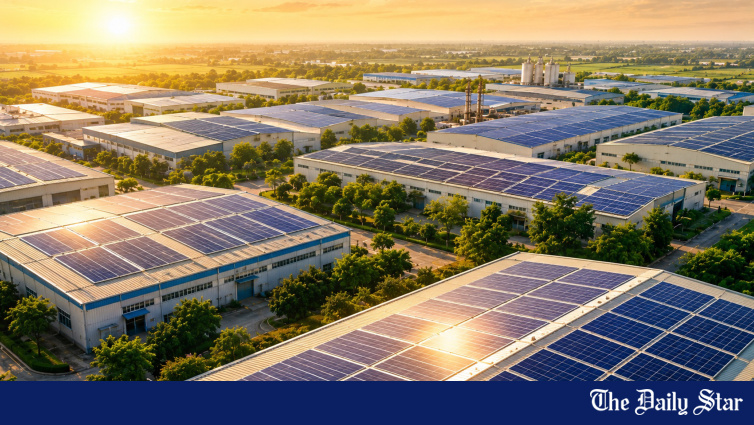
Bangladesh is also targeting 10,000 MW of renewable energy within five years as part of its clean-energy transition, including through wind power projects such as those in Cox's Bazar. The government is forming an inclusive, multi-sectoral team to present strong research and policy positions at COP31, the state minister added — signalling Bangladesh's intent to use the COP31 platform to attract both climate finance and clean technology investment.
👕 Why A Just Transition Chapter Matters
Speaking at a panel discussion, Dr Fahmida Khatun, distinguished fellow at the Centre for Policy Dialogue (CPD), said a just transition must focus on creating employment through the green transition. She called for sector- and occupation-level mapping to identify where jobs would be gained or lost and proposed adding a green jobs module to the Labour Force Survey to establish a reliable baseline. She also stressed the need for data disaggregated by sex, age, geography, and formal and informal employment to better target social safety-net programmes such as the Family Card.
Emission-reduction tracking should be paired with employment and decent-work indicators, she said, calling for an institutional mechanism to integrate data across the Bangladesh Bureau of Statistics, government ministries, employers and worker organisations. The CPD fellow's intervention reflects growing recognition that climate transitions can have uneven distributional consequences — with workers in carbon-intensive sectors such as textile dyeing, leather tanning and conventional power generation facing potential job displacement unless retraining and transition support are built into the climate agenda.
🤝 ILO's Global Perspective On Just Transition
Moustapha Kamal Gueye, director of the ILO's Just Transition Priority Action Programme, said climate ambition requires building human capacity among workers, businesses and communities to transform energy, agriculture and transport systems. Social justice and decent work are essential to climate mitigation and adaptation rather than merely additional benefits, he said, stressing that social dialogue should be formally institutionalised instead of remaining ad hoc.
The ILO's involvement in the Bangladesh NDC 3.0 development aligns with the organisation's global push to embed labour considerations into national climate plans — an approach that gained momentum following the 2015 Paris Agreement's explicit reference to "the imperatives of a just transition of the workforce and the creation of decent work and quality jobs." Bangladesh's decision to formally incorporate a Just Transition chapter places the country among a small group of global early movers, alongside Canada, Spain and Germany, that have made similar commitments.
💵 What The $1.85 Billion Will Fund
The $1.85 billion investment plan covers six priority sectors, each with a defined set of time-bound activities. In energy, the focus is on scaling renewable capacity — particularly solar and wind — to support the 10,000 MW renewable energy target within five years. In transport, the plan supports electrification of public transport and modal shift from road to rail freight. In construction, it promotes green building codes and energy-efficient materials. In agriculture, it funds climate-resilient farming practices and water-efficient irrigation. In waste management, it supports formalisation of the informal waste sector and circular economy infrastructure. In IPPU, it targets emission reductions in cement, steel and chemical industries.
For Bangladesh's export-oriented economy, the green transition plan carries particular strategic weight. International brands sourcing from Bangladesh — particularly in the ready-made garment (RMG) sector — have set Science Based Targets initiative (SBTi) commitments requiring supplier factories to transition to renewable electricity and reduce Scope 3 emissions. The $1.85 billion plan provides a national framework to support factory-level decarbonisation, helping Bangladeshi exporters maintain competitiveness in markets where carbon footprint is increasingly a sourcing criterion.
🌏 What Comes Next
The coming weeks will see the final implementation plan incorporated into NDC 3.0, with formal submission to the UNFCCC following internal government approval. The Bangladesh delegation's preparation for COP31 — including the multi-sectoral team being assembled by the state minister — will determine whether the $1.85 billion plan translates into concrete financing commitments from international development partners and private investors.
For an economy preparing to graduate from LDC status in November 2026, the green transition plan offers a strategic opportunity to position Bangladesh as a credible destination for climate finance and clean technology investment. With bilateral engagement already underway with Norway, Denmark and other European clean energy leaders, the NDC 3.0 framework provides the policy backbone to convert diplomatic interest into commercial outcomes. The coming 12-18 months will reveal whether the implementation matches the ambition of the plan — and whether Bangladesh can establish itself as a regional leader in just transition financing.
This news was originally published by The Financial Express. For the full original report, please visit: https://thefinancialexpress.com.bd/economy/bangladesh-unveils-185b-plan-for-green-transition
📬 Get Bangladesh Trade News in your inbox
Weekly digest of export industry news, policy updates, and market analysis.
📰 Related Stories