Bangladesh Targets 4,000 MW Rooftop Solar In One Year: $2 Billion Capital Mobilisation Challenge
Rooftop solar expansion requires $2B+ capital, RESCO model adoption, distribution utility transformation and national execution mechanism to meet aggressive 4,000 MW target
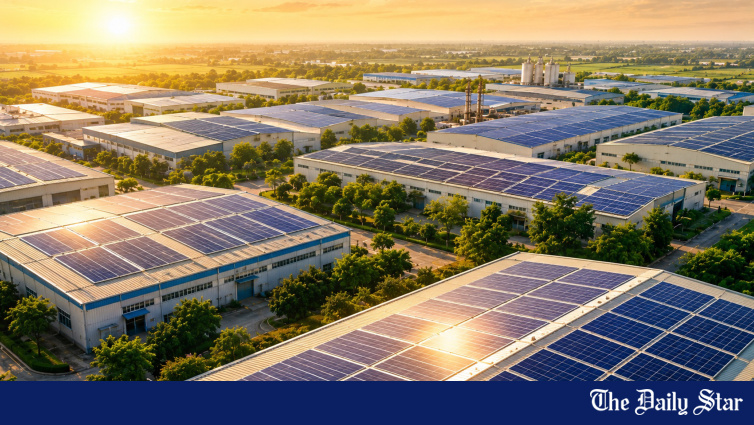
☀ Bangladesh aims to add up to 4,000 MW of rooftop solar within one year — an ambitious target that would more than double the country's current total renewable energy capacity and meaningfully close the gap between energy demand and supply. The challenge is converting existing policy incentives and available rooftops into financed, connected and commissioned projects that deliver actual megawatts to the grid.
📊 India added around 7,100 MW of rooftop solar in 2025 alone, taking cumulative capacity to approximately 23,500 MW by March 2026. Rapid large-scale deployment requires an integrated market architecture covering financing, contracts, utilities, grid connection, developers and execution. The Indian precedent demonstrates that the scale Bangladesh is targeting is achievable — but reaching it requires the kind of integrated policy framework that has taken India nearly a decade to build.
💰 RESCO Model: Third-Party Financing To Unlock Scale
The proposed shift towards third-party financed OPEX models, particularly Renewable Energy Service Company (RESCO) structures, is therefore important. Instead of investing their own capital, factory owners can contract a RESCO to design, finance, build, own and operate the solar plant, while purchasing electricity under a long-term agreement. But delivering 4,000 MW will require more than $2 billion of capital and a much broader enabling framework. Five critical areas need to be addressed.
The RESCO model addresses a fundamental constraint on Bangladesh's rooftop solar deployment: most factories lack the balance sheet capacity or risk appetite to invest $200,000-500,000 in a rooftop solar installation that will only break even over 5-7 years. By transferring the capital investment to specialised RESCO developers who can aggregate projects into portfolio financing arrangements, the model unlocks deployment at scale while leaving factory owners with cheaper electricity and operational risk transfer.
- ☀ Bangladesh rooftop solar target: 4,000 MW within one year
- 💰 Required capital: $2 billion+
- 📊 India 2025 rooftop addition: 7,100 MW
- 📊 India cumulative rooftop (March 2026): ~23,500 MW
- 💵 New grid-feed tariff: Tk 10.50
- 📅 Incentive window deadline: February 2027
- 🔌 Pipeline target needed: 5,000-6,000 MW development pipeline
- 📅 Critical areas identified: 5
💵 Five Critical Reform Areas
First, mobilising capital at this scale will require a financing framework capable of attracting domestic and international financial institutions, development finance and foreign investment. Credit enhancement or partial-risk guarantees could help reduce financing costs and enable lenders to finance portfolios of rooftop projects. The new tariff incentive can improve project economics, but it cannot substitute for access to long-term, competitively priced financing. For C&I projects in particular, the underlying economics will largely depend on electricity consumed directly by factories and businesses, with surplus exports providing an additional revenue stream.
Financing must also be supported by payment security and bankable contracts. If an investor installs a plant under a 15-year agreement, what happens if the factory closes, ownership changes or the electricity purchaser defaults? Standardised rooftop leases, RESCO power purchase agreements, termination provisions, lender step-in rights and payment-security arrangements are therefore essential. Without these contractual foundations, international investors and development finance institutions will not commit the $2 billion in capital needed to meet the target.
🏛 Distribution Utilities As Facilitators
Second, turn distribution utilities into facilitators. Distribution utilities control critical elements of rooftop deployment, including technical approvals, connections, metering and electricity settlement. The new incentive package makes their role even more important as they will also administer the measurement and settlement of surplus electricity. Each utility should receive annual and monthly MW targets, supported by measurable service standards for technical approvals, meter installation and commissioning.
Utility-Led Aggregation (ULA) should also be considered. Rather than waiting for customers to originate projects individually, utilities can identify and aggregate suitable rooftops and competitively procure RESCOs to finance and develop them as portfolios. A utility could, for example, aggregate 50-100 MW of commercial, residential or public-sector rooftops into a programme, reducing transaction costs and improving financing. ULA should complement and not replace privately originated RESCO projects. This creates three parallel engines for deployment: private C&I/RESCO investment, utility-led aggregation and aggregated solarisation of Government buildings.
👥 Service Capability And Accreditation
Local service capability is important, but strong geographic preferences risk fragmenting the market into district-level territories. Large-scale delivery will require experienced developers, strong EPC companies, portfolio financing and economies of scale. National accreditation combined with regional service requirements would be more effective. Providers should also be classified by capability. The technical and financial requirements for installing a 5 kW household system cannot be the same as those for financing and operating a multi-megawatt industrial portfolio. Separate accreditation categories should therefore cover residential installers, commercial EPC contractors, industrial developers and large RESCO investors.
🔌 Net-Metering And Tariff Framework
Net-metering and interconnection rules should increasingly be determined by technical grid capacity rather than historical electricity consumption. If a factory has sufficient rooftop space and the local network can safely accommodate the generation, there should be a pathway to install the economically optimal capacity. The new Tk 10.50 grid-feed tariff should help accelerate deployment, particularly for projects commissioned within the incentive window. However, the February 2027 deadline may be too short to drive meaningful scale, given the time required for project development, financing, approvals, procurement and commissioning. A time-bound incentive should ultimately transition into a transparent long-term pricing methodology that provides investors with durable certainty.
The inclusion of battery energy storage (BESS) is also welcome. As rooftop penetration increases, storage can play an increasingly important role in grid integration and maximising the value of distributed generation. BESS integration addresses one of the structural challenges of solar deployment — the mismatch between peak solar generation (midday) and peak demand (evening) — by storing excess solar energy for use during peak demand periods. Without storage, high rooftop solar penetration can create grid management challenges that constrain further deployment.
📜 National Execution Mechanism
Fifth, create one national execution mechanism. A National Rooftop Solar Mission, supported by a dedicated Programme Management Unit with clear authority and accountability, should coordinate distribution utilities, financial institutions, developers and relevant Government agencies. A single digital platform should cover registration, financing, vendor selection, technical approval, installation, metering, commissioning, settlement and performance monitoring.
The headline target must then be converted into an execution pipeline. Delivering the required commissioned capacity may require a 5,000-6,000 MW development pipeline to account for projects that are delayed, fail to reach financial close or ultimately do not proceed. Monthly milestones should track project identification, approvals, financing, construction and commissioning, with progress transparently reported. The 20-25% pipeline-to-completion slippage assumption reflects realistic project development experience in emerging market renewable energy deployment.
🌏 Strategic Context: Energy Security And Climate Goals
For Bangladesh's broader energy security strategy, the 4,000 MW rooftop solar target carries strategic significance that extends beyond renewable energy contribution. The target, if achieved, would meaningfully reduce Bangladesh's dependence on imported LNG and liquid fuels for power generation — directly addressing the energy security vulnerabilities exposed by the Iran war and the Bab el-Mandeb disruption. Rooftop solar also aligns with Bangladesh's $1.85 billion green transition plan and the country's NDC 3.0 commitments under the Paris Agreement.
The 4,000 MW target represents approximately 25-30% of Bangladesh's current peak demand (16,000+ MW). If the rooftop solar capacity generates at typical 18-22% capacity factors, it would contribute 800-900 MW of average generation — equivalent to roughly 6% of total electricity consumption. This is a meaningful contribution that would reduce fossil fuel import dependence, support industrial competitiveness through cheaper electricity, and create local employment in solar installation, operations and maintenance.
🤝 What Comes Next
Bangladesh has the rooftop potential and now has an important new incentive framework. But delivering at scale will require substantial private capital. Government's critical role is to establish a clear and predictable policy framework and a bankable investment environment capable of attracting domestic and international financial institutions and foreign investment. The priority now is ensuring that it translates into financed, connected and commissioned megawatts.
The coming months will reveal whether the government can translate the 4,000 MW target into a credible execution plan — with specific MW allocations to distribution utilities, identified RESCO developers, financing commitments from domestic and international lenders, and visible project pipelines. Without these operational foundations, the target risks remaining aspirational — joining the long list of renewable energy ambitions that have failed to translate into operational megawatts. With them, Bangladesh could meaningfully advance its energy security, climate and economic competitiveness agenda through rooftop solar deployment at unprecedented scale.
This news was originally published by The Daily Star. For the full original report, please visit: https://www.thedailystar.net/business/economy/news/delivering-4000-mw-rooftop-solar-4272896
Related on BangladeshExport
📬 Get Bangladesh Trade News in your inbox
Weekly digest of export industry news, policy updates, and market analysis.
📰 Related Stories