BKMEA Seeks High-Level Committee For Bangladesh Garment Policy Coordination
BKMEA President Mohammad Hatem submits proposal to PM Tarique Rahman for inter-ministerial committee on garment industry, Fair Code reform and long-term energy master plan
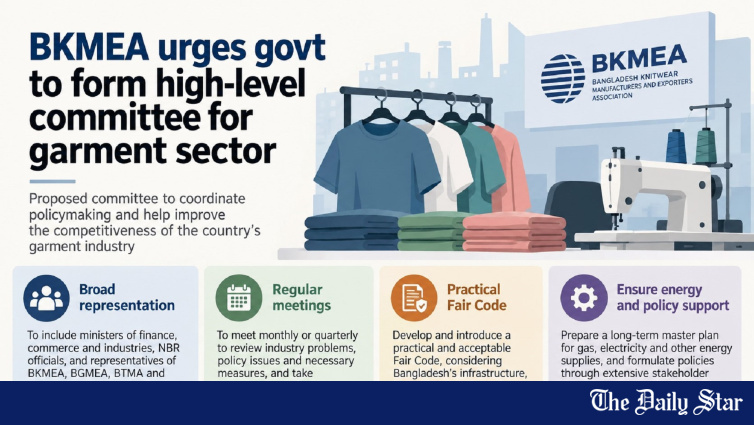
👕 Bangladesh Knitwear Manufacturers and Exporters Association (BKMEA) yesterday urged the government to form a high-level committee to coordinate policymaking for the garment industry. The proposal — submitted by BKMEA President Mohammad Hatem to Prime Minister Tarique Rahman — represents the knitwear sector's most comprehensive policy advocacy initiative in recent months, addressing structural coordination gaps that have constrained the garment industry's competitiveness.
📊 BKMEA President Mohammad Hatem submitted the proposal to Prime Minister Tarique Rahman, according to a statement issued by the association. The proposed committee would help improve the competitiveness of the country's garment industry and ensure necessary policy support. It would include the ministers of finance, commerce and industries, officials from the National Board of Revenue, and representatives of BKMEA, the Bangladesh Garment Manufacturers and Exporters Association (BGMEA), Bangladesh Textile Mills Association (BTMA) and other relevant organisations.
🏛 Composition And Frequency Of The Committee
The committee would meet monthly or quarterly to review emerging problems in the industry, policy issues and necessary measures, and take appropriate decisions. The proposed composition — bringing together three key economic ministries (finance, commerce, industries), the revenue authority (NBR), and three industry associations (BKMEA, BGMEA, BTMA) — would address the long-standing fragmentation in Bangladesh's garment sector policymaking, where decisions affecting the sector are made across multiple ministries without coordinated consultation with industry stakeholders.
The monthly or quarterly meeting frequency would ensure regular engagement — preventing the kind of policy drift that has historically occurred when sector issues are addressed only during crisis periods. The committee structure would also provide a formal channel for industry feedback on policy implementation, allowing for course correction before unintended consequences accumulate.
- 🏛 Proposed committee: Inter-ministerial garment sector coordination
- 👥 Members: Finance, Commerce, Industries Ministers + NBR + BKMEA + BGMEA + BTMA
- 📅 Meeting frequency: Monthly or quarterly
- 📜 Proposal submitted by: BKMEA President Mohammad Hatem
- 📜 Submitted to: Prime Minister Tarique Rahman
- 📜 Key proposals: Fair Code, energy master plan, stakeholder consultation
- 🏛 Other proposals: Road transport digitalisation, Building Code amendment
📜 Fair Code Reform: Bangladesh-Appropriate Standards
Alongside ensuring industrial safety and workers' rights, BKMEA proposed developing and introducing a practical and acceptable Fair Code that takes into account the country's existing infrastructure, industrial capacity and socioeconomic conditions. At present, Fair Codes based on practices followed in different countries are being adopted. However, many provisions are not compatible with Bangladesh's realities and capabilities, making them difficult to implement.
The Fair Code reform proposal addresses a long-standing concern of Bangladesh's garment industry — the adoption of international compliance standards that are designed for developed country contexts without adequate adaptation to Bangladeshi conditions. International buyers and brands often require supplier factories to comply with codes of conduct that include provisions on working hours, overtime compensation, building safety, fire prevention and worker representation that may exceed what is practically achievable in Bangladesh's current stage of development — particularly for small and medium-sized factories.
A Bangladesh-appropriate Fair Code — developed through consultation with industry, government, workers and international buyers — could provide a more realistic compliance framework that maintains core safety and labour standards while acknowledging the structural constraints of Bangladesh's industrial ecosystem. Such a code would also provide international buyers with a credible local compliance standard that they could reference in their sourcing decisions, reducing the proliferation of competing buyer-specific codes that create compliance fragmentation.
🚧 Long-Term Energy Master Plan For Industry
To protect industrial establishments and ensure the continuity of new investment, BKMEA proposed preparing a long-term and integrated master plan for the supply of gas, electricity and other forms of energy. The plan should consider not only the needs of existing industries but also potential future investment, expansion of industrial capacity and national export targets.
The energy master plan proposal directly addresses the energy supply uncertainty that has constrained Bangladesh's industrial production through 2025-26. Gas supply disruptions have forced garment factories to either curtail production or switch to expensive diesel generator backup — raising production costs and delaying export shipments. A long-term energy plan that explicitly considers industrial demand — including future capacity expansion — would provide the visibility needed for factories to make investment decisions with confidence.
🤝 Stakeholder Consultation And Transition Periods
The association also proposed formulating and implementing policies for the garment and textile sectors through extensive consultations with stakeholders, while considering changing global conditions and Bangladesh's realities. New policies should be based on the actual situation of the industry, the participation of all stakeholders and the country's capacity to implement them. Where necessary, a reasonable transition period should be provided to allow industries enough time to comply with new policies.
The stakeholder consultation and transition period proposals address two recurring complaints from Bangladesh's garment industry — the absence of meaningful consultation before policy changes are implemented, and the absence of transition periods that would allow factories to adapt operations to new requirements. Recent examples — including the quarterly VAT system that was reversed after two months following industry complaints — illustrate the cost of policy changes implemented without adequate consultation and transition planning.
🗃 Road Transport Digitalisation
BKMEA also recommended digitalising the road transport system to improve efficiency in business and commerce, reduce time and costs, and ensure effective revenue collection. It proposed introducing digital systems for national highways, roads, bridges, culverts, value-added tax and toll collection. The association urged the government to take the necessary steps to digitalise the road transport sector.
The road transport digitalisation proposal addresses the broader logistics infrastructure constraints that affect Bangladesh's garment exports beyond the factory gate. Garment shipments from Dhaka-area factories to Chattogram port — and from there to international destinations — depend on road transport that is subject to delays at toll plazas, check posts and document verification points. Digital systems for toll collection, VAT verification and cargo documentation would reduce transit times and improve the predictability of export logistics.
🏛 Bangladesh National Building Code Amendment
Considering the country's economic situation, industrial realities and capabilities, as well as the need to ensure fire and building safety, BKMEA proposed initiatives to amend and effectively implement the Bangladesh National Building Code. The Building Code amendment proposal reflects the garment industry's continued focus on structural safety — a priority that has been central to the sector's international credibility since the Rana Plaza collapse in 2013.
The Bangladesh National Building Code — last comprehensively updated in 2020 — provides the regulatory framework for industrial building safety. BKMEA's call for amendment reflects the industry's view that the code needs further refinement to reflect current industrial practices, technological capabilities and the structural requirements of modern garment factories. Effective implementation of the code — through strengthened enforcement capacity and factory-level compliance support — remains critical for maintaining international buyer confidence in Bangladesh's garment sector.
🌏 Strategic Context For Bangladesh's RMG Sector
For Bangladesh's broader RMG sector — which accounts for over 84% of merchandise exports and supports the livelihoods of approximately 4 million workers — BKMEA's policy coordination proposal carries strategic significance. The knitwear sub-sector specifically represents approximately 50% of Bangladesh's total RMG exports, with strong growth potential in man-made fibre (MMF) garments that the global apparel market is increasingly demanding.
The proposed committee — if established with meaningful authority and regular meeting cadence — could address several structural constraints that have limited Bangladesh's RMG competitiveness: policy fragmentation across ministries, inadequate consultation with industry before policy changes, energy supply uncertainty, logistics infrastructure gaps, and compliance code adaptation to Bangladesh's conditions. Each of these constraints individually limits the sector's growth trajectory; collectively, they have constrained Bangladesh's ability to maintain export growth momentum amid intensifying competition from Vietnam, Cambodia, India and Bangladesh's other regional competitors.
🤝 What Comes Next
The coming weeks will reveal whether the prime minister's office takes up BKMEA's proposal and establishes the high-level committee. The proposal's alignment with the broader government agenda — including the recent PM-business leaders meeting that addressed energy sector challenges — suggests that the political environment is receptive to structured industry-government engagement.
If established, the committee's effectiveness will depend on its authority to make binding decisions, the regularity of its meetings, the quality of industry participation, and the government's willingness to act on committee recommendations. Without these operational foundations, the committee risks becoming another consultative forum that produces recommendations without implementation — joining the long list of industry-government coordination mechanisms that have failed to translate dialogue into outcomes in Bangladesh's industrial policy landscape.
For Bangladesh's RMG sector's post-LDC graduation trajectory, the committee's establishment — and effective operation — could provide the structural policy coordination needed to navigate the competitive pressures of the next decade. The BKMEA proposal, if implemented meaningfully, would mark a meaningful upgrade to Bangladesh's industrial policy governance — providing the garment sector with the policy stability, consultation and coordination needed to sustain growth through and beyond November 2026.
This news was originally published by The Daily Star. For the full original report, please visit: https://www.thedailystar.net/business/economy/news/bkmea-seeks-stronger-policy-coordination-garment-sector-4272826
Related on BangladeshExport
📬 Get Bangladesh Trade News in your inbox
Weekly digest of export industry news, policy updates, and market analysis.
📰 Related Stories