Bangladesh Scraps Rampal Second Coal Unit, Builds 442MW Solar Plant Instead
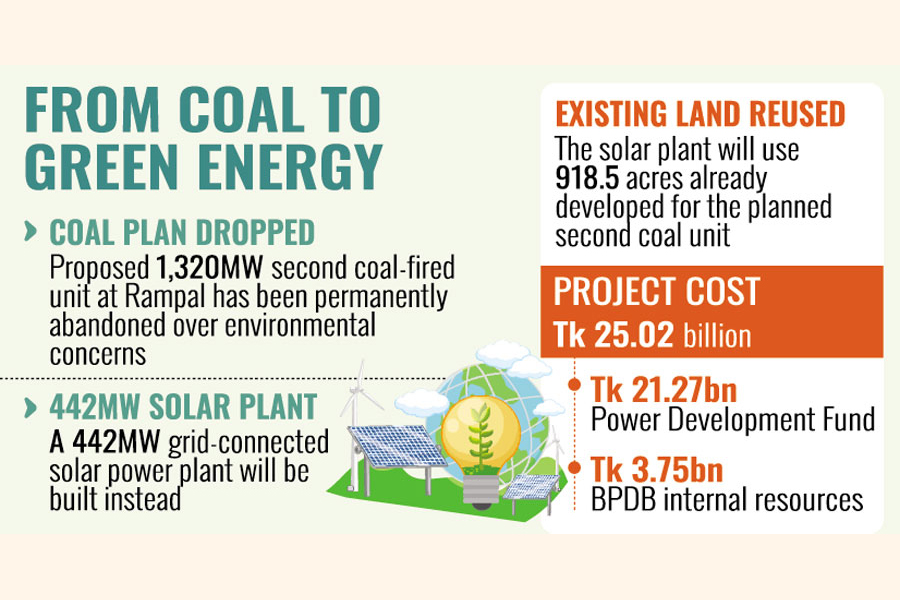
The Financial Express, Dhaka — A planned second coal-fired unit at the Rampal power plant has been effectively ditched amid sustained environmental outcry over its proximity to the Sundarbans, with the Bangladesh Power Development Board (BPDB) instead submitting a Development Project Proposal (DPP) for a 442-megawatt grid-connected solar power plant to the Planning Commission — marking a strategic pivot in Bangladesh's energy policy from coal to renewables.
The BPDB has formally submitted the DPP to the Planning Commission seeking approval for the Tk 25.02 billion solar-power megaproject, officials said on Thursday. The project represents one of the largest single-site solar investments in Bangladesh's history and signals a clear reversal of the previous plan to add a second 1,320 MW coal-fired unit alongside the existing Rampal coal plant operated by Bangladesh-India Friendship Power Company Limited (BIFPCL).
💰 Project Financing Structure
The government plans to build the solar power station with:
- 💰 Tk 21.27 billion from the Power Development Fund (domestic resources)
- 💰 Tk 3.75 billion from BPDB Internal Resources
- 📊 Total project cost: Tk 25.02 billion
The fully domestic financing structure is strategically significant — it represents a departure from the typical pattern of large Bangladesh power projects that rely on external concessional finance (JICA, World Bank, ADB) or foreign direct investment. By financing the Rampal solar plant from domestic resources, the government retains full ownership and operational control of the asset, while also building BPDB's internal capacity for renewable energy project development.
🏛 Strategic Reversal on Coal
The solar-based power plant is being built beside the current 1,320 MW coal-fired power plant at Rampal, on land that was originally earmarked for the second thermal unit. The reversal of the coal expansion plan reflects the cumulative impact of years of environmental advocacy focused on Rampal's location adjacent to the Sundarbans — the world's largest mangrove forest and a UNESCO World Heritage Site.
"The government has desisted from the decision of constructing another 1,320 MW coal-based power unit at Rampal considering the environmental issues. Now it has decided to set up a solar-power unit beside the current location," a senior BPDB official told The Financial Express.
🌿 Environmental Context: Sundarbans Protection
The Rampal coal plant has been the subject of intense environmental controversy since its original approval, with environmental groups raising concerns about:
- 🌿 Sundarbans proximity — the plant is approximately 14 km from the mangrove forest boundary
- 📨 Coal transport through the Passur River, affecting aquatic ecosystems
- 🌬 Air pollution and fly ash dispersion risks for the World Heritage site
- 🐯 Bengal tiger habitat and other endangered species in the Sundarbans
- 🌏 UNESCO monitoring and international advocacy pressure
The decision to abandon the second coal unit and replace it with solar capacity directly addresses these concerns, while still allowing Bangladesh to add critical power generation capacity to its grid. The 918.5 acres of land already developed at the Rampal site for the planned second coal unit will now be repurposed for the solar plant — avoiding the cost and political complexity of acquiring new land for renewable energy development.
🚧 Existing Rampal Coal Plant Context
The existing Rampal coal-fired power plant, operated by Bangladesh-India Friendship Power Company Limited (BIFPCL), is a 1,320 MW joint venture between Bangladesh and India:
- 🏛 Bangladesh stake: BPDB holds 50% equity
- 🏛 India stake: NTPC Limited holds 50% equity
- ⚡ Capacity: 1,320 MW (2 units x 660 MW each)
- 💰 Project cost: ~$1.6 billion (financed largely by Indian EXIM Bank)
- 📈 Commercial operation: began in recent years
At the site of the much-talked-about Rampal power plant, operated by BIFPCL, a 918.5-acre land parcel is already developed for setting up additional power generation capacity. "We have decided to utilise the land. We will set up the 442 MW solar-based power plant," the BPDB official added.
🔌 Grid Connection and Capacity
The proposed 442 MW solar plant will be:
- 🔌 Grid-connected — feeding power directly into the national grid
- 📊 442 MW capacity — substantial addition to Bangladesh's renewable energy base
- 🏗 Beside existing Rampal coal plant — leveraging existing transmission infrastructure
- 💰 Tk 25.02 billion investment — one of the largest single-site solar investments in Bangladesh
The Planning Commission is now scrutinising the project. Once approved, the project is expected to be implemented over a 2-3 year construction timeline, with the solar plant potentially coming online by 2028-2029 — providing critical additional baseload renewable capacity during the LDC graduation transition period.
⚡ Strategic Energy Policy Context
The Rampal solar pivot comes at a strategically important moment for Bangladesh's broader energy policy:
- 📊 62 power plants faced generation disruption in late August 2026 due to gas shortage
- 📊 660 textile mills affected by gas supply disruptions since July 2026
- 📊 FY26 petroleum import bill: $10.63 billion (up 107% YoY) due to Iran war
- 📊 LNG imports: 5.1 million tonnes in FY26 at elevated spot prices
- 📊 Bangladesh-US nuclear cooperation discussion for SMRs (August 2026)
- 📊 Government order to divert development budget for clean power generation
The Rampal solar decision therefore aligns with a broader pattern of strategic shifts in Bangladesh's energy mix — pivoting away from coal dependence, accelerating renewable energy deployment, and exploring next-generation nuclear (SMRs with US cooperation) to address the structural gas shortage crisis that has hobbled industrial production through 2026.
🌏 Implications for Bangladesh Climate Commitments
The Rampal solar plant decision also has significant implications for Bangladesh's international climate commitments:
- 🌏 NDC (Nationally Determined Contribution) targets under Paris Agreement
- 🌏 Renewable energy share of total installed capacity — currently below 5%
- 🌏 COP26/27/28 commitments to expand renewable energy capacity
- 🌏 Mujib Climate Prosperity Plan decarbonisation trajectory
By replacing the planned 1,320 MW coal unit with 442 MW of solar capacity, Bangladesh will avoid approximately 5-6 million tonnes of CO2 emissions annually that the coal plant would have generated — while adding the renewable capacity needed to meet the country's clean energy targets. The 442 MW solar plant will operate alongside the existing 1,320 MW coal unit, marking the Rampal site as a hybrid coal-plus-renewable power generation complex that bridges Bangladesh's energy transition.
🏛 Planning Commission Review
The Planning Commission is now scrutinising the project. The review process typically involves:
- 📜 Technical feasibility verification of the solar plant design and grid integration
- 💰 Financial viability assessment of the Tk 25.02 billion investment
- 🏛 Environmental impact review of solar plant construction at the existing Rampal site
- 📊 Capacity factor modelling for the 442 MW solar output
- 👥 Land use verification of the 918.5-acre site utilisation
Once the DPP is approved by the Planning Commission and the Executive Committee of the National Economic Council (ECNEC), BPDB can move to detailed engineering design and EPC contractor selection — with construction potentially beginning by mid-2027, depending on the procurement timeline.
🌏 Strategic Significance for Bangladesh Energy Transition
The Rampal solar pivot is more than a single project decision — it represents a strategic inflection point in Bangladesh's energy policy. By publicly abandoning the second coal unit and committing to solar capacity instead, the government is signalling:
- ✅ Coal moratorium signal — no new coal capacity beyond Rampal Unit 1 and the few approved projects
- ✅ Renewable acceleration — priority shift to grid-connected solar capacity
- ✅ Domestic financing — reduced reliance on external concessional finance for renewables
- ✅ Existing asset utilisation — leveraging developed land at existing power plant sites
This strategic direction will be increasingly important as Bangladesh navigates the LDC graduation transition beginning November 2026 — when concessional climate finance access narrows and the country must increasingly self-finance its renewable energy expansion. The Rampal solar plant, with its fully domestic Tk 25.02 billion financing, provides a template for how Bangladesh can scale renewable energy deployment using domestic resources while maintaining ownership of strategic energy infrastructure.
This news was originally published by The Financial Express. For the full original report, please visit: https://thefinancialexpress.com.bd/economy/no-second-thermal-power-unit-solar-plant-to-be-built-instead-at-rampal
📬 Get Bangladesh Trade News in your inbox
Weekly digest of export industry news, policy updates, and market analysis.
📰 Related Stories