Houthi Control Of Bab el-Mandeb: What It Means For Bangladesh Trade
Houthi seizure of Perim island and Mokha port threatens 39% of Bangladesh's foreign trade worth USD 46.45 billion, with fuel imports and RMG exports most exposed
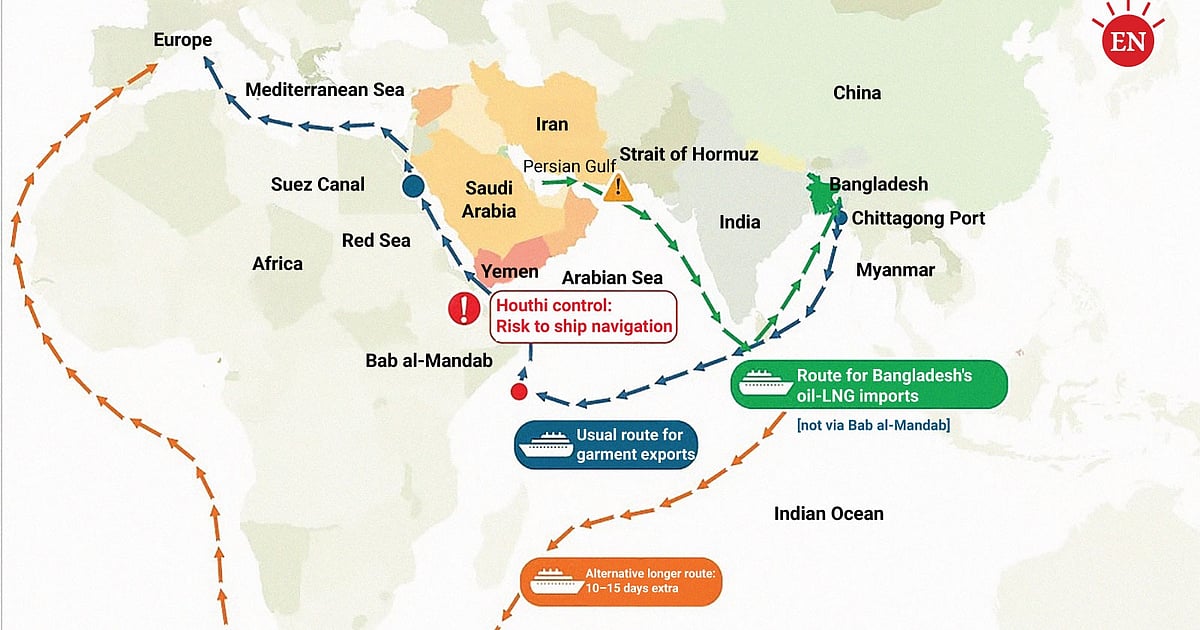
🚢 Iran-backed Houthis have seized Yemen's Mokha port and the strategically important Perim, or Mayyun, island in the Bab el-Mandeb, dramatically escalating their control over one of the world's most critical maritime chokepoints. The island divides the strait into two and is located near its narrowest point. As a result, the Houthis' strategic control over this important international shipping route has increased significantly — with profound implications for Bangladesh's USD 46.45 billion trade with dependent regions.
🌏 A tanker named MT Ninemia carrying fuel oil for Bangladesh Petroleum Corporation (BPC) set sail for Bangladesh as the Bab el-Mandeb Strait had emerged as an alternative route for bringing oil from Saudi Arabia. To avoid the risk of attack, the Bangladesh-bound Ninemia bypassed the Bab el-Mandeb and reached Chattogram after travelling through the Suez Canal, the Mediterranean and around Africa. The vessel arrived at Chattogram port on Saturday. The journey took around 50 days. Had it travelled through the Bab el-Mandeb, it would have taken about 16 days. The cost would also have been much lower.
💰 Cost Of Diversion: $4 Million Per Voyage
PK Roy, manager (operations) of Prime Ocean Trade Ltd, the tanker's local representative, told Prothom Alo that taking a longer route can add up to USD 4 million to the cost of a tanker's voyage. Such an additional cost does not arise when ships take the direct route. The 34-day extension in voyage time and $4 million cost premium illustrate the magnitude of the disruption that Bangladesh faces if Bab el-Mandeb becomes impassable.
The Strait of Hormuz is one of the main routes for supplying fuel from the Middle East to Bangladesh and other Asian countries. Shipping through the route has been disrupted by the Iran war. The Bab el-Mandeb Strait in the Red Sea had emerged as an important alternative route for bringing fuel oil to Bangladesh from Saudi Arabia. Now, risks have increased along that route as well.
- 🚢 Voyage via Bab el-Mandeb: ~16 days
- 🚢 Voyage around Africa (Cape of Good Hope): ~50 days
- 💰 Cost premium per diverted tanker: up to $4 million
- 📊 Bangladesh total foreign trade FY26: $119.39 billion
- 📊 Trade with Bab el-Mandeb dependent regions: $46.45 billion (39% of total)
- 📊 Exports to dependent regions: $35.51 billion (77% of total exports)
- 📊 Imports from dependent regions: $10.93 billion (15% of total imports)
- 🚢 Cargo diversion adds 10-12 days via Cape of Good Hope
📊 Trade Exposure: 77% Of Exports At Risk
For Bangladesh, the risks are not limited to fuel imports. A large share of the country's exports to Europe and parts of the United States passes through the Bab el-Mandeb, the Red Sea and the Suez Canal. This shipping route is also important for Bangladesh's trade with several African countries, including Egypt and Morocco, as well as with countries in the Mediterranean and Black Sea regions.
According to National Board of Revenue (NBR) data, Bangladesh exported goods worth USD 35.51 billion to Saudi Arabia, Egypt, Morocco, Europe and the United States in the 2025–26 fiscal year. It imported goods worth USD 10.93 billion from these countries and regions. Overall, the volume of trade amounted to USD 46.45 billion. Bangladesh's total foreign trade (imports and exports) stood at USD 119.39 billion in the 2025–26 fiscal year. Trade with countries and regions dependent on the Bab el-Mandeb and Suez Canal accounted for around 39 per cent of the country's total foreign trade.
More importantly, Bangladesh's exports are heavily dependent on this route. According to NBR data, around 77 per cent of the country's total exports went to these markets. By contrast, around 15 per cent of total imports came from these regions. The asymmetry — exports far more dependent than imports — means that any prolonged disruption would have outsized impact on Bangladesh's export earnings, foreign exchange inflows and the ready-made garment (RMG) sector that dominates the country's export basket.
⚠ Immediate Concern: Fuel Imports
The immediate concern for Bangladesh is fuel imports. After shipping through the Strait of Hormuz was disrupted, Saudi Arabia increased its use of the Red Sea port of Yanbu to supply oil to Asian countries. But with the Houthis maintaining their ban on Saudi vessels, the risks along this route have increased. Fuel oil, liquefied natural gas (LNG), liquefied petroleum gas (LPG), fertiliser and various other goods reach Bangladesh through the Strait of Hormuz and the Bab el-Mandeb. At present, virtually no vessels are arriving in Bangladesh through Hormuz. They are still coming through the Bab el-Mandeb.
If the situation there deteriorates, it will create security risks, higher insurance costs, increased shipping charges, longer transit times and uncertainty in the supply chain. Analysts say that if the crisis is prolonged, it could affect many sectors of Bangladesh's economy, from fuel imports to readymade garment exports.
💵 Export Impact: 10-12 Day Delays Via Cape Of Good Hope
The situation is somewhat different for Bangladesh's exports. If cargo ships bound for Europe, the Mediterranean and parts of the United States avoid the Bab el-Mandeb and Suez Canal, they will have to sail around the Cape of Good Hope. According to shipping agents, this can generally add another 10 to 12 days to the journey. Fuel consumption and transportation costs will increase as well.
The cost of sea freight for exported goods is usually borne by foreign buyers. However, there may be attempts to pass on the sudden increase in costs to exporters. Mahmud Hasan Khan, president of the Bangladesh Garment Manufacturers and Exporters Association (BGMEA), told Prothom Alo: "The indirect impact will be greater on exports. Even if foreign buyers pay the additional freight costs, ultimately the pressure may fall on us."
Mahmud Hasan Khan said imports of raw materials for the garment industry from Turkey and cotton from various parts of Africa could be affected immediately. If it takes longer for raw materials to arrive, production and export schedules will also come under pressure. The reference to Turkish fabric and African cotton inputs reveals how RMG supply chains are exposed not just on the export side but on the input side — both directions face potential disruption.
📜 Broader Economic Fallout
The impact of the US and Israeli attacks on Iran, which began in February, has affected Bangladesh in various ways. The country faced a severe fuel oil shortage in March and April. Now, Bangladesh is not getting enough gas. Power plants cannot be operated properly. Load-shedding is continuing for several hours a day across the country. The prices of fuel oil and gas have risen sharply. This has put pressure on the country's foreign exchange reserves, while prices have also had to be increased domestically.
The cascading impact — fuel shortages → power plant shutdowns → load-shedding → industrial production disruption → export delivery delays — illustrates the multi-layered vulnerability of Bangladesh's economy to Middle East geopolitical instability. The Bab el-Mandeb crisis compounds an already strained energy supply situation that has been building since the Iran war began.
🌏 Strategic Recommendations
Mustafizur Rahman, a distinguished fellow at the Centre for Policy Dialogue (CPD), told Prothom Alo that if the Bab el-Mandeb crisis continues for a prolonged period, Bangladesh's export competitiveness will decline. The country will particularly fall behind competitors that do not depend on the strait, as both the time and cost of transporting goods will increase. The competitive disadvantage is most acute against Vietnam, which has shorter maritime routes to European markets through the Suez Canal, and against regional competitors including India and Sri Lanka that have similarly short routes but better diversification of trade partners.
Mustafizur Rahman also said fuel oil imports would come under additional pressure, particularly when global energy prices are rising. The government must take strong initiatives now to increase imports from alternative sources of fuel. In the medium term, greater emphasis should be placed on expanding the use of solar power. The recommendation for accelerated solar deployment reflects growing recognition that domestic renewable energy capacity is Bangladesh's most credible long-term hedge against Middle East geopolitical risk — every megawatt of solar capacity reduces dependence on imported fuel that must traverse vulnerable maritime chokepoints.
For Bangladesh's broader trade strategy, the crisis underscores the need for diversification — both in terms of export markets (reducing the 77% dependence on Bab el-Mandeb dependent regions) and in terms of energy import sources (exploring LNG from Australia, US or Qatar that can be routed through Pacific rather than Middle East shipping lanes). The coming months will reveal whether the Houthi control of Bab el-Mandeb proves temporary or becomes a sustained disruption — but either way, the strategic case for trade and energy diversification has been decisively strengthened.
This news was originally published by Prothom Alo English. For the full original report, please visit: https://en.prothomalo.com/business/global/b53o5xocmq
Related on BangladeshExport
📬 Get Bangladesh Trade News in your inbox
Weekly digest of export industry news, policy updates, and market analysis.
📰 Related Stories