Bangladesh Bank Sets Tk 100 Crore Fund to Boost Bangla QR: Target 1 Crore Daily Transactions
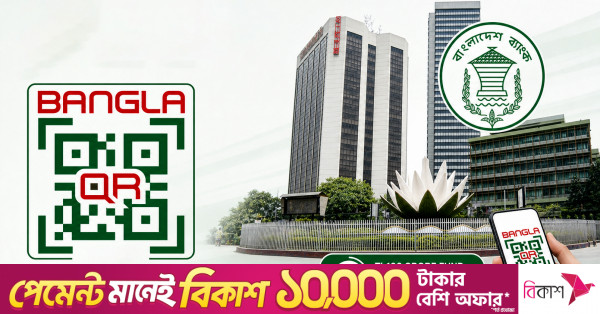
Chattogram, August 8, 2026 — Bangladesh Bank Governor Md Mostaqur Rahman has announced the establishment of a Tk 100 crore fund to boost the adoption of Bangla QR — the country's unified QR code payment system — with an ambitious target of increasing digital transactions from the current 1 crore per month to 1 crore per day by the end of the current fiscal year.
📱 The Target: 30-Fold Increase in 10 Months
Speaking at a Bangla QR workshop at the Radisson Blu Chattogram Bay View's Nilgiri Hall — organised jointly by Bangladesh Bank and the International Finance Corporation (IFC) under the "Cashless Digital Bangladesh" project — the governor said the country currently records around 1 crore digital transactions a month. The central bank aims to raise this to 1 crore a day by the end of the current fiscal year — a nearly 30-fold increase in about 10 months.
- 📈 Current digital transactions: ~1 crore per month
- 🚀 Target: 1 crore per day by end of FY27
- 📊 Required growth: ~30x in 10 months
- 💰 Fund allocated: Tk 100 crore for Bangla QR expansion
- 📈 Bangla QR volume growth (Jan-Jul 2026): 8.6x
- 📈 Bangla QR value growth (Jan-Jul 2026): ~7x
📊 Bangla QR Growth: Impressive but From a Low Base
Bangladesh Bank data show Bangla QR transactions rose from 7,23,378 worth Tk 212.05 crore in January 2026 to 62,54,938 worth Tk 1,475.95 crore in July — an 8.6-fold rise in volume and nearly sevenfold increase in value in six months. Bangla QR merchants increased from 13,52,712 in May to 16,85,188 in June and 24,25,133 in July, representing 79% growth in three months and nearly 93% in 10 months.
Deputy Governor Md Kabir Ahmed said around 24 lakh merchants now use the system, with about 2 lakh daily transactions worth nearly Tk 50 crore. Greater use, he said, could also help raise the tax-to-GDP ratio — a persistent challenge for Bangladesh, where the ratio remains among the lowest in South Asia.
💸 Cash Management Costs: Tk 20,000 Crore Annually
Md Parvez Anzam Munir, additional director of Bangladesh Bank's Payment Systems Department-1, revealed that cash management costs the country around Tk 20,000 crore annually — covering printing, production, distribution, collection of worn notes, and their eventual destruction. He called the expenditure an "extreme luxury and waste" for a poor country and said greater digital payments could substantially reduce it.
The Tk 20,000 crore annual cash management cost is a powerful argument for digital payment adoption. If even half of this could be saved through a shift to digital transactions, the savings — approximately Tk 10,000 crore per year — would more than cover the cost of the Tk 100 crore Bangla QR fund a hundred times over.
📱 The Smartphone Gap: Tk 30,000 Crore Challenge
Limited smartphone use remains a major obstacle, with around 6 crore people still using feature phones. The government is working to provide affordable Android handsets. Users are willing to spend around Tk 3,000, while manufacturers say such phones cannot be offered below Tk 8,000. Bridging the Tk 5,000 gap could require around Tk 30,000 crore, and initiatives are being explored to finance the investment, including instalment-based purchases through mobile operators.
This smartphone gap is the single biggest barrier to the 1-crore-daily-transactions target. Without affordable smartphones for the 6 crore feature phone users, the digital payment revolution cannot reach its full potential. The Tk 30,000 crore investment needed to bridge this gap dwarfs the Tk 100 crore Bangla QR fund — and will require innovative financing models involving mobile operators, handset manufacturers, and potentially multilateral development institutions.
🏛️ Transparency, Anti-Extortion, and Financial Inclusion
Governor Mostaqur said digital transactions would improve transparency in business finances and reduce risks for small traders who rely on employees to handle money — including concerns over missing funds and irregularities. Digital payments could also provide an alternative to cash for extortion payments — a reference to the illegal "toll" collections that plague businesses in many parts of Bangladesh, which are facilitated by the anonymity of cash transactions.
Bangla QR has been made mandatory for merchant licences issued by city corporations and municipalities, while institutions have been instructed to replace existing QR codes with Bangla QR by 2026. Instant settlement of Bangla QR transactions into merchants' accounts has also been introduced — addressing one of the key complaints from merchants who previously had to wait days for payment settlement.
🛡️ Security Warnings: Scams and Phishing
The workshop warned merchants about scams involving fake calls and SMS impersonating banks, mobile financial services, or government agencies — as well as phishing, hacking, malware, fake customer care, and fraudulent websites. Merchants were advised not to share personal information, PINs, or OTPs, and not to click unfamiliar links. The security warnings highlight the dual challenge of digital payment expansion: increasing adoption while protecting users from an evolving landscape of digital fraud.
👥 Workshop Details and Participants
Chaired by Payment Systems Department Executive Director Md Sirajul Islam, the workshop was attended by Governor Md Mostaqur Rahman as chief guest, Deputy Governor Md Kabir Ahmed, and IFC representative Hasan Shahriar as special guests. Around 120 merchants, including 20 women, participated in three sessions covering Bangla QR use, benefits, and transaction security. Hasan Shahriar said IFC's monthly digital transaction target had risen from 20 lakh to around 1 crore.
🌏 Regional Context: Learning from Neighbours
The governor said Bangladesh was drawing on neighbouring countries' experience to expand digital payments — a reference to India's spectacular success with UPI (Unified Payments Interface), which now processes over 10 billion transactions per month. India's UPI model, which allows interoperable payments across banks and payment apps via a single QR code, is the template that Bangla QR seeks to emulate. The key difference is that India's smartphone penetration is significantly higher than Bangladesh's — making the smartphone gap the critical variable that will determine whether Bangladesh can replicate India's digital payment success.
✅ What Comes Next
The Tk 100 crore fund will be deployed to expand merchant onboarding, consumer awareness campaigns, and technical infrastructure for Bangla QR. The mandatory merchant licence requirement and instant settlement feature should accelerate adoption. However, the 1-crore-daily-transactions target will be extremely challenging to achieve without closing the smartphone gap — making the affordable handset initiative arguably more important than the QR fund itself. For Bangladesh's digital economy, the next 10 months will determine whether the country can make the leap from a cash-dominated economy to a digitally-inclusive one — or whether the smartphone gap will constrain the digital payment revolution to the urban, middle-class segment that already has access.
This news was originally published by The Business Standard. For the full original report, please visit: https://www.tbsnews.net/economy/bangladesh-bank-sets-tk100cr-fund-boost-bangla-qr-use-1509826
📬 Get Bangladesh Trade News in your inbox
Weekly digest of export industry news, policy updates, and market analysis.
📰 Related Stories