Is BRICS Underperforming? Assessing The Delhi Summit 2026 Outcomes
Column examines the 18th BRICS summit's 140-point Delhi Declaration, assessing whether the bloc's economic weight is translating into institutional outcomes or remaining declaratory
🌏 The 18th summit of BRICS held in Delhi on September 12-13 had the theme 'Building for Resilience, Innovation, Co-operation and Sustainability'. At the end of the summit, the leaders of BRICS countries issued a 140-point, 45-page document that represents consensus on issues pertaining to global trade, finance, geopolitics and development. The question is whether this extensive declaration translates into meaningful institutional outcomes — or whether BRICS remains a declaratory body that underperforms relative to its economic weight.
📊 The overriding aspiration of the original architects of BRICS (Brazil, Russia, India, China and South Africa) was to build an alternative global economic order as the prevailing one had been made to work more in the interests of the industrially developed West than for the emerging and developing countries. The global financial crisis of 2008 strengthened the argument of emerging countries that the existing international financial system did not adequately reflect the changing distribution of economic power in the 21st century.
📜 BRICS Objectives: Five Categories
The objectives of BRICS can be broadly divided into five categories. First, the most important political objective is the reform of multilateral institutions based on the argument that institutions created after the second world war do not adequately reflect the distribution of political and economic power in the present day world. Particular attention has been given to reforming the IMF, World Bank and the UN Security Council to give greater representation to emerging economies.
Second, the economic objective focuses on creating alternative financial institutions and mechanisms — including the New Development Bank (NDB, formerly BRICS Bank), the Contingent Reserve Arrangement (CRA), and the push for local currency settlement in trade to reduce dependence on the US dollar. Third, the trade objective seeks to facilitate intra-BRICS trade and investment through reduced barriers, trade facilitation agreements and sectoral cooperation.
- 📜 Summit: 18th BRICS, Delhi, September 12-13, 2026
- 📜 Declaration: 140 points, 45 pages
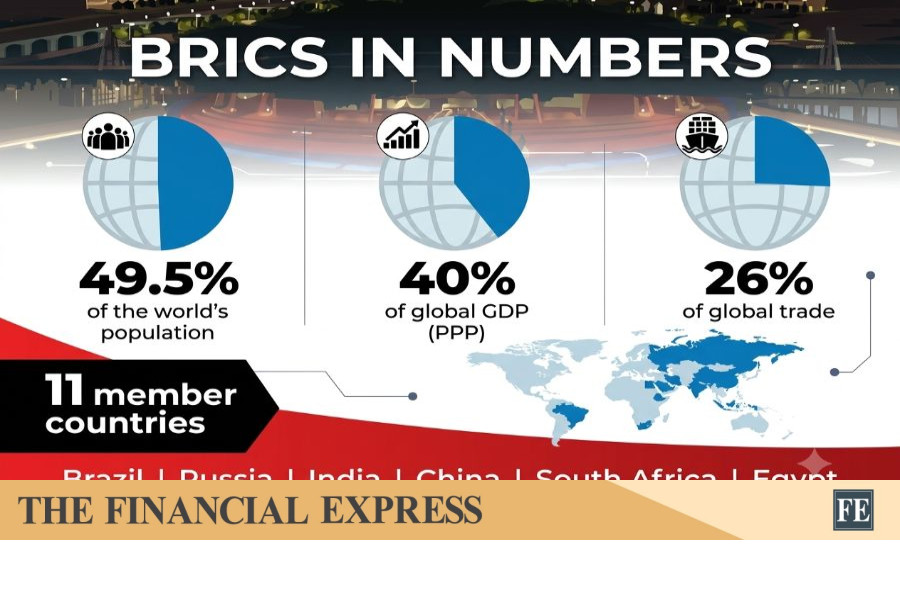
- 👥> Members: 11 countries (expanded from original 5)
- 💰 Combined GDP: ~$35 trillion
- 👥> Combined population: ~half of global total
- 📊> Global trade share: ~26%
⚠ Performance Assessment: Aspiration Vs Achievement
The performance assessment of BRICS must distinguish between declaratory achievement and operational outcome. On the declaratory side, BRICS has been prolific — producing extensive summit declarations, establishing institutional frameworks (NDB, CRA) and articulating positions on global governance reform. On the operational side, the results have been more mixed. The NDB has approved projects but at a pace that lags behind the World Bank and ADB. The CRA has never been activated. Local currency settlement remains aspirational rather than operational at meaningful scale.
The fundamental challenge facing BRICS is that its members have divergent economic structures, strategic interests and relationships with the existing global order. China and Russia have stronger incentives to challenge the US-led system; India, Brazil and South Africa have more nuanced positions that balance reform advocacy with engagement in existing institutions. The expansion to 11 members — adding Egypt, Ethiopia, Iran, Saudi Arabia and the UAE — has increased the bloc's geographic and economic reach but also its internal diversity, making consensus harder to achieve on substantive issues.
🌏 Implications For Bangladesh
For Bangladesh, the BRICS underperformance question is strategically relevant. As a country preparing to graduate from LDC status, Bangladesh benefits from a multipolar world where multiple power centres can provide alternative sources of financing, trade partnerships and diplomatic support. If BRICS can translate its economic weight into operational outcomes — meaningful NDB lending, local currency trade settlement, WTO dispute settlement restoration — the bloc would provide Bangladesh with alternatives to the Western-dominated financial architecture.
However, if BRICS remains primarily declaratory — producing ambitious declarations without operational follow-through — Bangladesh's engagement with the bloc should remain pragmatic rather than strategic. The Delhi Declaration's 140 points provide comprehensive positions on global issues, but the coming months will reveal whether any of those positions translate into concrete institutional reforms that benefit developing countries like Bangladesh.
The BRICS summit's most significant outcome for Bangladesh may be the diplomatic signal — that the world's largest emerging economies are collectively advocating for a more representative, multipolar global order. Whether that signal translates into tangible benefits depends on BRICS' ability to overcome its internal contradictions and translate declaratory consensus into operational outcomes. Until then, the question "Is BRICS underperforming?" remains open — with the answer leaning toward cautious affirmation.
This news was originally published by The Financial Express. For the full original report, please visit: https://thefinancialexpress.com.bd/views/is-brics-underperforming
📬 Get Bangladesh Trade News in your inbox
Weekly digest of export industry news, policy updates, and market analysis.
📰 Related Stories