Inflation Relapse Feared As Fuel Price Hike Sends Cost Shockwaves Across Bangladesh
Economists fear severe inflationary impact from Tk 20/litre fuel price hike; immediate passthrough to transport, food and production costs expected across all sectors
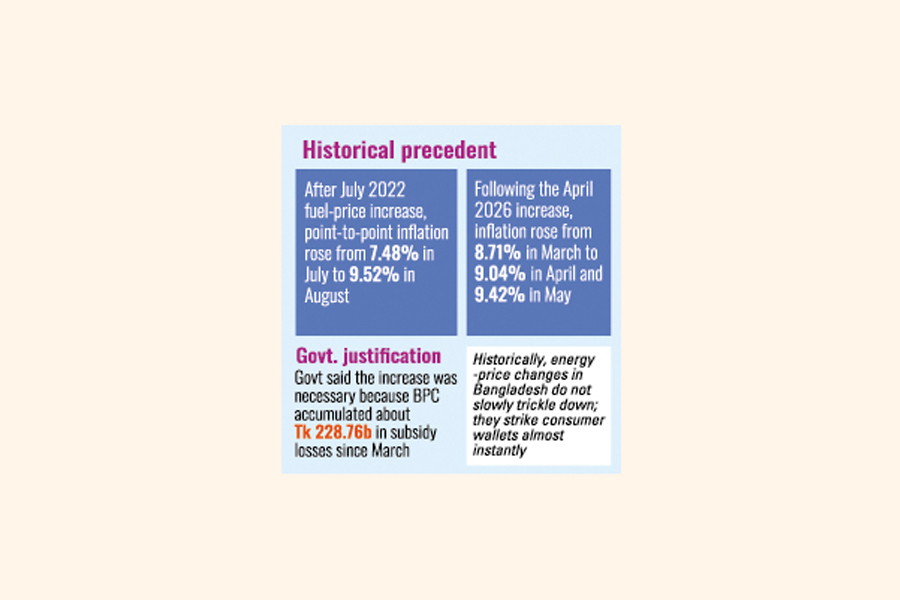
⚠ A brusque announcement ramping up prices of all major fuel oils has sent shockwaves through Bangladesh's economic landscape as economists fear a severe impact on inflation like in the past. The immediate impact of fuel-oil-price hikes on inflation used to be very severe after raising oil price as it cascades through transport, food and production costs across the economy.
📊 The Tk 20 per litre fuel price hike — affecting diesel, petrol, octane and kerosene simultaneously — represents one of the largest single fuel price adjustments in Bangladesh's history. The across-the-board nature of the increase means that every sector of the economy that uses petroleum products — from transport and agriculture to manufacturing and power generation — will face increased costs simultaneously, creating a compounding inflationary effect rather than the more moderate impact of sector-specific price adjustments.
💰 Transmission Channels
- 🚚 Transport costs: Truck, bus and agricultural transport fares increase immediately
- 🌾 Food prices: Higher transport costs raise wholesale and retail food prices
- 🏭 Production costs: Industrial power generation (diesel backup) becomes more expensive
- 💰 Irrigation costs: Farmers using diesel pumps for irrigation face higher costs
- 📊> Inflation expectations: Consumers and businesses adjust inflation expectations upward
🌏 Strategic Context: Inflation Already Above Target
For Bangladesh's broader macroeconomic management, the fuel price hike's inflationary impact compounds an already challenging inflation environment. With headline inflation at 8.26% in August 2026 — well above the government's 7.5% FY27 target — the fuel price hike's contribution to consumer price inflation could push headline inflation further into uncomfortable territory. The CPD's Dr Fahmida Khatun has warned that the increase will have "wide-ranging consequences" with transportation costs raising prices of food and other essentials.
The inflation relapse risk is particularly concerning because Bangladesh's economy is already struggling with multiple inflationary pressures: the Middle East war's impact on energy and food import prices, the domestic gas supply crisis that constrained industrial production, the currency depreciation pressure from the Fed's rate hikes, and now the domestic fuel price adjustment. Each of these pressures feeds into the same inflation index, creating a compounding effect that makes monetary policy management increasingly difficult.
For Bangladesh Bank, the fuel price hike creates a policy dilemma. The central bank has been easing monetary policy (cutting the policy rate to 9.5% in July) to stimulate private sector credit growth — but the fuel price hike's inflationary impact may force a reversal or pause in the easing cycle. If inflation accelerates above 9%, the central bank may face pressure to tighten rather than ease — constraining the credit growth needed to support economic recovery.
The coming weeks will reveal the actual magnitude of the inflation passthrough — and whether the government's social safety net programmes (Family Card, Farmer Card) can cushion the household-level impact for the most vulnerable populations. For ordinary consumers, the combination of higher fuel costs, higher transport fares and higher food prices creates a cost-of-living squeeze that will test household financial resilience across income groups.
This news was originally published by The Financial Express. For the full original report, please visit: https://thefinancialexpress.com.bd/economy/inflation-relapse-feared-on-across-the-board-cost-spikes-1
Related on BangladeshExport
📬 Get Bangladesh Trade News in your inbox
Weekly digest of export industry news, policy updates, and market analysis.
📰 Related Stories