Fuel Prices Adjusted To Prevent Smuggling: State Minister Amit
State Minister Anindya Islam Amit says diesel should be Tk 205/litre at full international pricing, but government kept it at Tk 135 with subsidies; 70% of imported fuel passes through Hormuz

⛽ State Minister for Power, Energy and Mineral Resources Anindya Islam Amit has said fuel prices had to be adjusted to prevent smuggling. "Fuels are purchased with foreign currency. But due to low price in the neighbouring countries it was being smuggled. So it was very crucial to increase the fuel price," he said at a press conference held at the Secretariat on Monday.
📊 Moreover, due to the Middle East war, the price of fuel shot up in the international market, compelling the government to give huge subsidies for fuel. Such subsidy should be contained to continue the government's social protection programmes, he said, BSS reports.
💰 Diesel Should Be Tk 205: Full International Pricing
He said that if the automatic pricing mechanism were fully implemented in line with international market prices, the price of diesel should have been fixed at Tk 205 per litre. However, considering the financial burden on the general people, the public transport sector and farmers dependent on irrigation, the government has kept the price considerably lower and at a tolerable level by providing substantial subsidies.
- 💰 Diesel at full international pricing: Tk 205/litre
- 💰 Actual diesel price: Tk 135/litre (after Tk 20 hike)
- 💰 Subsidy per litre: Tk 70 (Tk 205 - Tk 135)
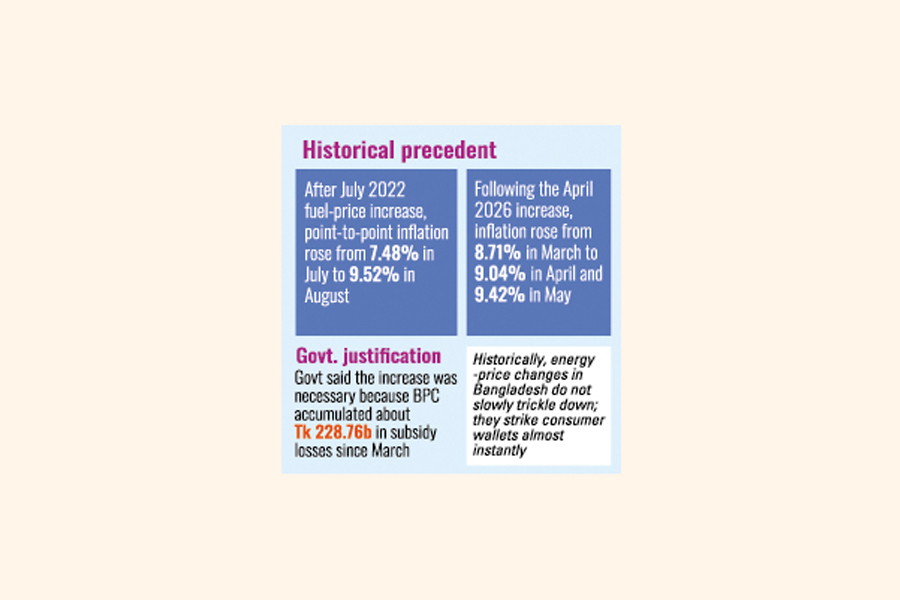
- 💰 BPC losses (March-August): Tk 22,875 crore
- 📊 Bangladesh fuel through Hormuz: 70% of imports
- 📊 Global energy through Hormuz: 20%
🌏 Regional Price Comparison
Referring to fuel prices in neighbouring and other countries, the state minister said, in terms of Bangladesh currency the price of diesel per litre is Tk 134.76 in Kolkata; Tk 164.83 in Myanmar; Tk 161.24 in Nepal; Tk 179.42 in Sri Lanka; Tk 151.22 in Thailand; Tk 137 in Vietnam; Tk 140 in the Maldives; Tk 168.53 in the Philippines; Tk 185.48 in Pakistan; and Tk 144.79 in Dubai of UAE. The regional comparison shows Bangladesh's new diesel price of Tk 135 is among the lowest in the region — only slightly above Kolkata (Tk 134.76) and below Vietnam (Tk 137), Maldives (Tk 140), Thailand (Tk 151.22) and most other Asian countries.
🏛 Middle East Crisis: More Complex Than COVID Or Russia-Ukraine
Regarding the ongoing international and Middle East crisis, the state minister said 70 percent of the country's imported fuel and 20 percent of the global energy supply pass through the Strait of Hormuz route. The current Middle East crisis has created an unprecedented situation, which is different and more complex than the Covid-19 pandemic or the Russia-Ukraine war.
Highlighting the financial capacity of Bangladesh Petroleum Corporation (BPC), he said BPC had been able to manage the situation without increasing prices so far, despite incurring losses of Tk 22,875 crore, because additional funds earned in the past had remained in its coffers. Although prices in the international market change every moment, efforts were made to protect the people by not making immediate adjustments. However, the sustained losses made the price adjustment unavoidable.
🌏 Strategic Context: Subsidy Sustainability
For Bangladesh's broader fiscal management, the state minister's disclosure that diesel at full international pricing should be Tk 205 per litre — versus the actual Tk 135 — reveals the magnitude of the implicit subsidy being absorbed. The Tk 70 per litre subsidy gap, applied across the country's annual diesel consumption of approximately 4.5 million tonnes, translates into an annual subsidy burden of approximately Tk 35,000 crore — a fiscal cost that the government cannot sustain indefinitely while also funding social safety net programmes, infrastructure investment and education/healthcare spending.
The government's decision to raise prices by Tk 20 (reducing the subsidy gap from Tk 89 to Tk 70 per litre) represents a partial adjustment — not a full elimination of the subsidy. This phased approach reflects political sensitivity to fuel price increases, but also means that BPC will continue incurring losses (albeit reduced by approximately Tk 10,000 crore annually). The state minister's framing — that the adjustment was necessary to "ensure the continuation of the government's social protection programmes" — signals that the fuel subsidy was crowding out social spending, creating a direct trade-off between energy subsidies and welfare programmes.
This news was originally published by The Financial Express. For the full original report, please visit: https://thefinancialexpress.com.bd/trade/fuel-prices-adjusted-to-prevent-smuggling-state-minister-amit
Related on BangladeshExport
📬 Get Bangladesh Trade News in your inbox
Weekly digest of export industry news, policy updates, and market analysis.
📰 Related Stories