Why Bangladesh, a Global Top Fish Producer, Still Imports Thousands of Tonnes Annually
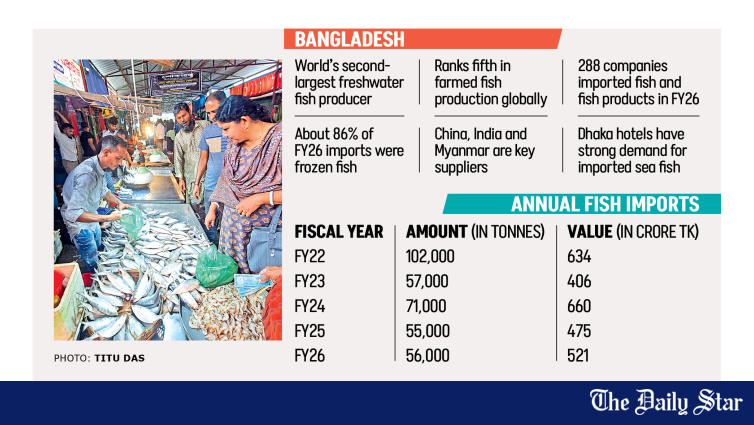
Dhaka, August 17, 2026 — By most measures, Bangladesh is one of the planet's great fish-producing nations. It ranks second in the world for fish caught in rivers, lakes, and wetlands, and fifth for farmed fish production, according to a June 2026 report by the Food and Agriculture Organization (FAO). The country's production now exceeds 50 lakh tonnes, surpassing the annual demand of around 48.93 lakh tonnes. Yet, government data shows that Bangladesh regularly imports thousands of tonnes of fish every year — a paradox that highlights the gap between aggregate production and consumer demand diversity.
🐟 Bangladesh's Fish Production Rankings
Bangladesh's fish production credentials are impressive:
- 🏆 2nd in the world — for inland capture fisheries (rivers, lakes, wetlands)
- 🏆 5th in the world — for farmed fish (aquaculture) production
- 📊 50 lakh+ tonnes — annual domestic production
- 📊 48.93 lakh tonnes — annual domestic demand
- ✅ Production exceeds demand — yet imports continue
📦 Fish Import Data
Despite surplus production, Bangladesh imports fish regularly:
- 💰 FY2025-26: 56,000 tonnes — worth Tk 521 crore
- 💰 FY2024-25: 55,000 tonnes — worth Tk 475 crore
- 💰 FY2023-24: 71,000 tonnes — worth Tk 660 crore
- 💰 FY2022-23: 57,000 tonnes — worth Tk 406 crore
- 🏢 288 companies — registered to import fish and fish products
🚧 Why Bangladesh Imports Fish Despite Surplus
The reasons, according to government officials and importers, come down to variety. Some fish Bangladeshis want to eat aren't available domestically in enough supply, or at all. Imports are needed to meet the demand of:
- 🏛️ Processing industry — fish processing plants need specific varieties
- 🏨 Hotels and restaurants — hospitality sector demands premium and exotic varieties
- 🛍️ Specialised markets — niche consumer preferences for imported species
- 🐟 Species not farmed locally — some fish species cannot be produced in Bangladesh
- 📊 Seasonal gaps — domestic supply may not meet year-round demand
📊 FAO Report Context
The FAO's June 2026 report provides important global context for Bangladesh's fish sector:
- 🌐 Global ranking — Bangladesh among top fish-producing nations
- 📊 Inland fisheries strength — riverine and wetland geography
- 🏭 Aquaculture growth — pond farming and commercial aquaculture
- 👥 Food security — fish provides 60% of animal protein in Bangladeshi diet
- 💰 Export potential — shrimp and prawn exports earn foreign exchange
🌐 Strategic Context: Fish Import and Food Security
The paradox of being a top fish producer yet importing fish reflects the complexity of food security in a diverse consumer market. While aggregate production exceeds demand, the mismatch between what Bangladesh produces and what consumers want creates import demand. This has several implications:
- 💰 Forex outflow — Tk 521 crore spent on fish imports in FY26
- 🌾 Aquaculture diversification — opportunity to farm imported species domestically
- 🏨 Hospitality sector — tourism development requires diverse fish supply
- 💼 Processing industry — fish processing for export requires specific varieties
- 👥 Consumer choice — rising middle class demands diverse fish varieties
For Bangladesh's export economy, the fish import paradox presents both a challenge and an opportunity. The challenge is the forex outflow — Tk 521 crore that could be saved if domestic production matched consumer demand. The opportunity is that Bangladesh's aquaculture sector, already ranked 5th globally, has the potential to diversify into farming the species currently imported — reducing import dependence while potentially creating new export products. With proper investment in aquaculture research, species diversification, and cold-chain infrastructure, Bangladesh could transform its fish import paradox into a food security and export competitiveness success story — leveraging its world-class aquaculture capabilities to meet both domestic variety demand and international market opportunities in the post-LDC era.
The fish import paradox also highlights the broader challenge of food system transformation in Bangladesh — where aggregate production may be sufficient but variety, quality, and supply chain gaps create persistent import dependence. Similar patterns exist in other food categories — with Bangladesh importing edible oil despite agricultural production capacity, and importing various fruits despite domestic cultivation. Addressing these paradoxes requires not just increasing aggregate production but also aligning production with consumer preferences, investing in processing infrastructure, and building efficient cold-chain logistics that can deliver diverse products to consumers year-round.
The Department of Fisheries data showing 288 registered fish import companies also suggests a well-established import infrastructure — with significant commercial interests vested in continuing fish imports. Any policy aimed at reducing fish import dependence would need to address the commercial ecosystem that has developed around fish importation — potentially by supporting domestic aquaculture diversification to produce the varieties currently imported, while providing transition support for importers to shift toward domestic sourcing. For an economy preparing for LDC graduation, reducing unnecessary food imports — even in categories where aggregate production exceeds demand — could contribute meaningfully to forex conservation and domestic agricultural sector growth.
This news was originally published by The Daily Star. For the full original report, please visit: https://www.thedailystar.net/business/economy/news/why-bangladesh-global-top-producer-still-imports-fish-4250246
📬 Get Bangladesh Trade News in your inbox
Weekly digest of export industry news, policy updates, and market analysis.
📰 Related Stories