Liberalise Imports to Fight Inflation in Bangladesh: Sadiq Ahmed
Sadiq Ahmed, Dhaka — Between fiscal year 1995-96 and fiscal year 2021-22, Bangladesh experienced an average inflation rate of 6.3 percent over the 26 years. There were episodic divergences during FY2012 and FY2013 from this long-term trend, but they were corrected quickly. This stability of the price level has been a big win for Bangladesh, playing a major role in boosting investment and protecting the incomes of the poor and lower-income groups.
By contrast, Bangladesh has experienced an average inflation rate of 9.3 percent over the past four years, from FY2023 to FY2026, and the inflation rate remains stubbornly high. This unusually high pace of inflation has hurt investment and the incomes of the poor and lower-income groups. Even the middle class is now feeling the pain of rising prices that continue to outstrip income growth for most households. Inflation control is arguably the biggest economic challenge facing the government today.
📊 Historical Inflation Performance
- 📊 FY1995-96 to FY2021-22 average inflation: 6.3 percent (26-year stable period)
- 📊 FY2023 to FY2026 average inflation: 9.3 percent (4-year elevated period)
- 📊 Inflation differential: +3 percentage points above long-term average
- 📊 Regional comparison: India, Thailand, Malaysia, Indonesia, Vietnam all saw inflation decline — but not Bangladesh
👥 Sadiq Ahmed's Diagnosis
When the current episode of inflationary pressure first emerged in FY2023, most people believed it was a temporary phenomenon caused by the combined effects of Covid-19-related disruption to global supply chains and the trade disruption caused by the Ukraine war. There was therefore a belief that this external-shock-related inflationary episode would pass once the world adjusted to these events and the surge in global commodity prices and global inflation subsided.
While global commodity prices have normalised and the global inflation rate has sharply declined, inflation in Bangladesh remains stubbornly high. Indeed, the average inflation rate in most countries has come down, including in India, Thailand, Malaysia, Indonesia and Vietnam, but not in Bangladesh.
Sadiq Ahmed, Vice-Chairperson of the Policy Research Institute of Bangladesh (PRI), argues that the inflationary spiral was ignited by Covid-19-related expansionary monetary and fiscal policies and then accentuated by a deep supply shock resulting from a sharp fall in the GDP growth rate, especially in the manufacturing sector, and unprecedented import cutbacks.
📊 Import Volume Crisis
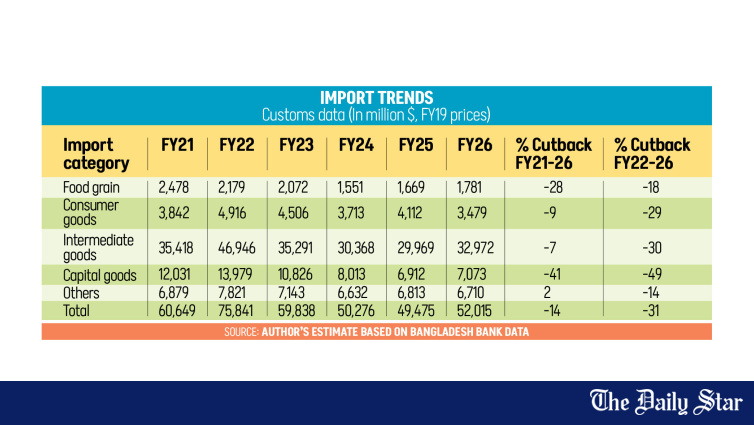
The country's total import volume has fallen by 31 percent since FY2022. This is the outcome of trade and exchange restrictions and the fall in import demand for capital goods owing to the sharp slide in public and private investment rates. Some researchers may argue that FY2022 was an abnormal year. The cutbacks remain deep if, instead, the base-year values of FY2021 are used:
- 📉 FY2021-FY2026 import volume decline: 14 percent
- 📉 Capital goods imports decline: 41 percent (deepest reduction)
- 📉 Intermediate goods imports decline: 7 percent
- 📉 Consumer goods imports decline: 9 percent
With an average GDP growth rate of 5 percent and an empirically verified income elasticity of demand of 1, imports should have grown by 25 percent between FY2021 and FY2026 instead of falling by 14 percent. The import supply shock is obvious. Additionally, given the crunch in domestic supply, reflected in the sharp slowdown of GDP growth, especially in the manufacturing sector, the adverse effects of the import cutbacks on domestic prices and inflation are magnified.
🏛 Import Controls: Blunt Instrument
Sadiq Ahmed argues that the axe on imports is the bluntest instrument that policymakers tend to use to respond to a balance of payments crisis. Its temporary use is understandable to avoid an unsustainable run on reserves. But import control is a poor instrument for achieving a sustainable balance of payments position over the longer term. It is also inconsistent with GDP growth and price stability objectives.
💰 Recommended Policy Reforms
Moving forward, to manage inflation, Ahmed recommends that the government must pursue policy reforms that help increase both domestic and import supply:
- 💰 Allow rapid recovery of imports, especially consumer goods, including food items
- 💰 Ease all import restrictions in terms of margin and licensing requirements
- 💰 Cut import duties, including supplementary and regulatory duties, to the maximum extent possible
- 💰 Apply duty cuts for a limited duration until domestic supply recovers and inflation is brought down to the 4-5 percent level
- 💰 Tackle adverse BoP effects through export diversification and greater remittance mobilisation
- 💰 Adopt fully flexible, market-based exchange rate without Bangladesh Bank intervention
Ahmed argues that a fully flexible, market-based exchange rate is essential to diversify and boost exports and mobilise remittances without the need for fiscal subsidies, which are in any case unsustainable in an environment of severe fiscal constraint.
📊 Strategic Context
The liberalise-imports-to-fight-inflation argument comes amid broader strategic context that supports Sadiq Ahmed's diagnosis:
- 📊 FY26 petroleum import bill: $10.63 billion (up 107% YoY) — but volume down
- 📊 FY26 fertiliser import bill: $3.72 billion (up 42% YoY) — but volume up only modestly
- 📊 REER at 103.93: Bangladesh Taka overvalued, reducing export competitiveness
- 📊 Government bank borrowing: Tk 165,538 crore (exceeding target by Tk 47,538 crore)
- 📊 FY26 GDP growth: 4.14 percent (well below 5% potential)
- 📊 Weak private sector credit growth: 4.47 percent YoY (10-year low)
Each of these data points reinforces Ahmed's diagnosis — the inflation problem is structural, driven by supply-side constraints (import cutbacks, gas crisis, energy shortages) rather than demand-side excesses. Standard monetary tightening alone cannot address supply-driven inflation.
🌏 The Path Forward
Ahmed's recommendation has several practical implications for Bangladesh's policy response:
- ✅ Immediate tariff relief: cut supplementary and regulatory duties on essential imports
- ✅ Margin requirement easing: remove 100% cash margin on selected imports
- ✅ License requirement simplification: streamline import licensing for essential goods
- ✅ Exchange rate flexibility: allow market-based taka depreciation to support export competitiveness
- ✅ Export diversification: reduce dependence on RMG through broader product mix
- ✅ Remittance mobilisation: incentivise formal channel remittance flows
- ⚠️ Domestic supply recovery: banking sector reform, energy sector stabilisation, fiscal consolidation
Since recovery of the domestic economy will take time in view of the deep-seated problems plaguing the Bangladesh economy — including the fragile banking sector, the crisis in the energy sector, and the severe fiscal constraint — the fastest way of lowering the inflation rate is to allow a rapid recovery of imports, especially consumer goods, including food items.
🏛 Strategic Implications
Sadiq Ahmed's policy prescription carries several strategic implications for Bangladesh's broader macroeconomic trajectory:
- ✅ Supply-side inflation diagnosis: acknowledges structural rather than demand-driven inflation
- ✅ Import liberalisation priority: fastest route to inflation reduction
- ✅ Exchange rate flexibility: needed for export competitiveness and remittance mobilisation
- ✅ Fiscal sustainability: subsidy-based approaches are unsustainable under fiscal constraint
- ⚠️ BoP risk management: imports liberalisation must be paired with export growth
- ⚠️ FX reserves pressure: higher imports could pressure $32.90 billion reserves
The inflation challenge is arguably the single most important macroeconomic issue facing Bangladesh through the LDC graduation transition period. With 9.3 percent average inflation over the past four years eroding household purchasing power and undermining investment confidence, the case for supply-side policy reforms — particularly import liberalisation — has become increasingly compelling. Whether the government adopts Ahmed's recommendations in full or in part will significantly influence Bangladesh's macroeconomic trajectory through the LDC graduation transition beginning November 2026.
Sadiq Ahmed is Vice-Chairperson of the Policy Research Institute of Bangladesh (PRI).
This news was originally published by The Daily Star. For the full original report, please visit: https://www.thedailystar.net/business/economy/news/liberalise-imports-fight-inflation-4261531
📬 Get Bangladesh Trade News in your inbox
Weekly digest of export industry news, policy updates, and market analysis.
📰 Related Stories