Smaller Firms Pay 20% of Goods Value in Import Requirements: UNCTAD Report
UNCTAD report based on 90,120 enterprises in 114 developing countries shows SMEs pay 20% of imported goods value in customs fees, broker payments and freight. SME interest rates in developing economies average 15.8% vs 6.3% in developed economies.
📊 Dhaka, Bangladesh — Smaller firms in developing countries pay 20 percent of the value of imported goods in import requirements, such as customs fees, other payments and fees paid to customs brokers or freight forwarders, according to a new report by UN Trade and Development (UNCTAD).
📊> These higher costs put small and medium enterprises at a disadvantage compared with medium and large businesses as shipping, insurance and energy costs rise, the organization said in its report.
💰> Key UNCTAD Findings
📊> The UNCTAD analysis was based on data from:
- 👥 90,120 enterprises
- 🌏 114 developing countries
- 🌏 43 developed countries
- 📅 2023-2025 period
📊> Key findings:
- 💰 SMEs pay 20% of goods value in import requirements (customs fees, broker payments, freight forwarders)
- 💰 SME interest rates in developing economies: 15.8% (2024) vs 6.3% in developed economies
- 📊 28% of small enterprises in developing countries face major/very severe difficulties obtaining finance
- 📊 1 in 4 small firms in developing countries spends more than 4.2% of total sales on electricity
- 📊 During 2020 economic shock: 88% of small enterprises reported lower sales vs 81% of large corporations
📊> Strait of Hormuz Disruption Impact
💬> The findings are particularly important as disruptions along key shipping routes, including the Strait of Hormuz, push up crude oil prices, freight charges and insurance costs.
💬> Large companies are generally better placed to deal with such shocks because they can spread their risks across different suppliers, markets and sources of financing. Smaller firms have fewer options and are therefore more exposed to sudden increases in costs.
💰> SME Financing Challenges
📊> Access to finance is a major concern for SMEs in developing countries:
- 💰 28% of small enterprises face major or very severe difficulties obtaining finance
- 📊 17% describe obstacles as major
- 📊 11% describe obstacles as very severe
- 💰 Average SME interest rate in developing economies: 15.8%
- 💰 Average SME interest rate in developed economies: 6.3%
- 📊 Interest rate gap: 9.5 percentage points
⚡> Energy Cost Burden on Small Manufacturers
📊> Energy costs are putting pressure on small manufacturers:
- ⚡ 1 in 4 small firms in developing countries spends more than 4.2% of total sales on electricity
- ⚡ Energy costs rising amid Middle East conflict and LNG supply disruption
- ⚡ Bangladesh SMEs particularly affected by gas rationing and LNG spot price surge
🌏> Strategic Context for Bangladesh SMEs
📊> For Bangladesh’s SME sector, the UNCTAD findings are directly relevant:
- 📊 Import-dependent SMEs — many Bangladeshi SMEs import raw materials, machinery
- 💰 High import costs — 20% of goods value in customs + fees + freight
- 💰 High interest rates — Bangladesh SME lending rates typically 11-15%
- ⚡ Energy costs — gas rationing, diesel backup increasing SME energy bills
- 🚢 Hormuz impact — freight rates 4x higher ($2,500 → $10,000 per container)
- 📊 Export competitiveness — SME exporters face higher costs than large RMG factories
📋> Global SME Significance
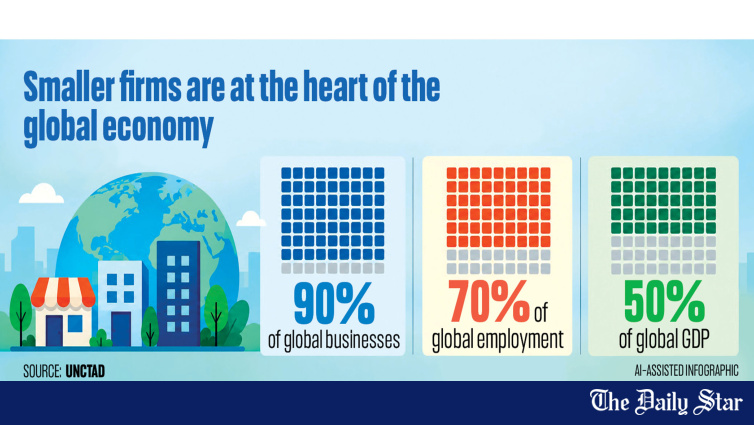
📊> The risks are significant because micro, small and medium enterprises account for:
- 👥 90% of businesses worldwide
- 👥 70% of employment
- 💰 50% of global GDP
📈> Implications for Bangladesh Export Diversification
📊> For Bangladesh’s export diversification strategy, the UNCTAD report has several implications:
- 📊 SME export support needed — reduce import costs for SME exporters
- 💰 Concessional financing — Bangladesh Bank refinance schemes for SMEs
- 📊 Trade facilitation — simplify customs procedures, reduce fees
- 📊 Digital customs — automate import documentation to reduce broker costs
- 📊 Energy cost mitigation — rooftop solar, energy efficiency for SMEs
- 📊 Freight subsidy — consider freight support for SME exporters during crisis
- 📊 LDC graduation preparation — SMEs need support before preference erosion
✅> For Bangladesh’s broader economic strategy, the UNCTAD report underscores the structural disadvantages that SMEs face in developing economies — from import costs and financing access to energy burdens and shipping disruption exposure. Addressing these challenges through targeted policy interventions could unlock significant export potential from Bangladesh’s SME sector, which currently contributes meaningfully to employment but faces barriers to scaling up and competing in international markets.
🌏> For the export community, the UNCTAD findings validate what Bangladeshi SME exporters have long experienced — that the cost of doing cross-border trade is disproportionately higher for smaller firms. As Bangladesh prepares for LDC graduation and the potential loss of trade preferences, reducing the 20% import cost burden on SMEs through trade facilitation reforms, digital customs modernization, and concessional financing will be essential to ensure that smaller exporters can remain competitive in the post-LDC era.
This news was originally published by The Daily Star. For the full original report, please visit: https://www.thedailystar.net/business/global-economy/news/smaller-firms-pay-20-goods-value-import-requirements-4269016
📬 Get Bangladesh Trade News in your inbox
Weekly digest of export industry news, policy updates, and market analysis.
📰 Related Stories