Bangladesh Taka Strengthens, Export Competitiveness Weakens: REER Hits 103.93
The Financial Express, Dhaka — Bangladesh's export competitiveness on the global market has weakened as the taka gets stronger in exchange with peer currencies, prompting exporters to entreat the government to consider currency devaluation — a strategically delicate policy dilemma for Bangladesh Bank at a moment when the broader macroeconomic stabilisation narrative is otherwise positive.
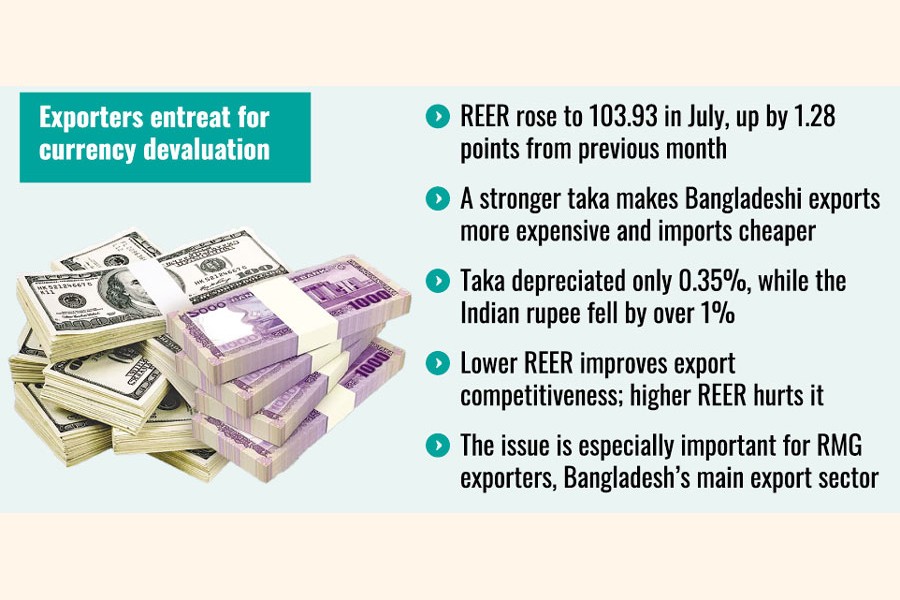
The Real Effective Exchange Rate (REER) rose to 103.93, as of July 2026, up 1.28 points from the previous month by official count — signifying further erosion in the country's export competitiveness. The increase in the REER suggests that the taka has become relatively stronger in real terms against a basket of trading-partner currencies after adjusting for inflation and trade weights.
💰 What the REER Measures
The REER is a measure of a currency's real value against a basket of trading partner currencies, adjusted for inflation differentials and trade weights. Key technical points:
- 📊 17-currency basket: Bangladesh Bank calculates REER against 17 major trading partner currencies
- 📊 Base year: FY2024 with an index value of 100
- 📊 Inputs: Trade patterns (exports and imports) plus remittance inflows
- 📊 July 2026 REER: 103.93 (above 100 indicates taka real strength)
A sustained rise in the index makes Bangladeshi exports relatively more expensive on the international market while making imports cheaper for the importers — a dynamic that works directly against the country's strategic objective of boosting export earnings ahead of LDC graduation in November 2026.
🏛 Bangladesh Bank Officials Acknowledge Concern
"The central bank should consider depreciating the currency as the REER has surged," a senior Bangladesh Bank official told The Financial Express, requesting not to be named. "The export-earning sector might face problems if the taka remains overvalued."
The unusual candour of a senior central bank official flagging the risk of taka overvaluation reflects the depth of concern within Bangladesh Bank about the implications of the REER trajectory for the country's broader export strategy. An REER reading above 100 does not, by itself, mean that the taka must be depreciated by a particular amount. Rather, it indicates that the currency's real exchange-rate position is stronger than its level in the base period.
📊 Nominal vs Real Exchange Rate
At the end of July 2026, the nominal exchange rate stood at Tk 123.98 to the US dollar. The rise in the REER indicates that the taka's real value has strengthened relative to the base period despite the nominal depreciation of the currency, the Bangladesh Bank said in its latest report.
This apparent paradox — nominal depreciation alongside real appreciation — reflects Bangladesh's relatively lower inflation rate compared to several major trading partners. Key dynamics include:
- 📊 Bangladesh inflation: has eased from peak 2024 levels, supporting real taka strength
- 📊 Trading partner inflation: several major partners have had higher inflation, weakening their real exchange rates
- 📊 Trade-weighted basket effect: the 17-currency basket reflects actual Bangladesh trade patterns, not just USD
💰 Direction and Size of Adjustment
The direction and size of any exchange rate adjustment depend on a range of factors:
- 📊 Inflation differentials between Bangladesh and major trading partners
- 📊 Productivity trends in export-oriented sectors
- 📊 Capital flows including FDI, portfolio investment, and external borrowing
- 📊 External-sector conditions including trade balance, remittances, and FX reserves
Bangladesh's position on each of these factors is mixed: inflation has eased but remains above target; productivity growth in RMG has been modest; FDI is improving (per JETRO's August assessment); and FX reserves stood at $32.90 billion (BPM6) at end-FY26 — adequate for 4.5-5 months of import cover but not excessive.
⚠️ Exporter Concerns
The REER appreciation is particularly problematic for Bangladesh's export sector at a moment when it is already under pressure from multiple external shocks:
- 👕 RMG exports to EU: fell 16.4% in H1 2026 (per TBS report)
- 👕 RMG net earnings FY26: only 0.96% growth to $38.97 billion
- 🌾 Handicraft exports: fell 15% in FY26 to $32.13 million
- 🚢 Global shipping: Strait of Hormuz disruptions affecting freight costs
- ⚡ Domestic gas crisis: 660 textile mills facing production disruption
Adding currency appreciation on top of these pressures creates a compounding margin squeeze for Bangladeshi exporters, who are already competing against Vietnam (with EU-Vietnam FTA benefits), India (with weaker rupee), and China (with managed depreciation).
🏛 LDC Graduation Context
The REER concern takes on added significance given the approaching LDC graduation in November 2026. With the EU's Everything But Arms (EBA) preferential tariff regime set to transition post-graduation, Bangladeshi exports will face higher tariffs in the EU market — making export competitiveness even more critical for sustaining market share against Vietnam and other competitors that benefit from preferential EU trade agreements.
If the taka remains overvalued at graduation, the combined effect of tariff loss and currency overvaluation could be particularly damaging to RMG sector margins — with potential cascading effects on employment, export earnings, and the broader current account.
💵 Policy Options for Bangladesh Bank
Bangladesh Bank faces a delicate policy balance. Potential responses to the REER appreciation include:
- 💰 Controlled nominal depreciation of the taka to bring REER closer to 100
- 💰 Interest rate adjustment to influence capital flows and FX demand
- 💰 FX reserve management through targeted intervention
- 💰 Structural competitiveness measures to offset currency strength
However, each option carries trade-offs. Nominal depreciation would increase import costs (particularly for petroleum, fertiliser, and capital machinery imports that are already elevated), potentially reigniting inflation. Interest rate adjustment could conflict with the broader monetary easing that the banking sector needs. And FX intervention would draw down reserves that are already modest by historical standards.
📊 Industry Recommendations
Exporters and industry associations are urging the government and Bangladesh Bank to:
- 💰 Bring REER back below 100 through controlled depreciation
- 💰 Coordinate with EPB on export competitiveness strategy
- 💰 Monitor competitor currency moves (Vietnam dong, Indian rupee, Chinese yuan)
- 💰 Enhance export cash incentives to offset currency strength
The coming months will be critical in determining whether Bangladesh Bank accommodates the exporter pressure for taka depreciation or maintains the current exchange rate stance. The decision will have far-reaching implications for the country's export trajectory through the LDC graduation transition period — and for the broader question of whether Bangladesh can sustain its export competitiveness in the post-graduation environment without the cushion of preferential tariff access.
This news was originally published by The Financial Express. For the full original report, please visit: https://thefinancialexpress.com.bd/bangladesh/taka-gets-stronger-export-competitiveness-weakens
📬 Get Bangladesh Trade News in your inbox
Weekly digest of export industry news, policy updates, and market analysis.
📰 Related Stories