Bangladesh LNG Spot Price Nears $30, Three Times Pre-War Rates
Vitol cargo at $29.795/MMBtu and TotalEnergies at $28.95 approved by Cabinet Committee, while DPM cargoes from Darab and Mind Mingle come at $17-$19 with delivery concerns
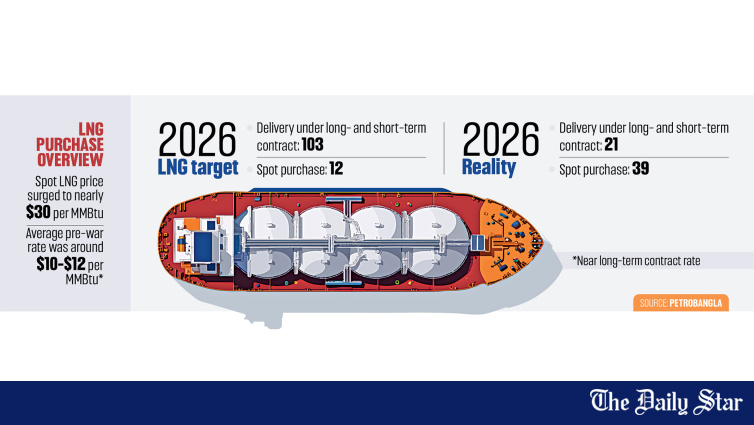
📊 Bangladesh is now paying nearly $30 per million British thermal units (MMBtu) for liquefied natural gas from the spot market, almost three times what it typically paid before the war in the Middle East. The Cabinet Committee on Government Purchase on Sunday night approved one LNG cargo from Singapore-based Vitol Asia at $29.795 per MMBtu and another from UK's TotalEnergies Gas & Power Ltd at $28.95. The latest spot purchases mark a new high in Bangladesh's escalating LNG import cost trajectory, which has more than doubled from the pre-war baseline of $10-$12 per MMBtu.
💰 A standard LNG cargo contains about 3.36 million MMBtu. At an exchange rate of around Tk 123 to the dollar, the TotalEnergies cargo will cost about Tk 1,200 crore and the Vitol cargo about Tk 1,230 crore. The Tk 2,430 crore combined cost for two LNG cargoes illustrates the scale of foreign exchange outflow that Bangladesh must absorb to maintain gas supply — a single month's LNG procurement at current prices can exceed Tk 5,000 crore, putting sustained pressure on the country's foreign exchange reserves.
📜 LNG Price Trajectory Through 2026
The latest purchases mark another increase in Bangladesh's LNG import costs, which had already more than doubled from $10-$12 per MMBtu before the US-Israel's war on Iran. A BP Singapore cargo for September 4-5 was approved at $21.778 per MMBtu, followed by September cargoes from Posco International and TotalEnergies at $24.625 and $24.25 respectively. Emergency purchases later rose to $26.67 per MMBtu from Vitol and $27.54 from Aramco Trading before a BP Singapore cargo crossed $28 earlier this month. The latest Vitol purchase has now pushed the price close to $30.
The price trajectory — $21.78 → $24.25 → $26.67 → $28+ → $29.80 — illustrates the accelerating cost pressure that Bangladesh has faced through August-September 2026. Each successive cargo has been procured at a higher price than the previous one, reflecting both the tightening global LNG market and Bangladesh's reduced bargaining position as a forced buyer with limited alternative supply options.
- 💰 Vitol Asia cargo price: $29.795/MMBtu
- 💰 TotalEnergies cargo price: $28.95/MMBtu
- 💰 Pre-war LNG price: $10-$12/MMBtu
- 💵 Cost per cargo (3.36 million MMBtu): Tk 1,200-1,230 crore
- 💰 DPM cargoes (Darab Inc): $17/MMBtu
- 💰 DPM cargoes (Mind Mingle LLC): $19/MMBtu
- 📊 LNG subsidy impact of Iran war (FY26): Tk 10,600 crore
- 📅 August DPM cargoes approved: 22 (14 + 8 emergency)
- 📊 Late/missing August cargoes: 8+
- 📊 Pre-crisis gas supply: ~2,550 mmcfd
- 📊 Current gas supply: ~2,300 mmcfd (recovering)
🌏 Why Spot Prices Are Surging
The surge in LNG prices comes as Bangladesh tries to make up for supplies disrupted by the Middle East war and the suspension of long-term deliveries from Qatar, the largest LNG supplier to Bangladesh. With less contracted gas available, Petrobangla has had to rely more heavily on the volatile spot market. The reference to suspended Qatar deliveries is strategically significant — Qatar had been Bangladesh's primary long-term LNG supplier under a 10-year SPA (Sale and Purchase Agreement) signed in 2017. If the suspension continues, Bangladesh will need to either negotiate a new long-term supply arrangement or accept continued exposure to spot market volatility.
The inflated LNG bills are adding to the cost of keeping the country's gas network running. The Iran war has already sharply increased the country's LNG subsidy requirement, with Petrobangla estimating that the conflict added Tk 10,600 crore to the burden in the fiscal year 2025-26. The Tk 10,600 crore Iran war subsidy burden represents a meaningful fiscal cost — equivalent to roughly 0.25% of GDP — that must be absorbed either through increased budgetary allocation to energy subsidies or through domestic gas tariff adjustments that would feed into industrial production costs and consumer inflation.
💰 Direct Procurement Method: Lower Prices But Delivery Concerns
Yet price is only part of the problem. Bangladesh has also been struggling to secure cargoes on time. At the same meeting on Sunday, the government approved four more LNG cargoes through the direct procurement method (DPM) at substantially lower prices. Two are from US-based Darab Inc at $17 per MMBtu and two from Mind Mingle LLC at $19. The comparatively cheaper purchases come despite serious delivery problems in the previous round of direct procurement.
In August, the government approved 22 LNG cargoes in two rounds without a tender. Fourteen were approved in the later round, with two cargoes each from seven companies, while another eight were cleared earlier under emergency direct procurement. At least eight of the cargoes scheduled for August did not arrive on time, according to officials involved in LNG imports. The missed deliveries aggravated the gas shortage and forced Petrobangla back to emergency spot tenders just as international LNG prices were rising sharply.
⚠ Excelerate FSRU Shutdown
The disruption became so severe that Excelerate Energy's floating storage unit stopped regasification on August 19 because there was no gas left in storage, even though the terminal was technically ready to resume operations. The next cargo was not expected until August 23. Petrobangla and Rupantarita Prakritik Gas Company Ltd officials said the missing DPM cargoes were a major reason LNG supply could not be restored even after the terminals returned to operation following repairs to a technical glitch.
The Excelerate shutdown — caused not by technical failure but by the absence of LNG in storage — represents a structural failure of the supply chain rather than infrastructure failure. The terminal was technically capable of regasifying LNG, but there was no LNG to regasify. This distinction is important because it identifies the procurement and logistics chain, rather than the FSRU infrastructure, as the binding constraint on Bangladesh's gas supply.
📜 DPM Vs Spot: Price Gap And Reliability Concerns
The government turned to direct procurement on the grounds that it could secure LNG more quickly and at lower prices during the supply emergency. The latest approvals again involve relatively little-known US trading companies. Neither Darab Inc nor Mind Mingle LLC has a publicly documented record of supplying LNG cargoes to Bangladesh or an established international LNG supply track record that The Daily Star could independently verify.
That leaves a striking price difference between the two procurement routes. The latest DPM cargoes cost $17-$19 per MMBtu, compared with $28.95-$29.795 for the latest spot purchases. But Bangladesh's recent experience has shown that a lower quoted price does not necessarily mean gas will arrive when it is needed. The $10-12 per MMBtu price differential between DPM and spot purchases is substantial — but if DPM cargoes fail to arrive, the resulting gap must be filled by expensive spot purchases, often at higher prices than would have been paid if the spot market had been accessed earlier.
📊 Supply Recovery Expected Today
Meanwhile, Petrobangla expects supply to improve from today as September LNG requirements have already been secured. According to the company's supply plan, total gas availability is expected to rise to about 2,550 million cubic feet per day (mmcfd), close to the level seen before July 21, when disruption at an LNG terminal pushed overall supply below 2,100 mmcfd. Supply has recovered to around 2,300 mmcfd from mid-August and is expected to rise by another 200-250 mmcfd, according to officials.
The 2,550 mmcfd target — close to the pre-crisis level — would represent meaningful recovery if achieved. However, the recovery depends on both the arrival of the contracted September cargoes (including the high-priced spot purchases from Vitol and TotalEnergies) and the continued operation of the Excelerate FSRU, which has been subject to recent disruptions. Any slippage in either element would force Petrobangla back to emergency spot procurement at prices that could exceed $30 per MMBtu.
🌏 Strategic Implications For Bangladesh's Energy Security
For Bangladesh's broader energy security strategy, the LNG price surge carries several strategic implications. First, the growing dependence on spot LNG at $25-30 per MMBtu makes Bangladesh's energy import bill structurally vulnerable to global LNG market volatility. The government's recently announced plan to add a third FSRU before 2028 and drill 300 new gas wells in two phases would, if successfully executed, reduce this dependence — but the timeline for meaningful impact extends 18-36 months into the future.
Second, the DPM procurement track record — with eight missing August cargoes — underscores the need for stronger supplier due diligence and contractual penalties for non-delivery. Without these safeguards, the DPM route's apparent cost advantage evaporates when cargoes fail to arrive and emergency spot procurement at premium prices becomes necessary.
Third, the suspension of Qatari LNG deliveries represents a structural break in Bangladesh's long-term supply arrangements that will need to be addressed through either renegotiation with Qatar or the negotiation of alternative long-term SPAs with other suppliers (Australia, US, Mozambique, Tanzania). The coming months will reveal whether Bangladesh can rebuild its long-term LNG supply portfolio — or whether the country will remain structurally exposed to spot market volatility through and beyond LDC graduation in November 2026.
This news was originally published by The Daily Star. For the full original report, please visit: https://www.thedailystar.net/business/economy/news/bangladesh-spot-lng-nears-30-three-times-pre-war-rates-4272961
📬 Get Bangladesh Trade News in your inbox
Weekly digest of export industry news, policy updates, and market analysis.
📰 Related Stories