Bangladesh Islamic Banks Remittance Receipts Fall 27% in June 2026: BB Report
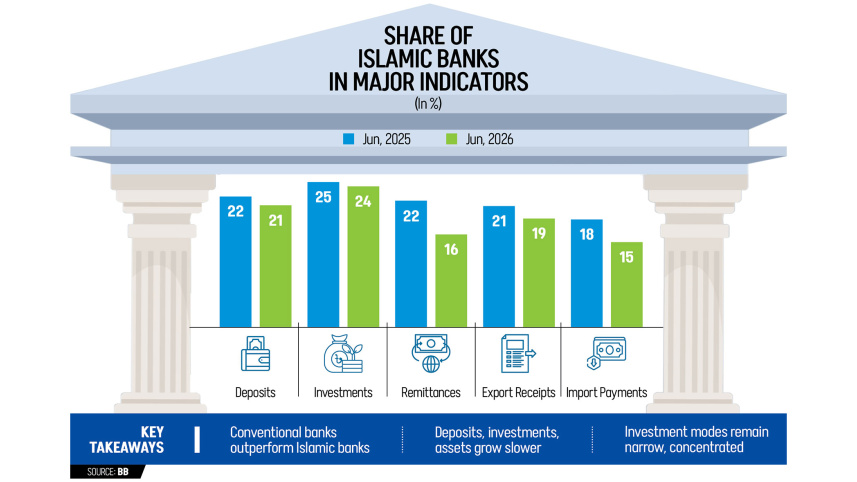
Dhaka, August 20, 2026 — Remittances channelled through Bangladesh's Islamic banks fell 27 percent year-on-year to $448 million in June 2026 — according to a Bangladesh Bank (BB) monthly Islamic Banking and Finance Statistics report released on 20 August 2026. The decline is sharply contrasting with conventional banks' remittance receipts, which rose 7.25 percent year-on-year to $2.37 billion in the same month — reflecting what the central bank described as an "unstable situation in the Islamic banking sector" that requires structural reforms to restore depositor confidence.
📊 The Numbers at a Glance
- 💰 $448 million — Islamic banks' June 2026 remittance receipts
- 📉 -27% year-on-year — Islamic banks' remittance decline
- 📊 16% — Islamic banks' share of total remittances in June 2026 (down from 22% YoY)
- 📊 22% — Islamic banks' share in June 2025
- 📊 19% — Islamic banks' share in May 2026 (previous month)
- 💰 $2.37 billion — conventional banks' June 2026 remittance receipts
- 📈 +7.25% year-on-year — conventional banks' remittance growth
- 📉 -15% month-on-month — conventional banks' remittance decline from May
- 💰 $2.78 billion — conventional banks' May 2026 remittance receipts
- 📊 21% — Islamic banks' share of total banking deposits (June 2026)
📊 The Islamic Banks vs Conventional Banks Divergence
The June 2026 data reveals a sharp divergence between Islamic and conventional banks in remittance handling:
- 🔴 Islamic banks: -27% YoY — remittance receipts declined sharply
- 🟢 Conventional banks: +7.25% YoY — remittance receipts grew modestly
- 🔴 Islamic banks' market share: 22% → 16% in one year — lost 6 percentage points
- 🟢 Conventional banks gained the share — Islamic banks' loss became conventional banks' gain
- 📊 BB verdict — "Islamic banks' inability to retain share of workers' remittances helped conventional banks' remittances grow in contrast"
The shift in remittance share from Islamic to conventional banks is particularly significant because Islamic banks have historically held a disproportionate share of remittance inflows relative to their overall banking market share — reflecting the preference of many Bangladeshi migrant workers (particularly in Saudi Arabia, UAE, Qatar, Kuwait, Oman, and Bahrain) for Shariah-compliant banking. The 6 percentage point share loss suggests that something structural has changed in the relationship between Islamic banks and remittance senders — requiring investigation and policy response.
⚠ "Unstable Situation" in Islamic Banking Sector
The Bangladesh Bank report explicitly characterises the situation as unstable: "However, recent experience of Islamic banks losing market share highlights an unstable situation in the Islamic banking sector." The central bank's use of the term "unstable" in an official regulatory report is unusual — reflecting the severity of the concerns about Islamic banking sector health.
The BB report identifies several factors that may be contributing to the instability:
- 💰 Depositor confidence factors — Islamic banks may need to pursue reforms with regard to factors that influence depositors' confidence
- 🏢 Governance concerns — several Islamic banks have faced governance and NPL challenges in recent years
- 💰 Liquidity stress — some Islamic banks have experienced liquidity pressure, affecting their ability to handle remittance flows
- 💼 Compliance issues — Shariah compliance concerns at some Islamic banks may have eroded depositor trust
- 💰 Branch and digital banking reach — Islamic banks may have lagged in digital banking infrastructure compared to conventional peers
- 🤝 Correspondent banking relationships — with foreign exchange houses in Gulf countries
- 📜 Regulatory enforcement — BB's recent actions on weak banks may have specifically affected Islamic banks
📅 The June 2026 Specific Context
The BB report identifies two specific factors that may have affected the June 2026 remittance patterns:
- 🎊 Eid-ul-Azha front-loading in May 2026 — the exceptionally high remittance inflow recorded in May 2026 ahead of Eid-ul-Azha may have pulled forward remittances that would otherwise have arrived in June
- 🌐 Geopolitical uncertainties in the Middle East — including the Iran crisis (US-Israel war on Iran, Hormuz disruption, UAE-Iran commercial rupture) may have affected remittance inflow patterns
The Eid-ul-Azha front-loading explanation is consistent with the month-on-month declines observed in both Islamic and conventional banks in June — with Islamic banks falling 27 percent YoY and conventional banks falling 15 percent month-on-month. However, the differential decline (Islamic banks falling faster than conventional banks) cannot be explained solely by Eid timing — suggesting that the structural issues specific to Islamic banks are also at play.
🌐 The Geopolitical Dimension: Middle East Crisis Impact
The BB report's reference to "geopolitical uncertainties in the Middle East, including the Iran crisis" is particularly relevant for Bangladesh's Islamic banking sector because:
- 🇸🇦 Saudi Arabia — largest source of Bangladeshi remittances; many Bangladeshi workers in Saudi use Islamic banking channels
- 🇦🇪 UAE — major remittance source; UAE-Iran commercial rupture creates regional uncertainty
- 🇶🇦 Qatar — important remittance source; Qatar PM just met Bangladesh FM for energy security engagement
- 🇰🇼 Kuwait — important source; Gulf regional tensions affecting migrant worker dynamics
- 🇴🇲 Oman — important source; Hormuz shipping disruption affects economic activity
- 🇧🇭 Bahrain — smaller but significant source
For Bangladeshi Islamic banks, the Middle East connection is particularly important because many migrant workers in Gulf countries prefer to send remittances through Shariah-compliant banking channels. If geopolitical uncertainties are causing some migrant workers to delay remittances or route them through conventional channels (which may have stronger correspondent banking relationships with foreign exchange houses), this would explain part of the Islamic banks' share loss.
💰 Deposit and Investment Growth
Despite the remittance decline, the BB report noted some positive trends in Islamic banking deposits:
- 💰 Islamic banks recorded increased deposits — in June compared with same month a year earlier
- 📊 Deposit growth much higher at conventional banks — in comparison
- 📊 21% share of total banking deposits — Islamic banks' deposit market share in June 2026
- 📊 Investment (lending) growth — trends also tracked by BB
The fact that Islamic banks' deposit share (21%) is higher than their remittance share (16%) suggests that Islamic banks are retaining existing depositors but losing the new remittance-driven deposit inflows that have historically been a key source of growth for the sector. This pattern is consistent with concerns about depositor confidence affecting new customer acquisition rather than driving existing customers to withdraw — a less acute but still concerning dynamic.
🏢 Bangladesh's Islamic Banking Sector Context
Bangladesh has a significant Islamic banking sector, with several full-fledged Islamic banks and Islamic banking windows operated by conventional banks:
- 🏢 Islami Bank Bangladesh PLC (IBBL) — largest Islamic bank in Bangladesh; historically dominant in remittance handling
- 🏢 Al-Arafah Islami Bank — major Islamic bank
- 🏢 Social Islami Bank — major Islamic bank (recently under BB supervision)
- 🏢 Shahjalal Islami Bank — major Islamic bank
- 🏢 Union Bank — Islamic bank (recently faced governance challenges)
- 🏢 First Security Islami Bank — Islamic bank
- 🏢 Global Islami Bank — Islamic bank
- 🏢 Exim Bank — operates Islamic banking windows
- 🏢 Several conventional banks — with Islamic banking windows
The Islamic banking sector collectively accounts for roughly 20-25 percent of Bangladesh's total banking system — a significant share that makes the sector's stability a matter of systemic importance. The 27 percent YoY remittance decline at Islamic banks therefore has implications beyond the sector itself, potentially affecting overall banking system liquidity, FX reserve dynamics, and monetary policy transmission.
🤝 BB's Reform Recommendation
The BB report recommends that Islamic banks "may need to pursue reforms with regard to the factors that influence depositors' confidence in Islamic banks" — a clear signal that the central bank expects the sector to address structural weaknesses. The reform areas implied include:
- 🏢 Governance reform — strengthening board oversight, fit-and-proper criteria for directors and senior management
- 💰 Asset quality — addressing NPL build-up through stricter credit risk management
- 💰 Liquidity management — ensuring adequate liquidity to handle remittance flows and depositor withdrawals
- 💼 Shariah compliance — strengthening Shariah supervisory boards and compliance frameworks
- 💻 Digital banking investment — upgrading IT infrastructure, mobile banking, and digital remittance channels
- 🤝 Correspondent banking relationships — strengthening ties with foreign exchange houses in Gulf countries
- 💰 Customer service — improving remittance handling speed, fees, and customer experience
- 💼 Brand and trust rebuilding — addressing reputational damage from recent governance issues
🌐 Strategic Significance for Bangladesh's Remittance and Banking Sectors
The Islamic banks' remittance decline carries strategic significance for Bangladesh's broader remittance and banking sectors:
- 💰 Remittance is critical FX source — Bangladesh's $25+ billion annual remittance inflows are critical for foreign exchange reserves
- 💰 Islamic banking sector stability — 20-25% of total banking sector; systemic importance
- 💰 Banking sector reform agenda — GED 5-year strategic framework must address Islamic banking specific challenges
- 💰 Depositor confidence — Islamic banks' deposit base (21% of system) must be protected
- 💰 Migrant worker welfare — remittance channels are critical for millions of Bangladeshis abroad
- 💰 FX reserve dynamics — $448M Islamic banks' June remittances + $2.37B conventional banks' = $2.82B total June remittance (vs $4.74B first 48 days of FY27 reported separately)
- 🤝 Geopolitical resilience — Middle East crisis testing Bangladesh's remittance infrastructure resilience
For Bangladesh Bank Governor Md. Mostaqur Rahman and Finance Minister Amir Khosru Mahmud Chowdhury, the Islamic banks' remittance decline adds another dimension to the broader banking sector reform agenda. The GED's five-year strategic framework for banking sector reform (July 2026-June 2031) — with its three phases of contain, rebuild, and deepen — must specifically address the Islamic banking sector's structural challenges, including governance reform at weaker Islamic banks, depositor confidence rebuilding, and Shariah compliance strengthening. The 27 percent YoY June 2026 remittance decline is a clear signal that without targeted reform, the Islamic banking sector risks continued erosion of its market position — with implications for the millions of Bangladeshi depositors and migrant workers who depend on Shariah-compliant banking services. The next 12–18 months will reveal whether the Islamic banking sector can respond to the BB's reform recommendations — or whether the structural decline continues, with potential systemic implications for the broader banking system and the country's remittance-driven foreign exchange position.
This news was originally published by The Daily Star. For the full original report, please visit: https://www.thedailystar.net/business/economy/news/islamic-banks-remittance-receipts-fall-27-june-4251911
Related on BangladeshExport
📬 Get Bangladesh Trade News in your inbox
Weekly digest of export industry news, policy updates, and market analysis.
📰 Related Stories