Bangladesh Handicraft Exports Fall 15% in FY26 Amid Weak Global Demand
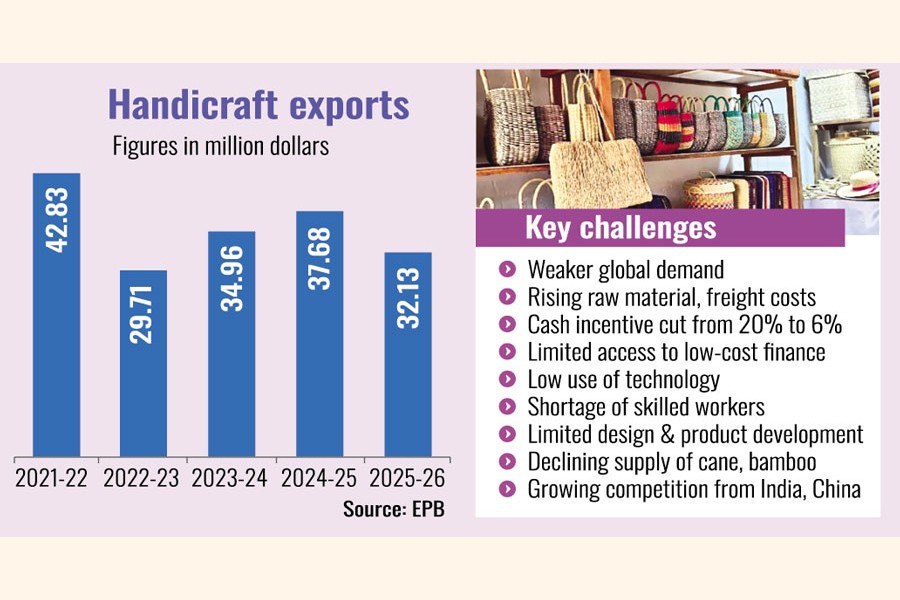
The Financial Express, Dhaka — Bangladesh's handicraft exports suffered a sharp contraction in fiscal year 2025-26, with earnings falling 15 percent to $32.13 million from $37.68 million in FY25, according to Export Promotion Bureau (EPB) data — a decline that exposes the structural vulnerabilities of one of the country's most culturally important but commercially fragile export segments.
The decline was caused by a combination of factors, according to industry insiders:
- 📉 Weaker global demand for handicraft and home decor products
- 📉 Rising input and freight costs squeezing exporter margins
- 📉 Reduced cash incentives from the government
- 📉 Limited access to finance for handicraft entrepreneurs
- 📉 Limitations in design and development capability
- 📉 Stronger regional competition, particularly from India and China
- 📉 Growing scarcity of skilled workers in traditional crafts
📊 Multi-Year Volatility Pattern
Bangladesh's handicraft exports have shown a volatile trend over the past five fiscal years:
- 📈 FY22: $42.83 million
- 📉 FY23: $29.71 million (sharp decline)
- 📈 FY24: $34.96 million (recovery)
- 📈 FY25: $37.68 million (continued recovery)
- 📉 FY26: $32.13 million (renewed decline)
The fluctuations reflect changes in the global demand for eco-friendly products, inconsistent policy support from the Bangladesh government, and the sector's failure to modernise designs and production methods — particularly by shifting from labour-intensive weaving to a greater use of machinery to compete with low-cost producers such as India and China.
👥 Exporter Concerns
Exporters say the combined pressures are affecting the viability of their business. "The reduction in cash incentives, along with rising raw material costs and the lack of low-cost credit, has pushed many small producers to the brink of closure," a Dhaka-based handicraft manufacturer told The Financial Express.
Without targeted policy support and cluster-based financing, it is becoming increasingly difficult to compete with mechanised producers in neighbouring countries, the manufacturer added — a reflection of the broader structural challenge facing labour-intensive export categories that compete against highly mechanised Chinese and Indian supply chains.
🏛 Banglacraft Identifies Structural Weaknesses
The Bangladesh Handicrafts Manufacturers and Exporters Association (Banglacraft) points to several major structural weaknesses holding back the sector:
- 💻 Shortage of technology use in production processes
- 👥 Lack of digitally active and well-connected entrepreneurs
- 🌐 Limited direct communication with overseas buyers
- 🌏 Restricted international marketing capacity
The absence of digitally integrated entrepreneurs is particularly significant: with global handicraft buyers increasingly sourcing through online B2B platforms such as Alibaba, Etsy Wholesale, and Amazon Handmade, the lack of digitally active Bangladeshi handicraft exporters creates a structural barrier to participation in the fastest-growing segment of the global handicraft market.
📊 Strategic Context: Export Diversification Imperative
The handicraft export decline comes at a strategically difficult moment for Bangladesh's broader export diversification agenda. With the country approaching LDC graduation in November 2026 and the EU's Everything But Arms (EBA) preferential tariff regime set to transition, Bangladesh needs to broaden its export product base beyond readymade garments — which currently account for over 84 percent of merchandise exports.
Handicrafts represent a strategically important export category for several reasons:
- 🌾 Labour-intensive — high job creation per dollar of export revenue
- 👩 Female employment — majority of handicraft workers are women in rural areas
- 🌏 Cultural branding — supports broader Bangladesh brand development
- 💰 Low capital intensity — accessible to small entrepreneurs
- 🌐 Eco-friendly positioning — aligns with global sustainable sourcing trends
Despite these structural advantages, the sector's contribution to total export earnings remains marginal — with $32.13 million in FY26 representing less than 0.07 percent of Bangladesh's total $48.38 billion merchandise export earnings.
🏛 Comparison with Regional Competitors
Bangladesh's handicraft export performance lags significantly behind regional competitors:
- 🇮🇳 India: Handicraft exports exceed $4 billion annually, supported by government EPCH (Export Promotion Council for Handicrafts) infrastructure
- 🇻🇳 Vietnam: Handicraft exports exceed $1 billion annually, integrated into broader home decor export strategy
- 🇧🇩 Bangladesh: $32.13 million in FY26 — less than 1% of India's handicraft export volume
The gap reflects both the structural disadvantages of the Bangladeshi handicraft sector (limited mechanisation, fragmented supply chain, weak marketing) and the absence of coordinated government support comparable to India's EPCH or Vietnam's integrated export promotion framework.
💰 Policy Reform Recommendations
Industry stakeholders have proposed several policy reform priorities to revive the handicraft export sector:
- 💰 Restore cash incentives to previous levels for handicraft exporters
- 💰 Cluster-based financing for major handicraft production hubs (e.g., Comilla, Tangail, Sonargaon)
- 💰 Low-cost credit lines through Bangladesh Bank refinance windows
- 💻 Digital entrepreneur development programme to build online marketing capacity
- 🏛 Design modernisation support through collaboration with international design institutes
- 🏛 Worker skill development to address the growing scarcity of traditional craft workers
The recommended cluster-based financing approach is particularly aligned with the government's broader SME promotion strategy, but has not yet been operationalised at scale for the handicraft sector — a gap that the Ministry of Commerce and the EPB will need to address if the sector is to recover from its FY26 contraction.
🌏 Implications for Bangladesh Export Strategy
The handicraft sector's decline underscores the broader challenge Bangladesh faces in diversifying its export base ahead of LDC graduation. While the country has successfully built scale in RMG, pharmaceuticals, leather, and jute, smaller export categories such as handicrafts continue to struggle with the structural disadvantages of fragmented production, limited digital integration, and inconsistent policy support.
Without a coordinated strategic intervention, the FY26 decline risks becoming structural — with Bangladesh's handicraft exporters permanently losing market share to Indian, Chinese, and Vietnamese competitors. The EPB's next fiscal year strategy will need to address both the immediate cost pressures on exporters and the longer-term structural modernisation needed to make the sector globally competitive in the post-LDC graduation environment.
This news was originally published by The Financial Express. For the full original report, please visit: https://thefinancialexpress.com.bd/trade/fy26-handicraft-exports-fall-15pc-amid-weak-demand
Related on BangladeshExport
📬 Get Bangladesh Trade News in your inbox
Weekly digest of export industry news, policy updates, and market analysis.
📰 Related Stories