Bangladesh Gas Supply Set to Recover as Petrobangla Books 8 September LNG Cargoes
The Financial Express, Dhaka — Overall gas supply across Bangladesh is expected to increase substantially in September 2026 amid the re-gasification of increased volumes of imported liquefied natural gas (LNG), with both the country's floating storage and regasification units (FSRUs) returning to full-steam operation — providing desperately needed relief for an industrial sector that has been crippled by gas shortages since late July.
"At least eight LNG cargoes will be imported in September, mostly from spot LNG suppliers and short-term contracted companies," a senior official of state-run Petrobangla told The Financial Express on Saturday — confirming the September supply recovery following weeks of disruption caused by the Excelerate Energy FSRU fire and subsequent operational suspensions.
📊 September Supply Forecast
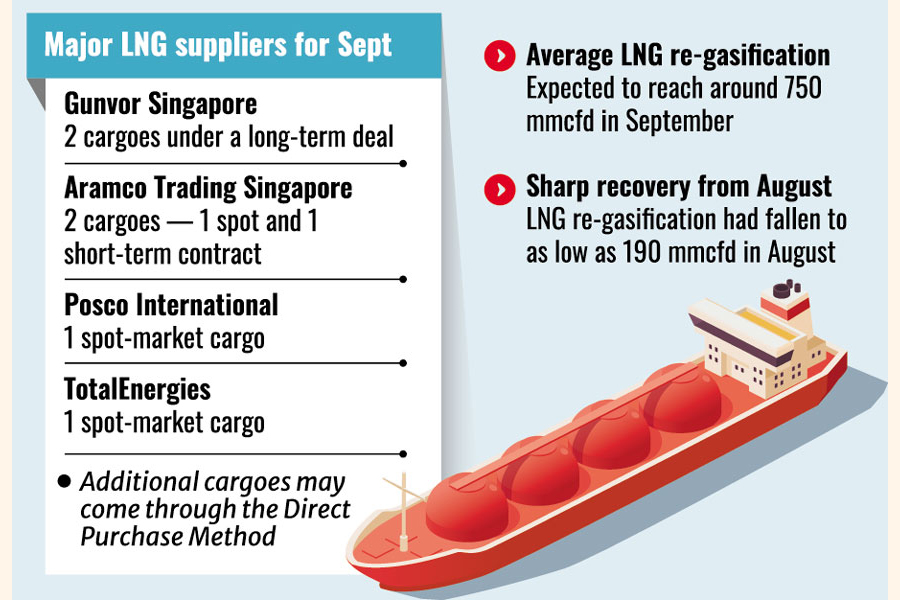
Average LNG re-gasification in the country's two operational FSRUs is expected to be around 750 million cubic feet per day (mmcfd), with the daily re-gasification ranging from 700 mmcfd to 800 mmcfd — a sharp recovery from the August lows that left textile mills, power plants, and industrial units operating at fraction of capacity.
The eight LNG cargoes confirmed for September delivery are sourced from a diversified mix of suppliers and contract structures:
- 🏛 Gunvor Singapore Pte Ltd: two cargoes under long-term deal with Petrobangla
- 🏛 Aramco Trading Singapore Pte Ltd: two cargoes — one spot, one short-term supply deal
- 🏛 Posco International Corporation: LNG cargo from spot market
- 🏛 TotalEnergies Gas & Power Ltd: LNG cargo from spot market
- 🏛 Additional cargoes from direct-purchase method (DPM) contracted firms
If the contracted firms under the direct-purchase method (DPM) supply LNG in line with their commitments, overall LNG re-gasification will increase further beyond the 750 mmcfd base forecast, the Petrobangla official said.
📉 August Disruption: How Bad It Got
The September recovery is particularly significant given how severely constrained Bangladesh's gas supply was during August 2026. The Petrobangla official noted that overall LNG re-gasification would be much higher in September compared to August when the LNG re-gasification fell as low as around 190 mmcfd — a fraction of normal operational levels.
The August supply collapse was caused by a combination of factors:
- 🔥 Excelerate Energy FSRU fire accident: An abrupt accident in the US Excelerate Energy FSRU on the Bay of Bengal left the floating LNG terminal idle for at least 15 days from late July to mid-August
- 🚢 Stranded cargoes: At least two spot LNG cargoes could not be delivered to the accident-ridden FSRU and had to remain stranded in the Bay of Bengal for a couple of weeks
- 🌊 Rough seas: Adverse sea conditions affected FSRU operations and cargo delivery schedules
- 📦 Faulty LNG cargo: An influx of a faulty LNG cargo further constrained overall LNG re-gasification during August
- 💰 Stranded supplier cargoes: Gunvor Singapore and TotalEnergies Gas & Power cargoes were affected by the FSRU shutdown
👥 Industrial Impact: From Crisis to Recovery
The August gas supply crisis had a cascading impact across Bangladesh's industrial sector:
- 👕 660 textile mills suffered from severe gas shortage since third week of July
- 👕 244 textile mills have remained closed since 2019 (cumulative stress)
- 🏗 62 power plants faced generation disruption in late August
- 💰 Mosharraf Composite Textile: production fell to 30% capacity, losing Tk 50 million in one month
- 💰 MS Dyeing Printing: shut completely since 18 August, losing Tk 1.10 crore daily revenue
- 🏗 Bhuiyan Textile: closed 22 consecutive days in Narsingdi
The September recovery to 750 mmcfd will not fully eliminate these industrial pressures, but it should allow many of the affected factories to resume meaningful production — particularly in the critical textile and apparel supply chain that has been the hardest hit.
🏛 FSRU Operations: Both Terminals at Full Steam
Bangladesh's LNG import infrastructure consists of two operational FSRUs in the Bay of Bengal, located off Moheshkhali:
- 🚢 Excelerate Energy FSRU: resumed partial operations on 15 August, then suspended again due to cargo-related problem, before resuming full operations on 22 August after remaining shut for three days
- 🚢 Summit LNG FSRU: became fully operational on 15 August after its own earlier disruptions
With both FSRUs now back in operation, the September supply recovery can proceed as planned — assuming no further technical disruptions. The previous pattern of intermittent FSRU suspensions has been the primary cause of the gas supply volatility that has plagued Bangladesh's industrial sector since mid-2026.
💰 LNG Procurement Strategy: Diversified Sources
The September cargo mix reflects a deliberate diversification of LNG supply sources:
- 💰 Long-term contracts: Gunvor Singapore under existing Petrobangla framework
- 💰 Short-term contracts: Aramco Trading Singapore supply deal
- 💰 Spot market purchases: Posco International and TotalEnergies Gas & Power cargoes
- 💰 Direct Purchase Method (DPM): additional cargoes from contracted firms
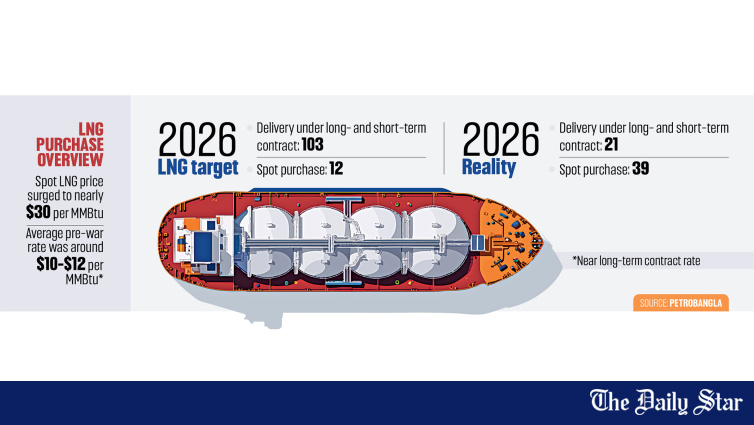
This diversified sourcing strategy is strategically important given the volatility of the global LNG market. The Iran war-driven disruption of Middle East LNG supplies, combined with seasonal demand spikes in Asia and Europe, has created an unpredictable pricing environment. By maintaining relationships with multiple suppliers across long-term, short-term, and spot market structures, Petrobangla can adapt to supply disruptions and price spikes more effectively than if it relied on a single contract structure.
🌏 Strategic Context: Energy Security
The September LNG recovery comes against the backdrop of broader strategic developments in Bangladesh's energy sector:
- 📊 FY26 petroleum import bill: $10.63 billion (up 107% YoY) — unsustainable trajectory
- 📊 September LNG cargoes: more than double pre-war rates due to spot market pricing
- 📊 Rampal coal unit scrapped: replaced by 442 MW solar plant (separate decision)
- 📊 US nuclear cooperation: Bangladesh seeking SMR technology partnership
- 📊 Government diverting development budget for clean power generation
The combination of these moves signals a comprehensive rethink of Bangladesh's energy strategy — with LNG remaining a critical bridging fuel in the short-to-medium term while the country accelerates longer-term investments in solar and nuclear capacity to reduce dependence on imported fossil fuels.
🏛 Petrobangla's Coordination Role
Petrobangla, as the state-run oil and gas corporation, plays the central coordination role in Bangladesh's LNG import and distribution system:
- 📜 LNG cargo procurement: long-term, short-term, spot, and DPM sourcing
- 📜 FSRU operation oversight: coordination with Excelerate Energy and Summit
- 📜 Gas distribution: through national gas transmission network
- 📜 Domestic gas exploration: ongoing efforts to develop domestic gas fields
The September cargo schedule reflects Petrobangla's recovery effort following the August disruption — and its ability to mobilise eight cargoes across multiple suppliers within weeks of the FSRU normalisation is itself a positive signal about the state utility's procurement capability.
🌏 Implications for Bangladesh Industry
For Bangladesh's industrial sector, the September gas supply recovery cannot come soon enough. Key implications:
- ✅ Textile mills: 660 affected mills can resume production at higher capacity utilisation
- ✅ RMG factories: backward linkage supply chain can stabilise for apparel exporters
- ✅ Power plants: 62 affected plants can resume fuller generation
- ✅ Fertiliser production: domestic fertiliser plants can supplement imported supply
- ✅ Steel, paper, ceramic industries: gas-dependent sectors can resume production
The September recovery also comes at a strategically important moment for Bangladesh's broader economic stabilisation narrative. With the central bank reporting Q4 FY26 RMG net earnings rebound of 10.38% QoQ, and the broader macroeconomic indicators showing signs of stabilisation, the restoration of normal gas supply will be a critical enabler of sustained industrial recovery through the LDC graduation transition beginning November 2026.
⚠️ Remaining Risks
Despite the positive September outlook, several risks remain:
- ⚠️ FSRU reliability: Both terminals have experienced multiple suspensions in recent months; further disruptions possible
- ⚠️ Spot LNG price volatility: Iran war and seasonal demand could push prices higher
- ⚠️ Cargo delivery reliability: Rough seas and supplier performance remain unpredictable
- ⚠️ FX reserves pressure: $10.63 billion FY26 petroleum bill has strained reserves
The September recovery should therefore be seen as a critical but fragile stabilisation — one that requires continued operational reliability from both FSRUs, sustained LNG cargo delivery performance, and stable international pricing conditions. Without these, Bangladesh's industrial sector remains exposed to further supply shocks through the LDC graduation transition period.
This news was originally published by The Financial Express. For the full original report, please visit: https://thefinancialexpress.com.bd/economy/gas-supply-getting-a-boost-with-lng-resurgence
📬 Get Bangladesh Trade News in your inbox
Weekly digest of export industry news, policy updates, and market analysis.
📰 Related Stories