Bangladesh ADP Spending Hits 17-Year Low in Q1 at Just 3.89 Percent
IMED data shows Tk 12,017 crore spent in July-September as economists warn of weakening growth signals
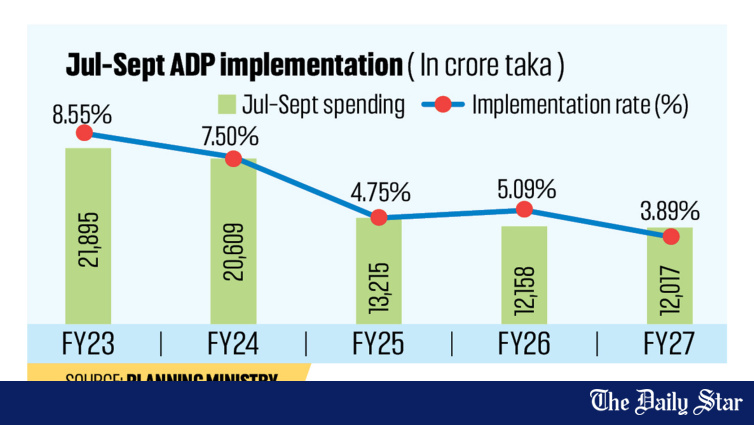
📉 The government's development spending in the first quarter of fiscal year 2026-27 fell to its lowest level in at least 17 years, raising concerns about its ability to implement budget plans and support economic growth. Ministries and divisions spent just Tk 12,017 crore — a mere 3.89 percent of the Annual Development Programme (ADP) allocation — between July and September, according to data from the Implementation Monitoring and Evaluation Division (IMED) released on Saturday.
🗓 The deterioration is measured in the trend, not just the level. The implementation rate was 5.09 percent in the same period of FY26, 4.75 percent in FY25 and 7.5 percent in FY24 — meaning ADP implementation this year was even slower than in either of the previous two fiscal years, when widespread administrative disruption following the 2024 mass uprising hampered development spending. A new government, in other words, has begun its tenure with a slower implementation record than the crisis years that preceded it.
🏥 Spending was particularly low in the health sector, despite growing concerns about access to healthcare: the Medical Education and Family Welfare Division spent just 1.86 percent of its allocation, while the Health Services Division used only 1.78 percent — divisions whose projects underpin hospitals, equipment and family services across the country.
🧪 Economists: the demand shock is the real story
💸 Md Deen Islam, a professor of economics at the University of Dhaka, said the slow pace of ADP implementation was worrying because public investment plays a key role in driving domestic demand. If public spending falls short of planned levels, domestic demand will weaken, and economic growth will slow, he said, noting that industries such as construction, cement and logistics depend directly on public investment and could suffer if government spending remains low. Weak implementation could also discourage private investment by undermining confidence in the government's ability to carry out its plans: if the private sector sees that the government cannot implement its plans, it sends the wrong signal, and investors may become more cautious and uncertain, he cautioned.
⏱ The cost mechanics compound over time. Many projects may initially have a positive net benefit — benefits exceeding costs — but delays and rising costs can erode those benefits, Deen said, and delays in power and transport projects in particular could raise business costs and reduce private-sector productivity. If these projects are delayed or not completed properly and on time, the cost of doing business will rise, productivity will fall, and that could affect private-sector jobs, he warned — adding that the new government needed to reverse the downward trend early in its tenure, because if it fails to do so, these risks could materialise.
💡 Ashikur Rahman, principal economist at the Policy Research Institute of Bangladesh (PRI), said the slow pace reflected persistent weaknesses in government agencies' ability to carry out projects: the expected improvement in implementation capacity has not materialised, suggesting that agencies continue to struggle to deliver on their budget commitments. The fact that the implementation rate had fallen below the level recorded under the interim government was particularly concerning, he noted. Budget allocations can deliver their intended economic benefits only when the money is spent on time and projects are completed effectively — and improving ADP implementation should be a priority as the economy needs fresh momentum. We cannot allow government agencies to remain stuck in an inefficient working mode when the economy urgently needs renewed momentum, he said.
🚧 The structural culprits behind slow disbursement
🔧 Implementation at this scale rarely fails for a single reason. The chronic blockers are well documented across IMED's own project reviews: land acquisition disputes that stall works before they begin, procurement challenges and tender irregularities that force re-tendering, delayed foreign financing approvals on donor-funded components, project director vacancies, and design changes requested mid-stream. New governments add a transitional layer — fresh ministries reviewing inherited projects, re-scoped priorities, and appointment cycles that leave agencies leaderless for months. The Q1 numbers are the arithmetic of those frictions landing on top of each other.
🛢 The fiscal arithmetic cuts both ways. Underspent development money eases the deficit in the short term — a meagre comfort for a treasury navigating tight revenues — but every quarter of unspent ADP is deferred growth: roads not built delay logistics savings, power lines not strung defer industrial capacity, and health facilities not upgraded push costs onto households. Bangladesh's development model has always been infrastructure-led; when the implementation pipeline clogs, the entire growth narrative inherits the blockage.
🔭 The watch-point now is the second quarter, when project seasons typically accelerate and implementation rates partially recover. The credible benchmark is not perfection but momentum: whether Q2 lifts disbursement toward historical averages, whether the health divisions' near-zero rates are corrected, and whether the new government attaches visible accountability — project-level reviews, named deadlines, consequence for inaction — to its budget execution. Economists have drawn the line clearly; the next IMED release will show whether the warning was heard.
This news was originally published by The Daily Star. For the full original report, please visit: https://www.thedailystar.net/business/economy/news/adp-spending-hits-17-year-low-q1-4307306
📬 Get Bangladesh Trade News in your inbox
Weekly digest of export industry news, policy updates, and market analysis.
📰 Related Stories