Patuakhali's Seaweed Potential Could Unlock Coastal Blue Economy
Year-long Sustainable Coastal and Marine Fisheries Project study confirms commercial viability of seaweed cultivation at Kuakata beach, with potential for food, cosmetics and climate adaptation value chains
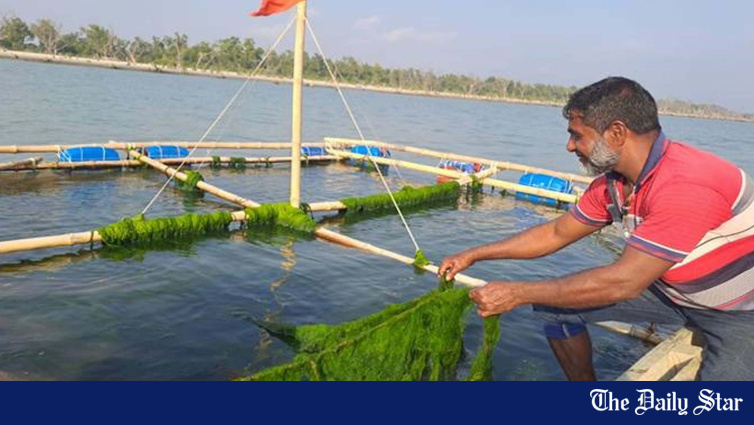
🌏 Seaweeds scattered across the sandy shore and shallow waters of Kuakata beach in Patuakhali are emerging as a potential source of alternative income for coastal communities. Researchers say expanding seaweed cultivation in Kuakata and nearby coastal areas could create employment, improve livelihoods and help mitigate climate change impacts — positioning Bangladesh's coastal belt as a credible contributor to the country's emerging blue economy agenda.
🌿 The Sustainable Coastal and Marine Fisheries Project, supervised by the Department of Fisheries, conducted a year-long study to assess the potential of seaweed cultivation. The research focused on training coastal communities, analysing the nutritional value of harvested seaweed, developing value-added products and assessing its climate change mitigation potential. The multi-dimensional research scope reflects the breadth of opportunity that seaweed cultivation offers — from direct economic returns for fishing communities to industrial applications in food, cosmetics, pharmaceuticals and biofertilizers.
📜 Historical Discovery: From 2015 To 2026
Earlier, in December 2015, Mohammad Ashraful, senior scientific officer of the Patuakhali Khepuara River Sub-station of the Bangladesh Fisheries Research Institute, explored Kuakata beach and surrounding areas, including Gangamati canal, Hajipur ferry terminal, and the Baliatali and Charipara areas along the Andharmanik river, and found large quantities of commercially viable seaweed. Ashraful had said the seaweed grew underwater in tidal zones near the beach. Samples collected and preserved were primarily identified as varieties belonging to the Hypnea genus.
The decade-long gap between Ashraful's initial discovery in 2015 and the recent Sustainable Coastal and Marine Fisheries Project's structured assessment underscores the slow pace at which Bangladesh has converted scientific discovery into commercial opportunity. Other Asian countries — including Indonesia, the Philippines and Vietnam — have built substantial seaweed industries over the same period, with combined annual production now exceeding 10 million tonnes and generating billions of dollars in export earnings.
🧵 Ulva Lactuca: The Promising Species
The recent research examined naturally occurring seaweed and the feasibility of organised cultivation using raft and long-line methods through local groups and training. The study identified Ulva lactuca, commonly known as sea lettuce, as a promising species that can be cultivated at low cost in relatively low-salinity and turbid water. Under favourable conditions, it can be harvested up to twice a month — a yield frequency that makes it commercially attractive for small-scale coastal farmers seeking regular income.
The selection of Ulva lactuca as the priority species reflects sound commercial logic. The species' tolerance for low-salinity and turbid water conditions means it can be cultivated in the brackish estuarine environments that characterise much of Bangladesh's coastal zone — rather than requiring the pristine clear-water conditions needed by more sensitive species. The twice-monthly harvest cycle generates cash flow at a frequency that aligns with household expenditure patterns, rather than the long cultivation cycles typical of traditional coastal aquaculture.
- 🌏 Location: Kuakata beach, Patuakhali
- 🧵 Priority species: Ulva lactuca (sea lettuce)
- 📜 Other species found: Hypnea genus varieties
- 📅 Initial discovery: December 2015 (Mohammad Ashraful, BFRI)
- ⏳ Year-long research: Sustainable Coastal and Marine Fisheries Project
- 📊 Harvest frequency: Up to twice per month
- 👥 Implementing agency: Department of Fisheries
- 🌏 Cultivation methods tested: Raft and long-line
🍗 Value-Added Products: From Nori To Body Scrubs
Prof Dr Md Ariful Alam of Patuakhali Science and Technology University (PSTU) said Patuakhali's coastal location offered considerable potential for seaweed cultivation. "Considering its availability and relatively low production costs, initiatives have been taken to promote its cultivation. At the same time, given its nutritional value, efforts are underway to develop various products from seaweed as an alternative food source," he said.
Researchers experimented with harvested seaweed to produce nori sheets, biscuits, jelly, chips, sausages, ice cream, jilapi, rasgulla, soap and herbal body scrubs. The breadth of products developed — spanning food, snacks, traditional Bangladeshi sweets, personal care and cosmetics — reflects the versatility of seaweed as a raw material and the multi-market opportunity it represents. Nori sheets, in particular, carry significant export potential given the global demand from Japanese, Korean and Chinese cuisine markets.
The combination of food and personal care applications is strategically significant. Food products target domestic and regional Asian markets, where seaweed consumption is culturally established. Personal care products — soap, body scrubs — target both domestic premium segments and international cosmetics markets, where seaweed-derived ingredients command premium prices due to their natural positioning and mineral-rich composition.
🏛 Safety And Quality Testing Framework
Researchers stressed the need to ensure seaweed safety for consumption. The study included microbiological tests, heavy metal analysis and lipid oxidation tests alongside nutritional analysis. The comprehensive testing protocol is critical — coastal seawater can carry heavy metal contamination from industrial discharge, agricultural runoff and shipping emissions, and any seaweed cultivated in such environments must be verified safe before commercial release.
Dr Montaria Jannat, medical officer at Dumki Lutheran Health Care, said seaweed could contain vitamins and minerals, but proper processing and nutritional guidelines were essential before consumption. The involvement of medical professionals in the research framework reflects appropriate caution about scaling consumption of a new food source without proper safety validation. For export markets — particularly EU, US and Japan — the testing protocols developed through this study will form the basis for compliance with international food safety standards including HACCP, ISO 22000 and country-specific import regulations.
🌏 Climate Change Mitigation Potential
The research also assessed the climate change mitigation potential of seaweed cultivation — a dimension that elevates the opportunity from a purely commercial proposition to a strategically significant climate adaptation intervention. Seaweed absorbs carbon dioxide during photosynthesis, with some species capable of sequestering carbon at rates significantly higher than terrestrial forests per unit area. Cultivated seaweed can therefore serve as a nature-based carbon sink, generating potential carbon credit revenue in addition to direct product sales.
For Bangladesh, which is among the world's most climate-vulnerable countries, nature-based carbon sequestration offers a meaningful complement to the country's broader climate adaptation strategy. Coastal seaweed cultivation also provides co-benefits including coastal protection (seaweed beds buffer wave energy), marine biodiversity habitat creation, and water quality improvement through nutrient absorption. These ecosystem services, while not directly monetised, contribute to the long-term resilience of coastal communities facing rising sea levels and increasing storm intensity.
💰 Blue Economy Strategic Context
For Bangladesh's broader blue economy agenda, the Patuakhali seaweed study represents one of the most promising commercial opportunities in the coastal zone. Bangladesh declared its Blue Economy ambition in 2017, identifying six priority sectors: fisheries and aquaculture, maritime trade and shipping, energy and minerals, tourism, maritime industries, and coastal protection. Seaweed cultivation sits at the intersection of fisheries, maritime industries and coastal protection — making it a structurally important intervention for the broader blue economy strategy.
The global seaweed market is projected to exceed $25 billion by 2028, driven by food, pharmaceutical, cosmetic and biofuel applications. Bangladesh, with its extensive coastline in the Bay of Bengal and its established fisheries workforce, is structurally well-positioned to capture a meaningful share of this market — provided the commercial cultivation infrastructure is built and the export compliance frameworks are established.
🤝 What Comes Next
The transition from research to commercial cultivation will require several enabling steps. First, coastal communities will need training in modern cultivation techniques — including raft construction, long-line installation, seed stock management and harvest optimisation. Second, processing infrastructure will need to be built — including drying facilities, packaging units and value-added product manufacturing capacity. Third, market access channels will need to be developed — both for domestic sales of value-added products and for export of dried seaweed and processed derivatives.
For Patuakhali's coastal communities — who have historically depended on capture fishing, shrimp farming and agriculture — seaweed cultivation offers a climate-resilient livelihood alternative that does not displace existing activities but complements them. The twice-monthly harvest cycle allows farmers to integrate seaweed cultivation with other income-generating activities, smoothing household cash flow and diversifying income sources against the volatility of traditional coastal livelihoods.
The coming years will reveal whether the research findings translate into commercial cultivation at scale. If successful, Patuakhali's seaweed industry could become a flagship case for how Bangladesh converts its blue economy ambition into tangible livelihood outcomes — while contributing to climate mitigation, food security and export diversification simultaneously. The decade-long gestation from Ashraful's 2015 discovery to the current commercial assessment is a reminder that the path from research to industry is rarely linear — but the potential rewards, both economic and environmental, justify the sustained investment required to bring Patuakhali's seaweed potential to commercial scale.
This news was originally published by The Daily Star. For the full original report, please visit: https://www.thedailystar.net/business/agriculture/news/patuakhalis-seaweed-potential-yet-be-tapped-4270591
📬 Get Bangladesh Trade News in your inbox
Weekly digest of export industry news, policy updates, and market analysis.
📰 Related Stories