IoT Onion Storage Bins Could Cut Post-Harvest Losses by 16 Percent in Bangladesh
Bangladesh Agricultural University team develops Tk 25,000 sensor-controlled storage unit amid the paradox of surplus production and 86,
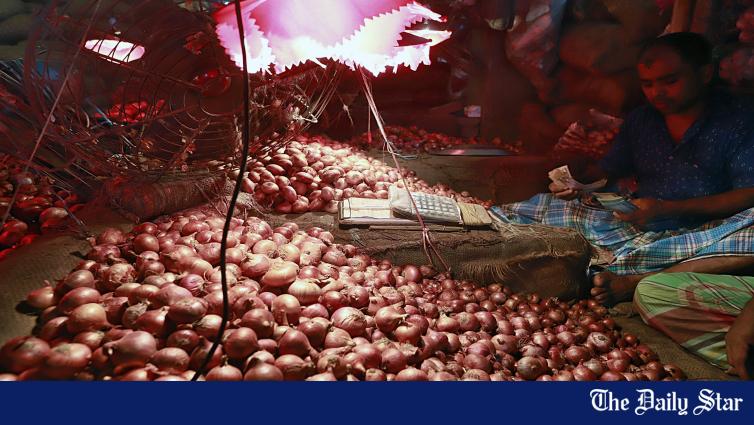
🍄 Researchers at Bangladesh Agricultural University (BAU) say Internet of Things (IoT) and sensor-based storage systems could reduce post-harvest losses of onions caused by inadequate storage facilities — a chronic weakness that leaves the country dependent on imports later in the year even though its own harvest exceeds demand. The team's answer is disarmingly simple: a smart bin that watches the onions so farmers do not have to gamble on them.
🔧 A team of researchers at BAU is developing an IoT-based, bin-shaped storage unit that can hold 500kg of onions and automatically monitor and control its internal environment. The setup can be installed for around Tk 25,000 and used for at least 10 years, and electricity costs are expected to be low — potentially minimal if farmers pair the unit with solar panels, said Prof Rostom Ali, professor at BAU's Department of Farm Power and Machinery, who is leading the research. The project began in March 2025 with funding from the University Grants Commission (UGC).
🌡 The objective is to develop a comparatively low-cost modern storage system that can regularly monitor and control temperature, humidity and other environmental conditions to preserve onion quality for longer, Prof Ali explained. Sensors detect changes in the storage environment and trigger adjustments to the airflow system, including automatically regulating fan operation — removing the guesswork that turns a farmer's storeroom into a lottery of rot, sprouting and weight loss.
📊 Early results and what comes next
✅ Experimental results so far suggest the technology could reduce onion storage losses by around 15-16 percent, though the research has not yet reached its final stage. The team is also monitoring weight loss, rotting, sprouting and quality changes, and the findings so far have been encouraging. If results remain satisfactory and the necessary financial and technical support is available, the researchers plan to introduce the technology on a pilot basis, with a model suitable for field-level use possible within one to two years.
📦 The economics explain why the humble onion deserves this attention. According to the Department of Agricultural Extension (DAE), Bangladesh produces around 4.264 million tonnes of onions annually against demand of approximately 3.50-3.60 million tonnes — yet despite domestic production exceeding demand, the country imported around 86,000 tonnes of onions in the 2025-26 fiscal year. The paradox is storage: harvests arrive in concentrated gluts that depress prices for growers, and onions that cannot be kept safely through the monsoon and off-season must later be replaced with imports, often at politically sensitive prices.
🔱 A chronic vulnerability, a cheap insurance policy
⚠ Onion price spikes are among the most visible food-price shocks in Bangladesh's recent history, and the root cause is rarely a production failure alone. Onions are perishable, high-moisture bulbs that sprout and rot quickly in the country's heat and humidity, and the traditional storage practice — bamboo-and-mud structures or simple jute sacks — offers little protection against ambient conditions. Post-harvest losses in onions have long been estimated in double-digit percentages, meaning a meaningful share of each harvest simply never reaches a consumer.
💰 That is what makes the Tk 25,000 price tag the most important number in the BAU project. Industrial cold storage is capital-intensive, centralised and geared toward traders rather than smallholders; a farmer-level smart bin that pays for itself within a season or two, runs on solar power and lasts a decade changes the storage calculus at the point where losses begin. If pilot deployments confirm the laboratory results, the technology could sit alongside onion-drying racks and improved varieties as one of the rare innovations that smallholders can actually adopt without credit.
🌏 The bigger prize is replication. The same sensing-and-airflow logic applies to potatoes, garlic, dry fish and other staples where Bangladesh loses produce between harvest and plate, and where import bills climb whenever the storage chain breaks. A domestic agri-tech supply chain — local sensors, local fabrication, local servicing — would itself be a small industry, one of the many value-added niches that policymakers hope will absorb the engineering graduates the country produces in growing numbers.
🔭 For now, the watchword is scale-up. Laboratory success in Mymensingh must survive dust, power cuts, monsoon humidity and rough handling in the field; extension services must train farmers to trust the readouts; and financing channels must deliver the units at prices that do not erase the savings they create. The researchers' two-year timeline for a field-ready model is realistic rather than optimistic — and if it holds, Bangladesh's onion traders may finally spend less time watching import price tickers and more time selling the surplus the country already grows.
💡 The development also carries a quiet lesson for the national research system: this is what patient, locally-rooted innovation looks like — a university department, a modest UGC grant and a problem defined by farmers themselves, rather than an imported blueprint. Bangladesh grows more onions than it eats; the challenge of keeping them is an engineering problem, and engineering problems are exactly what the country's agricultural universities are built to solve.
This news was originally published by The Daily Star. For the full original report, please visit: https://www.thedailystar.net/business/agriculture/news/low-cost-fix-cut-onion-losses-4306096
📬 Get Bangladesh Trade News in your inbox
Weekly digest of export industry news, policy updates, and market analysis.
📰 Related Stories