Mobile Phones And Internet Revolutionize Bangladesh Poultry Industry: Free Flow Of Price Information
FE analysis documents how mobile phones have created an information network that empowers thousands of egg producers and traders to compare prices across markets, preventing cartel formation and supporting 145% growth in per capita egg consumption since 2005.
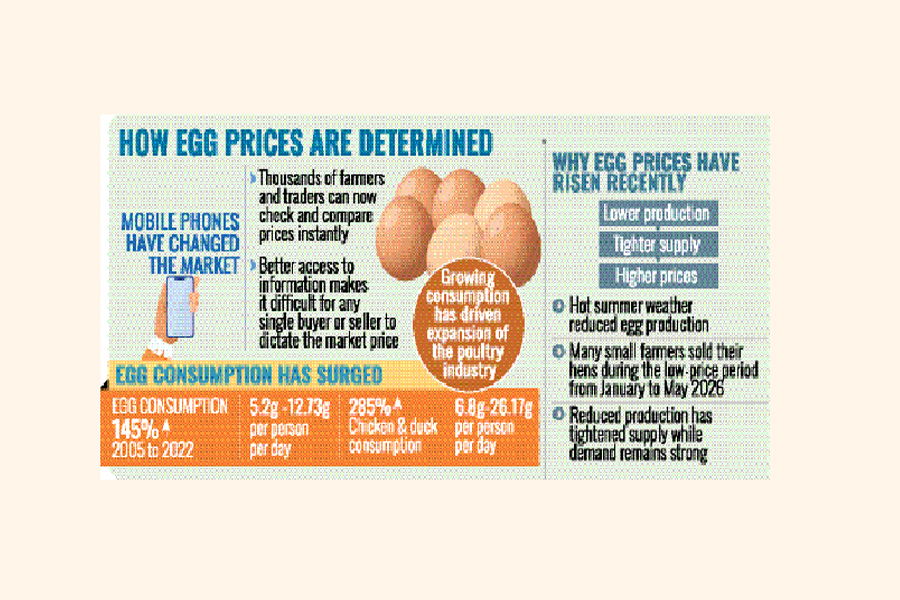
Tangail/Dhaka, September 24, 2026 — Egg farmers in rural areas want to find a trader who will buy at a higher price, while egg traders in each city want to find a supplier who will sell at a lower price. The egg price in each city is determined by the supply of eggs and the demand for eggs in that city. Cellphones have created an information network that empowers thousands of egg producers and traders to compare prices across markets — transforming Bangladesh's poultry industry.
📱 The Financial Express's Sultanul Islam documents how the proliferation of mobile phones and internet access has revolutionised Bangladesh's poultry industry — a transformation that has supported 145 per cent growth in per capita egg consumption between 2005 and 2022, while preventing cartel formation and improving price discovery across rural and urban markets.
📊 Poultry Consumption Growth: 2005-2022
The Household Income and Expenditure Survey shows striking growth in per capita consumption of poultry products:
- 🥚 Egg consumption: increased by 145 per cent — from 5.2 grams to 12.73 grams per person per day between 2005 and 2022.
- 🐔 Chicken and duck consumption: increased by 285 per cent — from 6.8 grams to 26.17 grams per person per day over the same 17-year period.
This rapid growth shows clearly that there is no cartel which is limiting supply. New companies and farmers enter the poultry business whenever prices are high, showing that there is no barrier to entry.
🧮 Why Mobile Phones Prevent Cartel Formation
Economists say that a cartel (or “syndicate”) is not possible in a business where there is no barrier to entry. Industry stakeholders say that it is not possible for producers or traders to form a cartel, because:
- 📱 Thousands of people buy and sell eggs every day.
- 📱 Information about market prices in each location is easy to obtain via mobile phone.
- 📱 Anyone trying to sell at artificially high prices will be undercut by competitors offering better prices.
- 📱 New entrants can quickly emerge when prices are attractive — preventing any single producer from cornering the market.
If anyone tries to sell at a high price, no one will buy from him — because buyers can quickly find alternative suppliers through mobile phone-based information networks.
💼 Why Egg Prices Have Risen Recently
The recent increase in egg price is attributed to a fall in egg production during hot summer months, because many marginal egg farmers sold their hens (and stopped producing eggs) during the recent months of low egg prices (January to May 2026).
This natural supply-demand dynamic — rather than any cartel activity — explains the price volatility. The story is consistent with seasonal patterns in egg production, where:
- 🌡 Summer heat reduces hen productivity.
- 🌡 Low winter prices force marginal farmers to exit, reducing summer supply.
- 🌡 Higher summer prices then attract new entrants, restoring supply over time.
👥 Voices From The Poultry Sector
Dr Sabbir Hossain, 28, is a veterinarian and farmer with 3,500 layer hens in Horipur village of Ghatail, Tangail. He said, “I know the prices of eggs in different markets. The arotdars (wholesalers) who buy eggs from us cannot fix the price, and neither can we. In fact, there is no centre where the price is fixed.”
He also said that information technology allows poultry farmers to get information about prices from different markets. On 17 September, he sold eggs for Tk 11 each, and made a profit — but he incurred losses for many months when the price was low.
Nazrul Islam, 52, is a small farmer in Luchia Nagarbari, Madhupur. He said that farmers like him sell eggs to whoever offers a higher price. “Because of mobile phones with internet, we can check the market price anytime,” he said.
Jahangir Khan, 42, runs Noor Dimer Arot (wholesale shop) at Pakutia, Ghatail. He buys about 20,000 eggs each day from farmers and small traders and sells them to wholesalers in Moulvibazar and Dhaka.
💬 “In the morning I get an idea of the day's price, and then call farmers and traders to offer a price,” he said. “When demand increases in Dhaka and other cities, egg prices also increase in rural markets. Farmers can sell at a better price because they can get market information via mobile phone.”
Keramot Ali Khan, 48, is one of the owners of Setu Enterprise in Porabari, Ghatail. He sells up to 100,000 eggs almost every day to wholesale traders in Kaptanbazar, Dhaka. “I buy mostly from traders in Tangail and Jamalpur districts. Whether I am buying or selling, the price depends on demand and supply,” he said.
📊 Bangladesh Egg Market At A Glance
- 📊 Dhaka city daily egg consumption: approximately 15 million eggs per day.
- 📊 Tejgaon daily egg trade: approximately 2 million eggs per day — a small fraction of Dhaka's total.
- 📊 National commercial egg production: approximately 50 million eggs per day.
- 📊 Kazi Farms daily auction: approximately 700,000 eggs per day at its Ashulia sales centre.
Amanat Ullah, a leader of the Egg Traders Multipurpose Samity (association), told FE: “The price depends on supply and demand; it can't be influenced by anyone.”
🏢 Kazi Farms' App-Based Commodity Auction Model
Kazi Farms auctions about 700,000 eggs each day at its sales centre in Ashulia near Dhaka city. Kazi Zahin Hasan, director of Kazi Farms, explained their innovative auction mechanism:
💬 “We try to sell our entire stock of eggs each day, because eggs are perishable. Every morning, buyers submit their price bids and the desired quantity of eggs through our phone app. We examine the bids, and determine the highest price at which all our eggs will be sold.
💬 “If we want to sell 700,000 eggs, and each bidder wants about 50,000 eggs, we only need to sell eggs to the 14 highest bidders. So, our selling price will be the 14th-highest price bid. We will sell eggs to all 14 highest bidders at the same price, so they all feel that they are treated fairly.
💬 “Economists call this a commodity auction with a uniform selling price, many buyers and sealed bids. Our customers have the option of buying from other sellers. They are buying from us because our price is competitive compared to other sellers.”
This auction model — made possible by mobile technology — ensures transparent price discovery that aligns with actual supply and demand conditions.
📈 The Price-Quantity Trade-Off
Kazi Zahin Hasan also explained the broader price cycle:
💬 “At present, the demand for eggs exceeds the supply, and our auction price is higher than it was a few months ago. In February, when the supply of eggs exceeded the demand, our auction price was only 7.43 taka per egg. Every egg producer made losses for about five months this year.
💬 “When demand is higher than supply, the price is high, and consumers are unhappy, but farmers make profit. When supply is higher than demand, the price is low, and consumers are happy, but farmers lose money. Prices of agricultural products like eggs and vegetables are never stable.”
💼 Why Mobile-Based Price Discovery Matters For Bangladesh's Economy
The mobile phone-driven transformation of Bangladesh's poultry industry has several wider economic implications:
- 📱 Reduced information asymmetry — between rural producers and urban buyers.
- 📱 Better price realisation for farmers — who can now compare offers across multiple markets.
- 📱 Lower consumer prices — through competitive pressure on intermediaries.
- 📱 Reduced cartel risk — as transparent information prevents anti-competitive behaviour.
- 📱 Encouraged market entry — as new producers can quickly access market intelligence.
- 📱 Improved supply chain efficiency — as traders can match supply with demand more effectively.
🌏 The Digital Bangladesh Context
The poultry industry transformation is part of a broader digital transformation of Bangladesh's agricultural sector. Other examples include:
- 🌾 Krishoker Janani app — for agricultural price information.
- 🌾 e-Krishok — for digital extension services.
- 🌾 Agriculture helplines — for farmer advisory services.
- 🌾 Mobile-based market linkage platforms — connecting farmers directly with buyers.
Bangladesh has approximately 180 million mobile subscribers and over 130 million internet users — providing the connectivity infrastructure needed to support such digital transformation across multiple sectors.
🏛 The Broader Lesson: Information As A Public Good
The poultry industry story offers a broader lesson for Bangladesh's economic governance. The traditional policy response to perceived “syndicates” in agricultural markets has been to:
- 🔹 Establish government price monitoring committees.
- 🔹 Conduct raids against alleged hoarders.
- 🔹 Set administrative price controls.
- 🔹 Restrict market access for selected intermediaries.
These interventions have generally failed to deliver sustainable price stability — because they do not address the underlying information asymmetry that creates opportunities for intermediaries to extract rents.
The poultry industry experience suggests that information — specifically real-time, accessible, and comparable market price data — is the most effective antidote to market manipulation. When thousands of producers and consumers can see the same prices, intermediaries cannot extract rents without losing business to more efficient competitors.
💼 Implications For Other Agricultural Markets
The poultry industry's mobile-driven transformation offers lessons for other agricultural markets in Bangladesh that have struggled with price volatility and alleged cartel behaviour:
- 🌾 Vegetable markets — where similar mobile-based price information could improve transparency.
- 🌾 Rice markets — where farmgate-to-retail margins remain opaque.
- 🌾 Fish markets — where prices vary widely across regions.
- 🌾 Fruit markets — where seasonal gluts and shortages cause extreme price swings.
- 🌾 Pulse and edible oil markets — where import dependence complicates price discovery.
For each of these markets, the lesson is the same: transparent, accessible price information — enabled by mobile technology — is more effective than administrative price controls in delivering fair prices for both producers and consumers.
📜 Looking Ahead
The Bangladesh poultry industry's transformation demonstrates how digital technology can disrupt traditional agricultural market structures and create more efficient, transparent, and competitive outcomes. The experience offers a template for other sectors — and reinforces the case for continued investment in digital infrastructure, mobile literacy, and open data initiatives across Bangladesh's agricultural economy.
For consumers worried about high egg prices, the lesson is also clear: the answer is not price controls but rather more information — allowing markets to function efficiently while protecting both producer livelihoods and consumer welfare.
This news was originally published by The Financial Express. For the full original report, please visit: https://thefinancialexpress.com.bd/trade/mobile-phone-internet-revolutionize-the-poultry-industry-with-free-flow-of-price-information
📬 Get Bangladesh Trade News in your inbox
Weekly digest of export industry news, policy updates, and market analysis.
📰 Related Stories

✍️ More from System Administrator