Bangladesh Companies Dodge Fuel Price Shock By Cutting Costs: Smaller Packets, Solar Power, Recipe Tweaks
Daily Star's Jagaran Chakma and Sukanta Halder document how FMCG companies are shrinking packet sizes, reducing dealer commissions, switching to solar power, and tweaking recipes to keep retail prices unchanged despite the Tk 20 per litre fuel price hike.
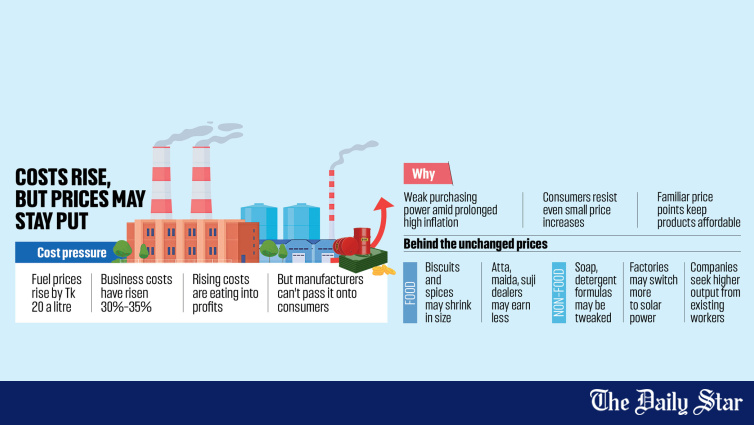
Dhaka, September 29, 2026 — In the coming weeks, biscuits and spices may start arriving in slightly smaller packets, while dealers and retailers of atta, maida and suji may receive lower commissions on each packet sold. Some companies may also tweak their recipes. Liquid soap and detergents, for example, could contain less active material while maintaining product performance. Inside factory premises, manufacturers may also increasingly turn to cheaper solar power and try to get more from their existing workforces.
📊 All the changes are aimed at keeping retail prices unchanged even though the latest fuel price hike has raised production and transport costs. Local fast-moving consumer goods (FMCG) companies say they simply cannot pass on those costs to consumers as high inflation continues to erode purchasing power for years.
⛽ The Fuel Price Hike Context
In the third week of September, the latest round of fuel price adjustments increased prices of diesel, petrol and octane by Tk 20 a litre, citing volatile global market rates and rising subsidies. The increase pushed up the prices of almost everything, from fresh vegetables, poultry and milk to transport fares and industrial inputs.
💼 Cost-Cutting Strategies Being Deployed
Manufacturers are deploying multiple strategies to absorb the cost shock:
- 📦 Packet size reduction — biscuits, spices, and other packaged goods may arrive in slightly smaller packets while maintaining the same retail price point
- 💰 Lower dealer commissions — dealers and retailers of atta, maida and suji may receive reduced margins
- 🧽 Recipe tweaks — liquid soap and detergents could contain less active material while maintaining product performance
- ☀ Solar power adoption — manufacturers increasingly turning to cheaper solar energy to reduce electricity costs
- 👥 Workforce optimisation — getting more output from existing workforces rather than hiring new staff
- 🚚 Logistics efficiency — optimising transport routes and consolidating shipments
💬 Why Companies Cannot Pass Costs To Consumers
The fundamental challenge is that Bangladeshi consumers have been under sustained inflation pressure for over four years:
- 📈 Inflation has remained above 8 per cent for most of 2025-2026
- 📈 Purchasing power has been eroded by cumulative price increases since 2022
- 📈 Consumer demand has weakened across multiple FMCG categories
- 📈 Competition among FMCG companies prevents unilateral price increases
Companies that raise prices risk losing market share to competitors who absorb costs — making cost-cutting the only viable strategy for maintaining both margins and market position.
💼 The FMCG Sector Context
Bangladesh's FMCG sector is one of the country's largest industrial segments:
- 🛍 Major categories: food and beverages, personal care, home care, tobacco
- 🛍 Key players: City Group, Meghna Group, ACI, Unilever Bangladesh, Nestle Bangladesh, Pran-RFL Group, Square Group
- 🛍 Employment: hundreds of thousands of workers across manufacturing, distribution, and retail
- 🛍 Distribution network: nationwide, reaching from urban supermarkets to rural village shops
💰 Impact On Production Costs
The fuel price hike has affected production costs through multiple channels:
- ⛽ Transport costs — higher diesel prices increase the cost of moving raw materials to factories and finished goods to markets
- ⛽ Generator costs — many factories use diesel generators during power outages, with costs now 3x higher than grid electricity
- ⛽ Packaging costs — plastic packaging is petroleum-derived, so higher oil prices increase packaging costs
- ⛽ Imported inputs — many FMCG raw materials are imported, and higher freight costs add to landed costs
☀ The Solar Power Shift
The fuel price hike is accelerating the shift towards solar power in Bangladesh's manufacturing sector. Key trends:
- ☀ Rooftop solar installations — factories installing solar panels to reduce grid dependency
- ☀ Net metering — selling excess solar power back to the grid
- ☀ Solar-plus-storage — combining solar with battery systems for 24/7 coverage
- ☀ LEED-certified factories — Bangladesh already has the world's highest number of LEED-certified green factories, mostly in the RMG sector
The economic case for solar has strengthened significantly — with the September 20 fuel price hike making diesel-based backup power even more expensive, the payback period for solar investments has shortened considerably.
📋 The 'Shrinkflation' Phenomenon
The practice of reducing packet sizes while maintaining prices — known as 'shrinkflation' — is a well-known FMCG strategy globally:
- 📦 Consumer psychology — consumers are more sensitive to price changes than to small size changes
- 📦 Regulatory considerations — packet size changes must comply with Bangladesh Standards and Testing Institution (BSTI) regulations
- 📦 Labeling requirements — net weight must be accurately declared on packaging
- 📦 Competitive dynamics — if one company shrinks packets, competitors may maintain sizes to gain market share
📜 Looking Ahead
For Bangladesh's FMCG sector, the cost-cutting strategies represent a pragmatic response to a challenging economic environment. However, there are limits to how much costs can be cut without affecting product quality or company viability:
- ⚠ Quality risk — excessive recipe tweaks could compromise product quality and brand reputation
- ⚠ Dealer viability — reducing commissions too far could push dealers and retailers out of business
- ⚠ Investment deferral — companies may delay capacity expansion and new product development
- ⚠ Employment impact — workforce optimisation could limit new hiring
Ultimately, the cost-cutting strategies provide a temporary buffer — but if fuel prices remain elevated or increase further, companies may eventually be forced to raise prices. The coming months will reveal whether the current cost-cutting approach is sustainable, or whether Bangladesh's FMCG sector will need to adjust to a new pricing reality.
This news was originally published by The Daily Star. For the full original report, please visit: https://www.thedailystar.net/business/economy/news/companies-are-dodging-price-shock-cutting-costs-4285476
📬 Get Bangladesh Trade News in your inbox
Weekly digest of export industry news, policy updates, and market analysis.
📰 Related Stories



✍️ More from System Administrator

