Bangladesh Wheat Imports Likely Fall 11% In 2026-27: USDA
USDA forecasts wheat imports to decline to 66 lakh tonnes from record 74 lakh tonnes, driven by high global prices and large carryover stocks from private sector
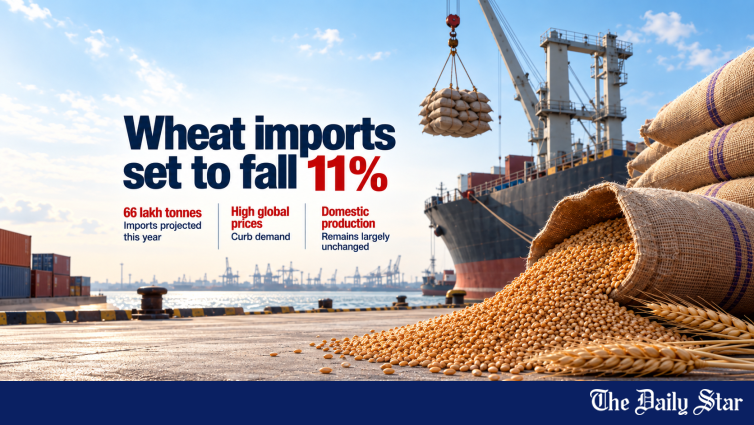
🌾 Bangladesh's wheat imports are projected to decline 11 percent in the 2026-27 marketing year as elevated global prices and large carryover stocks from the previous year's record purchases reduce fresh import demand. The forecast, contained in a recent United States Department of Agriculture (USDA) report on Bangladesh, highlights the country's structural vulnerability to global grain market volatility and the complex interplay between international prices, domestic stocks and import dynamics.
📊 The country relies on imports for more than 80 percent of its wheat-based food needs. It imported 74 lakh tonnes of wheat in the previous marketing year, according to the USDA report. The wheat marketing year runs from July to June. The 11% projected decline would bring imports to approximately 66 lakh tonnes in 2026-27 — still well above historical averages but a meaningful reduction from the record FY26 level.
🌏 Black Sea Disruptions Drive Price Volatility
The USDA said disruptions to grain shipments from Russia and Ukraine had reduced export supplies from the Black Sea, making global supply and trade flows less predictable for countries that depend heavily on imports. US wheat export prices have increased by $26 per tonne since July. Hard Red Winter (HRW) wheat reached $321, or more than Tk 39,500, per tonne in August, partly because the disruptions increased market volatility.
"Because Bangladesh's wheat import market is highly price-sensitive, higher global prices are expected to reduce import demand," the report said. The price sensitivity reflects the structure of Bangladesh's wheat import market — dominated by private millers and traders who must pass through global price changes to domestic consumers, where affordability constraints cap the maximum price that can be charged without significant demand destruction.
- 📊 FY26 imports: 74 lakh tonnes (record high)
- 📊 FY27 forecast imports: 66 lakh tonnes (-11%)
- 💰 US HRW wheat price (August): $321/tonne (~Tk 39,500)
- 💰 Price increase since July: $26/tonne
- 📊 FY27 consumption forecast: 78 lakh tonnes (+4% vs previous estimate)
- 📊 Local wheat production: 10.5 lakh tonnes (unchanged)
- 📊 Import dependence: 80%+ of wheat needs
- 💰 US Wheat MoU commitment: up to 7 lakh tonnes annually until 2030
💰 Private Sector Stock Build-Up
The private sector imported a large volume of wheat last year, pushing total imports to a record high, the USDA said. Private millers and traders are now holding substantial stocks, which are expected to reduce the need for fresh imports this year, particularly if global prices remain elevated. Private-sector wheat imports rose 16 percent to nearly 66 lakh tonnes last year, while public-sector imports increased 61 percent to 7.51 lakh tonnes.
The private sector's record 66 lakh tonnes of imports in FY26 represents a meaningful inventory build-up that will be drawn down through FY27 as millers supply domestic consumption from existing stocks rather than importing fresh wheat at elevated prices. This dynamic — large private stocks dampening fresh import demand — is structurally healthy for Bangladesh's wheat market in the short term, but creates vulnerability in the medium term if stocks are drawn down faster than expected or if global prices fail to ease.
🤝 US Wheat Associates MoU And Public Sector Imports
The increase in public-sector imports was largely driven by purchases from the United States after the government signed a memorandum of understanding (MoU) with US Wheat Associates. Under the MoU, Bangladesh procured about 7.45 lakh tonnes of US wheat during the period, according to the USDA. The government has committed to buying up to 7 lakh tonnes of US wheat annually until 2030. It has already contracted around 2.2 lakh tonnes for this year.
The MoU with US Wheat Associates represents a strategic diversification of Bangladesh's wheat sourcing — historically dominated by Black Sea origins (Russia, Ukraine) and to a lesser extent Canada and Australia. The commitment to purchase up to 7 lakh tonnes annually until 2030 provides a structural floor to public-sector wheat imports, ensuring a minimum flow of US-origin wheat regardless of Black Sea supply disruptions. The MoU also reflects broader trade diplomacy under the recently signed Agreement on Reciprocal Trade (ART) between Bangladesh and the US.
📊 Consumption Growth Despite Import Decline
Despite the expected decline in imports, the USDA forecasts wheat consumption at 78 lakh tonnes this year, 4 percent higher than its previous estimate. Demand for wheat flour remains strong among households and industries producing biscuits, confectionery, pasta, noodles and bakery products. "As rice prices have remained high for more than a year, many households are now consuming more wheat flour than before," the USDA said.
The substitution effect — households shifting from rice to wheat flour due to elevated rice prices — has been a recurring feature of Bangladesh's food consumption dynamics in recent years. With rice prices remaining elevated through 2025-26, the substitution has accelerated, contributing to the 4% upward revision in wheat consumption forecasts. The pattern highlights the interconnected nature of Bangladesh's food security challenges: when one staple becomes expensive, demand shifts to alternatives, creating knock-on effects on import requirements for the substitute commodity.
🌿 Local Wheat Production Stagnant
The USDA kept its forecast for local wheat production unchanged at 10.5 lakh tonnes. It said both wheat acreage and production have remained largely stagnant in recent years. "Despite strong domestic demand for wheat and wheat flour, farmers have shown limited interest in expanding wheat cultivation," the report said.
Farmers can earn higher returns from other crops, such as vegetables and corn, during the same Rabi season. This reduces their incentive to use more land for wheat, the USDA said. The agency also identified the limited availability of high-yielding wheat varieties suited to local conditions as a major constraint on production. These factors are expected to continue limiting any significant increase in wheat acreage and production this year.
The stagnation in local wheat production underscores the structural challenge of reducing Bangladesh's import dependence through domestic agriculture. Even with strong demand and elevated prices creating market signals that would normally incentivise production expansion, the lack of high-yielding varieties suited to local agro-ecological conditions and the competing attractiveness of other Rabi season crops means wheat acreage has failed to grow. Without significant investment in agricultural research to develop heat-tolerant, disease-resistant wheat varieties adapted to Bangladesh's conditions, the structural import dependence will persist.
🌏 Strategic Implications For Bangladesh's Food Security
For Bangladesh's broader food security strategy, the USDA forecast carries several strategic implications. First, the country's import dependence (80%+) on wheat creates structural vulnerability to global supply disruptions — whether driven by Black Sea geopolitical conflict, climate-induced harvest failures in major exporting countries, or shipping route disruptions in the Bab el-Mandeb or Strait of Hormuz. The recent Bab el-Mandeb crisis, with cargo diversion adding 10-12 days to voyage times, has direct implications for wheat import logistics and costs.
Second, the price sensitivity of Bangladesh's wheat import market creates a structural dampener on domestic consumption growth — when global prices spike, import volumes contract, and the price increase is passed through to domestic consumers, suppressing demand growth. This dynamic provides a natural market-based mechanism for managing foreign exchange outflows on wheat imports, but at the cost of reduced consumer welfare.
Third, the strategic partnership with US Wheat Associates provides a structural hedge against Black Sea supply disruptions, ensuring a minimum flow of wheat from a geographically diversified origin. The MoU's commitment through 2030 gives Bangladesh a long-term supply anchor that complements spot-market purchases from other origins.
The coming marketing year will reveal whether the projected 11% import decline materialises as expected, or whether stronger-than-anticipated consumption growth or faster stock drawdown forces Bangladesh to import more than forecast. Either way, the structural reality of 80%+ import dependence will remain — a reality that will continue to shape Bangladesh's food security strategy through and beyond LDC graduation in November 2026.
This news was originally published by The Daily Star. For the full original report, please visit: https://www.thedailystar.net/business/news/wheat-imports-likely-fall-11-2026-27-4272111
Related on BangladeshExport
📬 Get Bangladesh Trade News in your inbox
Weekly digest of export industry news, policy updates, and market analysis.
📰 Related Stories