Bangladesh Eyes Myanmar LNG Import in 12-Hour Transit: A New Energy Corridor Takes Shape
Dhaka, August 4, 2026 — Bangladesh is pursuing an ambitious plan to import liquefied natural gas (LNG) from neighbouring Myanmar — with transit time as short as 12 hours — as the country battles its most severe gas crisis in over a decade and seeks to break its dependence on volatile long-haul LNG supply chains that have been disrupted by the Middle East conflict.
🇲🇲 The Proposal
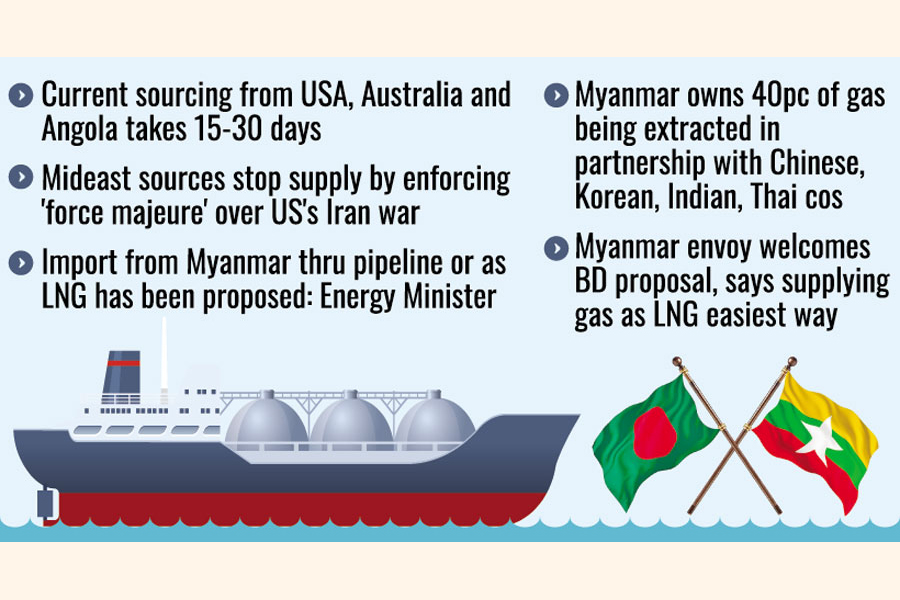
Bangladesh hopes to procure liquefied natural gas from next-door neighbour Myanmar in 12-hour transportation once a much-expected LNG sales-and-purchase deal is done, as the country faces exigencies of energy. Currently, the country sources LNG from the United States, Australia and Angola, where import consignments take 15 to 30 days. It takes around six to seven days to import the fuel from the nearest sources in Middle-Eastern countries — but Bangladesh has not got LNG from its Mideast sources (QatarEnergy and OQ Trading) over the past several months, as they have stopped supplying the gas by enforcing "force majeure" since late February, immediately after the war between the USA and Iran broke out.
"If both countries agree and settle price negotiations, Bangladesh will be able to import LNG from Myanmar within 12 hours — the shortest possible time to import the fuel," Iqbal Hasan Mahmood, Minister for Power, Energy and Mineral Resources (MPEMR), told The Financial Express on Tuesday.
- 🇺🇸 US/Australia/Angola transit: 15–30 days
- 🇦🇪 Middle East transit: 6–7 days (currently under force majeure)
- 🇲🇲 Myanmar proposed transit: 12 hours
- ⚠️ Mideast supply status: Force majeure since late Feb 2026
- 📈 Spot cargo purchases YTD (by Aug): 41 cargoes (39 since Middle East war)
🏛️ PM Tarique Rahman's Green Signal
"We have proposed importing gas from neighbouring Myanmar through pipeline or as LNG," the minister said. "I made the proposal on Sunday after having the green signal from Prime Minister Tarique Rahman to import gas from our neighbour, which is a gas-rich country in this region, to resolve our mounting natural-gas crisis," said the minister — making clear that the Myanmar LNG initiative has top-level political backing and is not just a bureaucratic proposal.
Myanmar has around 40 percent of gas of its own in various oil-and-gas-exploration projects being implemented under partnership with Chinese, Korean, Indian and Thai energy companies, from where the country can export LNG to Bangladesh, said the Bangladeshi minister. The 40 percent figure refers to Myanmar's share of production from joint-venture gas fields — meaning the country has surplus export capacity beyond its domestic requirements, particularly from the Yadana and Yetagun fields in the Andaman Sea.
🤝 Diplomatic Engagement
The option was discussed during a meeting with Myanmar's ambassador in Bangladesh, Kyaw Soe Moe, on Sunday at the secretariat. As a close neighbour, Bangladesh is prioritising enhanced energy cooperation with Myanmar, the minister said, as industries, households and other consumers are in a crying need for gas amid a fuel crunch. Importing LNG from Myanmar could further cut Bangladesh's dependence on the volatile spot market, he added — a strategic objective that has gained urgency as spot cargo prices have surged on Middle East conflict risk premiums.
Bangladesh has significant domestic demand for natural gas, and the government is particularly interested in sourcing energy from Myanmar via pipeline in the long term and as LNG in the short term, Mahmood said — signalling a two-track approach that combines immediate LNG shipments with a more ambitious pipeline vision that would take years to materialise.
🌏 Myanmar's Response
The Myanmar ambassador welcomed Bangladesh's proposal and said supplying gas as LNG would be the easiest way for energy cooperation between the two bordering countries. The envoy suggested that the matter could be reviewed at a Bangladesh-Myanmar joint technical-committee meeting — a procedural step that would allow experts from both sides to evaluate the technical feasibility, pricing structure, and infrastructure requirements before political negotiations begin in earnest.
The minister also extended a formal invitation to Myanmar's energy minister to visit Bangladesh and expressed his own willingness to undertake a trip to Myanmar to discuss the gas import. Bilateral energy cooperation could play a supportive role in establishing the proposed China-Myanmar-Bangladesh corridor, which was discussed during the Bangladeshi prime minister's recent visit to China, the energy minister said — linking the gas import initiative to a broader regional connectivity agenda that could reshape Bangladesh's geo-economic positioning in South and Southeast Asia.
⚠️ The Crisis Driving the Urgency
Bangladesh is currently struggling to meet its gas demand amid elevated LNG prices, and as contracted long-term LNG suppliers continue to restrict scheduled cargo deliveries. Due to disruptions to long- and short-term LNG supply, Bangladesh's LNG spot cargo purchases this year are set to reach 41 by August, 39 of which have come after the start of the war in the Middle East — a striking figure that illustrates the degree to which Bangladesh has been forced into the spot market to compensate for the collapse of its long-term supply contracts.
In addition to limited contractual supplies due to the war in the Middle East, Bangladesh is currently facing a restriction in natural gas supply following the abrupt shutdown of operations at one of its two FSRUs on July 21. The combined impact is severe:
- 📉 Aug 2 total gas supply: ~2,139 mmcfd (down from 2,642 mmcfd pre-accident)
- 📉 Regasified LNG component: 493 mmcfd (sharply reduced from pre-accident)
- 📈 Daily gas demand: ~4,000 mmcfd (per Petrobangla)
- 📉 Structural shortfall: ~1,861 mmcfd (47% of demand unmet)
- ⚡ Power generation lost: ~2,500 MW (gas-fired plants worst hit)
- 📉 Gas to power plants: ~680 mmcfd (down from ~950 mmcfd pre-accident)
Gas-fired power plants are the worst hit, with electricity generation of about 2,500 megawatts being affected due to the FSRU disruption, state-owned Bangladesh Power Development Board (BPDB) Chairman Md Rezaul Karim said. The gas-fired power plants are currently receiving about 680 mmcfd, down from about 950 mmcfd in the pre-accident period, he said. The shutdown of the FSRU has reduced gas pressure in many areas, disrupting industrial production as well — with the BGMEA, BKMEA and BPGMEA all reporting capacity utilisation in the 30–50 percent range across their member factories.
🌏 Geopolitical and Strategic Dimensions
The Myanmar LNG proposal is not just a commercial arrangement — it carries significant geopolitical and strategic dimensions. First, it would create a new energy corridor between South and Southeast Asia, reducing Bangladesh's reliance on Middle Eastern supply routes that are vulnerable to Strait of Hormuz disruption. Second, it would deepen Bangladesh-Myanmar bilateral ties at a time when both countries are seeking to diversify their diplomatic options beyond traditional partners. Third, it could pave the way for the broader China-Myanmar-Bangladesh corridor mentioned by the minister — a connectivity initiative that has been under discussion for over a decade but has gained new momentum under the current government.
The proposal also has implications for Bangladesh's LDC graduation strategy. As the country prepares to lose duty-free market access in several key markets after November 2026, reducing energy import costs becomes critical to maintaining export competitiveness — particularly in the energy-intensive RMG, textile and plastic sectors that dominate Bangladesh's export basket. A 12-hour LNG supply from Myanmar, at a competitive price, could reduce Bangladesh's energy import bill by hundreds of millions of dollars annually while improving supply reliability.
⚠️ Challenges and Risks
Despite the promise, the Myanmar LNG initiative faces several challenges. First, Myanmar's own political situation remains unstable following the 2021 military takeover, and any long-term supply agreement will require safeguards against political disruption. Second, the infrastructure for cross-border LNG trade between the two countries does not yet exist — a pipeline would take 3–5 years to build, while LNG shipment via small-scale vessels would require dedicated loading and regasification facilities on both sides. Third, pricing negotiations could be complex, as Myanmar's gas is currently contracted to other buyers (China, Thailand, India) and Bangladesh would need to offer competitive terms to divert supply.
There is also the broader regional context to consider. Myanmar's gas exports are part of a complex web of energy geopolitics involving China's Belt and Road Initiative, India's Act East policy, and ASEAN energy cooperation frameworks. Bangladesh's entry into this market would need to navigate these existing relationships carefully — particularly the Chinese involvement in Myanmar's energy sector, which could be both an enabler (through the proposed China-Myanmar-Bangladesh corridor) and a complication (if Chinese companies prioritise their own supply contracts).
✅ What Comes Next
The immediate next step is the convening of the Bangladesh-Myanmar joint technical committee meeting, where experts from both sides will evaluate the technical and commercial feasibility of the proposal. If the technical committee gives a positive assessment, the matter will move to political negotiations — potentially culminating in a formal LNG sales-and-purchase agreement by the end of 2026 or early 2027. In the short term, Bangladesh will continue to rely on emergency spot cargo purchases (the 8-cargo direct procurement approved on August 6) and the partial FSRU resumption to bridge the gap. But the Myanmar initiative represents the first credible medium-term structural solution to Bangladesh's gas crisis — and if it succeeds, it could transform the country's energy security outlook for the next decade.
This news was originally published by The Financial Express. For the full original report, please visit: https://thefinancialexpress.com.bd/economy/bd-eyes-rapid-lng-import-from-next-door-myanmar
📬 Get Bangladesh Trade News in your inbox
Weekly digest of export industry news, policy updates, and market analysis.
📰 Related Stories