Bangladesh Government Plans Fiscal Year Shift from July-June to April-March
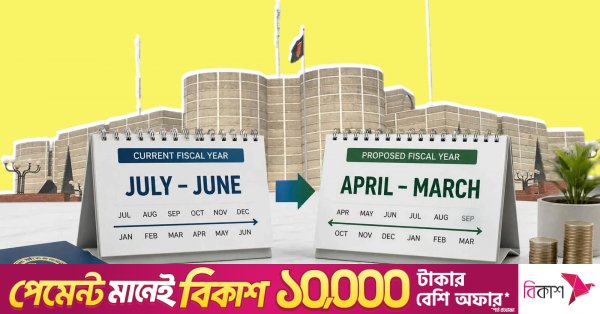
Dhaka, August 13, 2026 — The Bangladesh government is planning to change the country's fiscal year from the current July-June cycle to April-March, with a proposal expected to be placed before a cabinet committee soon. Finance Minister Amir Khosru Mahmud Chowdhury has instructed officials to prepare the proposal, according to finance ministry sources — marking one of the most significant administrative reforms contemplated by the interim government.
📅 The Problem: Monsoon-Battered Project Implementation
At the heart of the proposed shift is a long-recognised problem with Bangladesh's July-June fiscal year: the final three months — April, May, and June — coincide with the peak monsoon season. Heavy rainfall, waterlogging, and flooding make outdoor construction work extremely difficult during this period. Yet this is precisely when ministries and contractors face maximum pressure to spend allocated budget before the fiscal year closes on June 30.
The result is a perverse incentive structure that has plagued Bangladeshi public investment for decades:
- ⚡ Rushed implementation — projects crammed into monsoon months to spend budget
- 🚧 Poor-quality work — construction in wet conditions compromises durability
- 💰 Wasted public money — rework and repairs absorb additional funds
- 🚗 Roads and bridges particularly affected — earthworks fail in saturated soil
- 🌊 Water development projects stalled — cannot work during high water levels
- 🏗️ Local government projects delayed — especially in low-lying areas
Under an April-March fiscal year, the final three months would fall between January and March — moving the budget spend-down pressure away from the monsoon. Officials said this could allow better scheduling of planning, tendering, project implementation, and bill payments.
🏛️ The Review: What Needs to Change
The Budget Wing of the finance ministry is now reviewing what changes would be needed across a wide range of laws and administrative systems:
- 📜 Fiscal year laws — the Finance Act defines fiscal year as July 1 to June 30
- 📝 Budget-making process — entire budget calendar would shift
- 💰 Tax system — income tax returns, VAT assessments, tax filing deadlines
- 📊 Government accounting — annual reports, financial statements
- 🏭 Development project implementation — ADP project cycles
Once the review is completed, the proposal will be placed before the cabinet committee. If approved, the necessary changes will be made and the new system introduced from the next fiscal year. Officials indicated that opinions would be sought on how and in which month the current fiscal year should end — with the work of two fiscal years running alongside each other during April, May, and June next year to manage the transition.
💰 The Tk 9.38 Lakh Crore Budget Challenge
The Tk 9.38 lakh crore (Tk 9.38 trillion) budget for fiscal 2026-27 came into effect on July 1 and was prepared under the existing July-June framework. An interim arrangement would therefore be needed to:
- 🔄 Close the old fiscal year — reconcile accounts under the existing calendar
- ⏳ Determine transition period duration — how long the overlap will last
- 📊 Align existing budget with new timeframe — remap allocations to new fiscal calendar
- 💻 Update government software — accounting, budget, tax, and reporting systems
- 💼 Adjust procurement schedules — tendering cycles would need recalibration
- 📈 Revise performance indicators — ministry annual targets reset to new calendar
Officials stressed that the change should not be viewed simply as moving the calendar forward by three months — the entire administrative architecture of government finance would need to be realigned.
📱 Digital Tracking Dashboards Coming
The fiscal year reform is being packaged with broader project implementation improvements — including plans to introduce digital tracking dashboards across ministries. The dashboards will use traffic-light signals (red, yellow, green) to show project progress in real-time, enabling senior officials and the Prime Minister's Office to identify bottlenecks quickly.
Prime Minister Tarique Rahman is expected to inaugurate the dashboard system this month, according to finance ministry sources. Additional reforms being introduced include:
- 👥 Appointment of project directors — strengthened accountability
- 🏗️ Construction rate schedules — standardised pricing to prevent cost inflation
- 📊 Performance monitoring — real-time tracking of project milestones
- 🚧 Bottleneck identification — early warning system for stalled projects
🧑💼 Economist View: A Long-Demanded Reform
Dr Fahmida Khatun, Executive Director of the Centre for Policy Dialogue (CPD), endorsed the proposed shift, saying it could help reduce delays and waste in development projects. She noted that the demand for changing the fiscal year has existed for a long time and has practical justification — particularly because the final three months of the current fiscal year fall during the monsoon season.
However, economists caution that changing the fiscal year alone will not automatically stop rushed spending at the end of June, project delays, poor-quality work, or waste of public money. They argue that reforms would be needed across the entire system — including:
- 📜 Project approval processes — faster, more transparent approvals
- 🤝 Tendering process — reduce corruption and collusion risks
- 👥 Project director appointments — merit-based, with accountability
- 💰 Fund releases — timely disbursement to avoid end-of-year rush
- 💼 Procurement management — professional procurement capacity
- 🔍 Project monitoring — independent oversight and audits
🏛️ Historical Context: A 2010 Precedent
This is not the first time Bangladesh has considered shifting its fiscal year. A similar initiative was taken in 2010, but was ultimately not implemented — a cautionary tale for the current reform effort. The 2010 attempt reportedly stalled due to resistance from various government departments concerned about the transitional complexity and the absence of political momentum.
The current proposal faces similar risks — particularly the scale of system changes required and the limited implementation window. However, the political context this time appears more favourable, with the interim government enjoying stronger mandate for structural reform and the Prime Minister's Office driving the digital dashboard initiative.
🗃️ Jamaat's Alternative: January-December
The fiscal year question has also drawn attention from opposition parties. Jamaat-e-Islami proposed changing the fiscal year to January-December during the 2026 budget debate. On June 29, Jamaat Ameer and Leader of the Opposition Shafiqur Rahman told parliament that the July-June system often resulted in work being completed towards the end of the fiscal year merely to show that bills had been processed.
Jamaat's proposal included three specific reforms:
- 📅 January-December fiscal year — calendar-year alignment
- 📜 Supplementary budget — presented at least three months before fiscal year-end
- 📊 Quarterly budget implementation reviews — every four months
The opposition proposal signals cross-party recognition that the current fiscal calendar is suboptimal — though the specific alternative (January-December vs April-March) remains a subject of debate.
🌐 Strategic Context: Reform as a Signal
For an economy preparing for LDC graduation in November 2026, the fiscal year reform sends a powerful signal — both domestically and internationally. It demonstrates the government's willingness to tackle long-standing structural inefficiencies in public financial management, even at the cost of significant transitional disruption. Combined with the digital tracking dashboards and procurement reforms, the fiscal year shift could materially improve the quality and timeliness of public investment — supporting the broader competitiveness agenda that Bangladesh needs as it transitions out of LDC status.
Whether the proposal survives the cabinet committee review and the inevitable resistance from affected departments will be one of the more consequential public finance questions of the coming months.
This news was originally published by The Business Standard. For the full original report, please visit: https://www.tbsnews.net/bangladesh/govt-plans-shift-fiscal-year-july-june-april-march-1513576
Related on BangladeshExport
📬 Get Bangladesh Trade News in your inbox
Weekly digest of export industry news, policy updates, and market analysis.
📰 Related Stories