Can The US Become A Top Import Source For Bangladesh? Agreement On Reciprocal Trade Sparks Debate
Daily Star's Refayet Ullah Mirdha examines whether the US can overtake China and India as Bangladesh's top import source following the February 9 Agreement on Reciprocal Trade — with US imports already at $2.72 billion in FY25.
Dhaka, September 25, 2026 — Bangladesh is well connected with major global players in international trade. China, the world's second-largest economy and largest manufacturing hub, is its largest import source. The neighbouring India, the fourth-largest economy, is second. The United States is the single largest export destination. Local manufacturers depend heavily on industrial raw materials, machinery and food items from China and India, making the two the top sourcing destinations.
📊 In fiscal year 2024-2025 (FY25), according to Bangladesh Bank data:
- 🇨🇳 Bangladesh imports from China: $18.19 billion (up from $16.63 billion in FY24)
- 🇮🇳 Bangladesh imports from India: $9.62 billion (up from $9 billion in FY24) — per NBR data
- 🇺🇸 Bangladesh imports from US: $2.72 billion (up from $2.53 billion in FY24) — per BB
- 🇺🇸 Bangladesh exports to US: $8.69 billion in FY25
The US has largely been an export destination for Bangladesh, but that is beginning to shift.
🤝 The Agreement On Reciprocal Trade (ART)
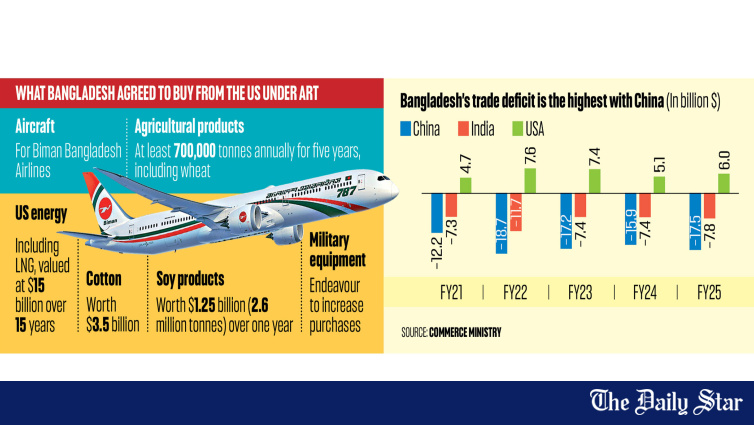
While imports from the US had been growing steadily over the years, the Agreement on Reciprocal Trade (ART), signed on February 9, 2026, is encouraging further purchases to narrow that nearly $6 billion trade gap. The required purchases, ranging from energy, commodities, aircraft, military equipment and more, amount to billions of dollars.
The developments have raised a question for Bangladesh's trade landscape: can the US eventually overtake China and India as a major source of imports?
💬 Economists' View: Bangladesh's Import Pattern Matters
According to economists and trade leaders, the answer depends largely on what Bangladesh needs to import. MA Razzaque, chairman of the Research and Policy Integration for Development (RAPID), said it would be difficult for the US to overtake China and India given Bangladesh's import and consumption pattern, which is closely tied to its textile and garment industry.
The country imports large quantities of:
- 🌿 Cotton, yarn, fabrics
- 🌿 Dyes and chemicals
- 🌿 Machinery
- 🌿 Other industrial inputs
China and India have extensive supply chains for most of these products.
💬 “The US goods are expensive and China is the most efficient supply chain manager globally now,” Razzaque said.
The US, despite being a major cotton exporter, lacks a comparable production base for fabrics, yarn, and many chemicals and accessories used by Bangladesh's apparel industry.
🌿 The Corn Example: Illustrating The Gap
Corn illustrates the gap. Bangladesh resumed importing US corn in market year 2025-26 after a seven-year gap, but the US supplied only around 1.11 lakh tonnes of it or about 6 per cent of the country's corn imports. The breakdown:
- 🇧🇷 Brazil: 68 per cent of Bangladesh's corn imports
- 🇮🇳 India: 24 per cent
- 🇺🇸 US: 6 per cent (1.11 lakh tonnes)
per a USDA report.
🌿 Bangladesh's Other Commodity Sourcing
Bangladesh sources other key commodities elsewhere:
- 🌿 Cotton: from India, African countries, Australia and Argentina
- 🌿 Soybean: largely from Brazil and Argentina
- 🌿 Wheat: from Russia, Ukraine and European countries
Of the roughly 6.6 million tonnes of wheat Bangladesh imported in MY2025-26, most came through the private sector, according to Ministry of Finance data, with the government importing the rest.
💰 The ART Commitments: US LNG, Wheat, Soy, Cotton
The US, however, is a major global supplier of agricultural commodities and energy, and the ART could allow American suppliers to gain share in these categories without displacing China and India more broadly. Under the agreement, Bangladesh shall “endeavour” in purchasing or facilitating the purchase of:
- ⛽ US liquefied natural gas (LNG) worth an estimated $15 billion over 15 years
- 🌿 Wheat
- 🌿 Soy
- 🌿 Cotton — worth a combined $3.5 billion
🌿 Wheat Purchase Commitment
On wheat specifically, under an agreement between the food ministry and US Wheat Associates, Bangladesh has committed to buying up to 7 lakh tonnes of US wheat annually through 2030. The current performance:
- 📊 MY2025-26: Bangladesh purchased around 7.45 lakh tonnes of US wheat
- 📊 Current marketing year: Already contracted 2.2 lakh tonnes
💰 Civilian Aircraft Commitments
The ART also requires increased purchases of US civilian aircraft, parts, and service by Biman Bangladesh Airlines. Recent Boeing aircraft orders include:
- ✈ Biman Bangladesh Airlines: 11 Boeing aircraft ordered this week — estimated cost $2.25 billion
- ✈ Biman (April 2026): 14 Boeing aircraft for $3.7 billion
- ✈ US-Bangla Airlines (July 2026): 21 Boeing aircraft — approximately $1.5 billion
Total Bangladesh carrier Boeing commitments: approximately $7.45 billion in 2026 alone — representing a major US export win.
💰 Military Equipment And Other Categories
Under ART, Bangladesh has also been encouraged to:
- 🔹 Increase purchases of US military equipment — while limiting procurement from certain other countries.
📜 Regulatory Mutual Recognition
To facilitate greater access for US goods, Bangladesh has agreed to treat US regulatory approvals as sufficient on their own. American-approved items that can enter Bangladesh on US certification alone — without separate testing or re-authorisation by Bangladeshi regulators — include:
- 💊 Medicines
- 💉 Medical devices
- 🥛 Dairy products
- 🍖 Meat
- 🐔 Poultry
- 🌾 Biotech crops
Bangladesh has also agreed not to require prior testing of imported US agricultural goods.
📜 Zero-Duty Access For US-Cotton Apparel
Both sides have also agreed to reduce barriers on a range of American goods, including:
- 👕 Zero-duty access for Bangladeshi apparel made with US cotton and man-made fibre
The commercial impact for exporters of the zero-duty facility remains unclear as the exact volume of duty-free apparel allowed under the system is yet to be decided.
⚖ The Non-Market Economy Clause
The agreement extends well beyond tariffs. It bars Bangladesh from signing “new free trade agreement or preferential economic agreement with a non-market country” that undermines the ART, on pain of the US reimposing its earlier reciprocal tariff.
The agreement does not name specific countries, but the US Commerce Department's standing non-market-economy list — used for anti-dumping enforcement — includes China and Russia.
💬 Chittagong Chamber President's View
Amirul Haque, president of the Chittagong Chamber of Commerce and Industry, who represented the private sector in the ART negotiations, said the US needs to weigh Bangladesh's market and economic structure.
💬 “In normal goods export, it is not possible to overtake China and India,” he said.
Distance is a further constraint. Bangladeshi importers typically receive goods from China and India faster than from the US, and longer shipping times raise freight, inventory and financing costs — a significant factor for Bangladesh's fast-moving manufacturing sector.
💬 AmCham Bangladesh View: Where US Can Win
The US does hold an edge in high-value goods.
💬 Syed Ershad Ahmed, immediate past president of the American Chamber of Commerce in Bangladesh, said: “The US can overtake China and India in high-valued items such as medical equipment, high-tech items, LNG, semiconductors and aircraft.”
He, however, added that it is not feasible for the US to overtake China and India in terms of cotton, soybean and wheat exports to Bangladesh.
📊 The Trade Picture At A Glance
| Category | China | India | US |
|---|---|---|---|
| Bangladesh imports (FY25) | $18.19bn | $9.62bn | $2.72bn |
| Bangladesh exports (FY25) | — | — | $8.69bn |
| Trade gap with Bangladesh | Bangladesh deficit | Bangladesh deficit | Bangladesh surplus ~$6bn |
💼 Strategic Implications For Bangladesh
The ART represents a major strategic shift in Bangladesh's trade policy. By committing to purchase US LNG, wheat, soy, cotton, aircraft and military equipment — and by accepting US regulatory certifications — Bangladesh has effectively tilted its sourcing strategy towards the US in selected categories.
However, the structural realities of Bangladesh's import pattern — particularly the dominance of Chinese and Indian supply chains for textile inputs — mean that the US is unlikely to overtake these two countries as the overall top import source anytime soon.
Instead, what is more likely is a gradual increase in US share in specific categories:
- ⛽ LNG imports — $15 billion over 15 years.
- 🌿 Wheat imports — up to 7 lakh tonnes annually through 2030.
- ✈ Civilian aircraft — $7.45 billion already committed in 2026.
- 💊 Pharmaceuticals and medical devices — through regulatory mutual recognition.
- 💉 High-tech equipment — including semiconductors.
- 🔹 Military equipment — as part of strategic security cooperation.
📜 The China Constraint
The ART's non-market economy clause — effectively barring Bangladesh from new FTAs with China — is perhaps the agreement's most strategically consequential provision. Bangladesh's previously proposed FTA with Malaysia, if it matures, would need to be carefully structured to avoid violating the ART's non-market economy restrictions.
For Bangladesh's trade negotiators, the ART represents both an opportunity and a constraint:
- ✅ Opportunity: Greater access to US goods, capital, and technology.
- ✅ Opportunity: Zero-duty apparel access for US-cotton-based products.
- ⚠ Constraint: Limits on new FTAs with non-market economies.
- ⚠ Constraint: Reduced flexibility in trade diplomacy.
- ⚠ Constraint: Potential higher input costs if US sourcing displaces cheaper Chinese alternatives.
📜 Outlook
For Bangladesh, the ART represents a strategic bet on long-term US partnership — in exchange for tariff relief on apparel exports and access to US technology, energy, and agricultural commodities. The success of this bet will depend on:
- 📋 Whether US LNG and agricultural exports can be competitively priced.
- 📋 Whether the zero-duty apparel access delivers meaningful export gains.
- 📋 Whether US regulatory mutual recognition delivers quality products.
- 📋 Whether the China constraint becomes commercially painful.
- 📋 Whether Bangladesh can navigate the strategic competition between the US and China without sacrificing economic interests.
For now, the US is unlikely to overtake China or India as Bangladesh's top import source — but the ART marks the beginning of a meaningful shift in Bangladesh-US trade relations that will be watched closely by industry, policymakers, and trade analysts in the coming years.
This news was originally published by The Daily Star. For the full original report, please visit: https://www.thedailystar.net/business/economy/news/can-the-us-become-top-import-source-bangladesh-4282321
📬 Get Bangladesh Trade News in your inbox
Weekly digest of export industry news, policy updates, and market analysis.
📰 Related Stories
✍️ More from System Administrator