Bangladesh Export Supply Chain Riddled With 66 Information Gaps Threatening Compliance With EU And US Traceability Rules
BUILD diagnostic identifies 39 critical gaps in RMG, leather, agro-food and fisheries sectors; government sets up National Traceability Platform and Digital Product Passport pilots to address compliance.
⚠ Bangladesh faces 66 operational and policy gaps in ensuring supply-chain traceability in major export sectors, posing compliance problems in major export destinations, according to a comprehensive diagnostic presented by the Ministry of Commerce (MoC) at a recent closed-door workshop. The lapse stokes concerns about the country''s ability to comply with increasingly stringent international trace-and-track requirements in trade operations — and could threaten Bangladesh''s market access to key export destinations if not addressed quickly.
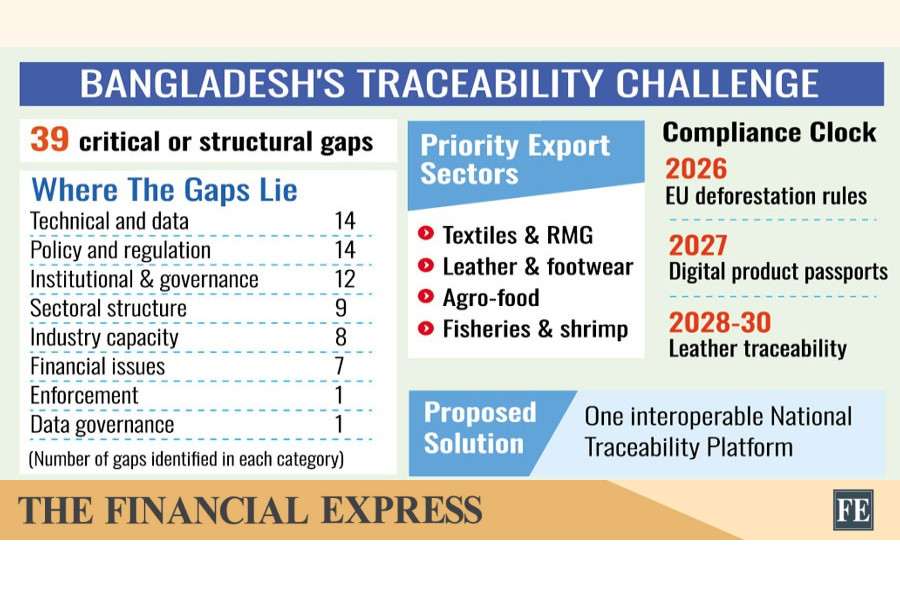
📊 A comprehensive diagnostic presented by the Ministry of Commerce at a recent closed-door workshop has revealed these gaps. The diagnostic was conducted by BUILD with the support of GIZ, and identifies gaps across key export sectors including readymade garments (RMG), leather and footwear, agro-food and fisheries. Of the 66 gaps identified, 39 have been classified as critical or structural based on the Criticality Preference Scoring (CPS) method.
🏛 The diagnostic findings
The diagnostic identified 18 critical gaps requiring action within 18 months, 13 structural gaps to be addressed within 18 to 36 months, and eight strategic gaps requiring attention over 36 to 60 months. The breakdown by category reveals where Bangladesh''s most significant weaknesses lie:
- 📊 Technical and data-related gaps: 14 gaps, of which 5 are critical — the largest single category
- 📊 Policy and regulatory gaps: 14 gaps, including 4 critical
- 📊 Institutional and governance gaps: 12 gaps, of which 3 are critical
- 📊 Sectoral structure gaps: 9 gaps
- 📊 Industry capacity gaps: 8 gaps
- 📊 Financial issues: 7 gaps
- 📊 Enforcement and data governance: 1 gap each
The diagnostic has found that the country''s key weakness is not the complete absence of supply-chain data but the fragmentation of existing information across different systems, including customs, according to an MoC report. "Data are not sufficiently connected, standardised, interoperable, verified or reusable across supply chains," the report says. "The lack of an integrated system is also creating difficulties in meeting requirements in major export markets."
🌏 Why traceability matters for Bangladesh''s exports
Traceability is the process of identifying and tracking a product or component''s path from raw materials to finished goods, helping destination countries make policy decisions about imports. For Bangladesh, traceability has become a critical compliance issue as major export destinations — particularly the European Union and the United States — tighten their requirements around product origin, sustainability and forced-labour prevention.
There is currently no real-time data link connecting exporter-origin information with customs authorities at both ends of international supply chains, according to the diagnostic. In particular, blended-origin cotton poses challenges for Bangladeshi exporters seeking to comply with the US Uyghur Forced Labor Prevention Act (UFLPA), as origin information is not adequately documented at the mill level. Exporters often have to rely on foreign verification services, increasing costs and potentially delaying shipments.
The report notes that digital-traceability initiatives remain largely confined to individual factories or pilot projects instead of operating through a common sector-wide system. This fragmented approach means that even where companies have invested in traceability technologies, the benefits are not scaling across the broader export sector.
🤝 Compliance deadlines approaching
The report has placed textiles and RMG, leather and footwear, agro-food and fisheries, and shrimp in the very-high-priority category because of regulatory requirements and enforcement deadlines in major export destinations. Several critical compliance deadlines are fast approaching:
- ✅ EU CATCH certification system: In use for seafood imports since 10 January 2026
- ✅ EU Digital Product Passport (DPP): Mandatory application for RMG and apparel expected from Q3/Q4 2027
- ✅ EU Deforestation Regulation: Requires plot-level geolocation information for medium and large enterprises from 30 December 2026; deforestation-free supply chains expected to become increasingly important towards 2030
- ✅ Leather Working Group requirements: Slaughterhouse-level traceability expected to be phased in during 2028-2030
These deadlines mean that Bangladesh has a narrow window — in some cases less than 18 months — to address the identified gaps or risk losing market access to its largest export destinations. The EU alone accounts for roughly 60% of Bangladesh''s RMG exports, making compliance with EU traceability requirements a make-or-break issue for the country''s export economy.
🏛 Government response: traceability strategy and pilot programmes
Against this backdrop, the Ministry of Commerce has established a Policy Coordination Unit for Circularity and Traceability and an Interministerial Coordination Committee. The government is also working on a National Traceability Strategy, an ESG Framework and responsible business conduct guidelines.
Digital Product Passport pilots have been launched at companies that include Urmi Group, Epyllion and Fatullah Apparels, while the Leathertrace pilot covers 16 tanneries and a shrimp-tracking initiative covers around 400 farmers. These pilots are designed to test traceability technologies and processes at the company and supply-chain level before being scaled up to a national system.
Commerce Minister Abdul Muktadir, who was the chief guest at the workshop, said the government had decided to introduce sector-based traceability for both export markets and the domestic market. "Concerns over food adulteration and fair prices for farmers would be resolved if we could ensure traceability of products," he said. Commerce Secretary Ataur Rahman chaired the workshop, which was attended by high-ups from all relevant ministries, stakeholders, diplomats, development partners and exporters.
👥 Industry response
Chief Executive Officer of BUILD Ferdous Ara Begum said domestic traceability is important, but priority should be given to export traceability in the first phase. "We have to introduce Digital Product Passports (DPPs) involving relevant ministries to address the different types of requirements from buyers," she said. She has suggested establishing a national traceability platform and expediting the traceability strategy by giving it the utmost priority.
ABM Faqrul Alam, head of Sustainability at Urmi Group, who attended the workshop, has stressed the need for interministerial coordination and said the Ministry of Energy should be included in the process. He said Urmi Group had already made significant progress in traceability and recommended scaling up industry best practices. "Traceability is urgent for the sake of business, as the EU is the major export destination for Bangladesh," he added.
Alam said Urmi Group formally started its traceability initiative in 2024 using data dating back to 2015-16. The company has introduced the first Digital Product Passport (DPP) in Bangladesh and uses more than 20 portals for traceability — demonstrating that Bangladeshi companies can build traceability capabilities when they invest in the right technology and processes.
BKMEA Joint Secretary Farzana Sharmin said awareness and preparing a policy framework are important now — a recognition that the regulatory landscape is moving fast and that Bangladesh needs to act quickly to keep pace.
💰 The path forward: National Traceability Platform
The diagnostic recommends establishing an interoperable National Traceability Platform rather than creating another standalone database. Such a platform would provide common data standards, unique identifiers and real-time integration with customs systems across export sectors. It also recommends establishing a National Traceability Steering Committee to coordinate the system and ensure interoperability among government agencies, exporters and other supply-chain stakeholders.
The recommendations are significant because they recognise that Bangladesh''s traceability challenge is not primarily a technology problem — it is a coordination problem. The country already has significant data flowing through customs, export promotion, banking and corporate systems, but that data is not connected, standardised or shared across the supply chain. A National Traceability Platform would address this fragmentation by creating common standards and real-time integration points.
🌏 Strategic significance for Bangladesh
For Bangladesh''s broader export strategy, the traceability diagnostic is a wake-up call. The country''s export economy has been built on the back of preferential market access, low-cost labour and an increasingly sophisticated RMG supply chain — but the next phase of export competitiveness will be determined by traceability, sustainability and compliance with international labour and environmental standards. The 66 gaps identified in the diagnostic represent the distance between Bangladesh''s current capabilities and the standards required to maintain market access to the EU, US and other major destinations.
The coming months will be critical for Bangladesh''s traceability agenda. With the EU Digital Product Passport requirements approaching in 2027 and the EU Deforestation Regulation taking effect from December 2026, the government and industry will need to move quickly to implement the diagnostic''s recommendations. Failure to do so could result in lost market access, reduced export competitiveness and damage to Bangladesh''s reputation as a responsible sourcing destination — outcomes that would have far-reaching consequences for the country''s export economy and the millions of workers who depend on it.
This news was originally published by The Financial Express. For the full original report, please visit: https://thefinancialexpress.com.bd/trade/bangladeshs-export-supply-chain-riddled-with-66-info-gaps
Related on BangladeshExport
📬 Get Bangladesh Trade News in your inbox
Weekly digest of export industry news, policy updates, and market analysis.
📰 Related Stories