Freight Cost Surge Squeezes Bangladesh's US-Bound Exports As Buyers Delay Orders
Exporters say shipping charges in some cases approaching or exceeding prices of products; Middle East conflict complicates order planning, shipment schedules.
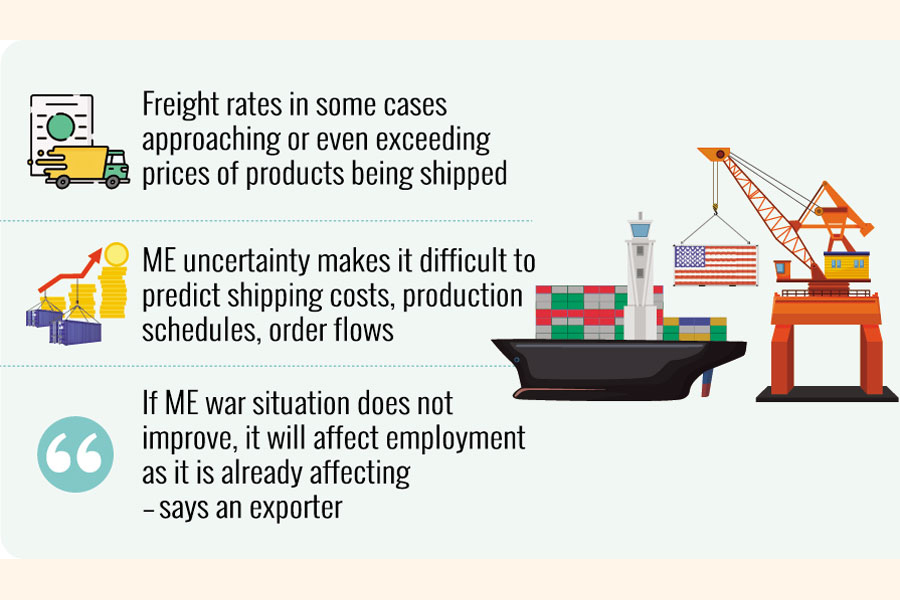
📦 Bangladesh''s exports struggle to remain competitive on the US market as persistently high freight costs combine with rising raw-material prices and expensive bank financing to pose headwinds. Some buyers are splitting orders or delaying production, leaving manufacturers struggling with idle capacity, mounting investment costs and uncertainty over future shipment amid the ongoing Middle East conflict. Exporters have said higher shipping charges are making it increasingly difficult for them to keep the cost of production competitive, with freight rates in some cases approaching or even exceeding the prices of the products being shipped.
📊 Uncertainty stemming from the Middle East conflict has further complicated order planning and shipment. Exporters said prolonged uncertainty over the conflict had made it difficult to predict shipping costs, production schedules and order flows. They have hoped a resolution would help stabilise freight rates and restore confidence among international buyers. Costs of shipping to the US are particularly high compared with those to European destinations.
🏛 Freight rate comparison
According to shipping quotations collected by The Financial Express on 15 October 2026, freight rates for a 20-foot container from Chattogram to US East Coast ports were significantly higher than to European destinations. The freight rate differential reflects the longer shipping distances to US ports, the limited number of direct shipping services between Bangladesh and the US, and the impact of the Middle East conflict on shipping route options.
For Bangladeshi exporters, the high freight costs to US destinations are particularly problematic because the US is one of Bangladesh''s largest export markets — particularly for readymade garments, which account for the bulk of Bangladesh''s exports to the US. Higher freight costs translate directly into higher landed costs for Bangladeshi products in the US market, eroding the competitive advantage that Bangladesh has built through low-cost production.
👥 Why freight costs are elevated
Several factors have contributed to the elevated freight costs affecting Bangladesh''s exports:
- ⚠ Middle East conflict: The closure of the Strait of Hormuz and broader Middle East security concerns have disrupted shipping routes, particularly for vessels travelling between Asia and Europe via the Suez Canal.
- ⚠ Red Sea shipping disruption: Houthi attacks on shipping in the Red Sea have forced many vessels to take the longer route around the Cape of Good Hope, increasing transit times and costs.
- ⚠ Container shortage: Global container availability has been tight, with containers being held up in congested ports or on delayed vessels, driving up container leasing costs.
- ⚠ Elevated bunker fuel prices: Higher oil prices (with Brent above $100/barrel) have increased shipping operating costs, which are passed through to shippers in the form of higher freight rates.
- ⚠ Limited direct services: Bangladesh has limited direct shipping services to US ports, meaning most cargo must transit through other regional hubs — adding transshipment costs and delays.
💰 Impact on export competitiveness
The freight cost surge is having a meaningful impact on Bangladesh''s export competitiveness. When freight rates approach or exceed the prices of the products being shipped, the landed cost of Bangladeshi products in the US market becomes uncompetitive relative to alternatives. Buyers may respond by shifting orders to suppliers in countries with lower freight costs to the US — such as Mexico, Central American countries, or Caribbean basin nations that benefit from geographic proximity to the US market.
The pressure on export competitiveness comes at a particularly challenging moment for Bangladesh. The country''s export sector is already under pressure from weak global demand, elevated input costs (particularly for cotton, polyester, and other raw materials), and the macroeconomic headwinds affecting the domestic economy. Adding high freight costs to this mix creates a particularly challenging environment for Bangladeshi exporters.
🌏 Buyer behaviour changes
The high freight costs are also changing buyer behaviour in ways that could have lasting implications for Bangladesh''s export sector:
- ⚠ Order splitting: Buyers are splitting orders across multiple suppliers in different countries to reduce their exposure to freight cost volatility and shipping route disruptions.
- ⚠ Order delays: Buyers are delaying order placements in the hope that freight rates will come down, leaving manufacturers with idle capacity and uncertain production schedules.
- ⚠ Near-shoring: Some buyers are shifting production closer to their end markets ("near-shoring") to reduce freight costs and supply chain risks — a trend that could reduce demand for Bangladeshi exports in the longer term.
- ⚠ Longer-term contracts: Some buyers are seeking longer-term freight contracts to lock in rates and reduce uncertainty, but this requires commitments that smaller exporters may struggle to meet.
🤝 Looking ahead
For Bangladesh''s export sector, the freight cost challenge requires both short-term and long-term responses. In the short term, exporters need to manage the cost pressure through efficiency improvements, cost reductions, and pricing strategies that maintain competitiveness despite higher freight costs. In the longer term, Bangladesh needs to invest in port infrastructure, shipping services, and trade facilitation measures that reduce the country''s freight cost disadvantage relative to competitor exporting countries.
The Middle East conflict''s eventual resolution would help stabilise freight rates by reopening disrupted shipping routes. However, the broader trend towards higher freight costs — driven by container shortages, elevated fuel prices, and supply chain reconfiguration — is likely to persist even after the conflict ends. Bangladesh''s export sector will need to adapt to this new reality by building greater resilience into its supply chain and logistics operations.
The coming months will show whether Bangladeshi exporters can navigate the freight cost challenge while maintaining their competitive position in international markets. If they can, the country''s export sector will emerge stronger from the current difficulties. If they cannot, Bangladesh risks losing market share to competitors that are better positioned to manage the freight cost pressure — with significant implications for the country''s broader economic trajectory.
This news was originally published by The Financial Express. For the full original report, please visit: https://thefinancialexpress.com.bd/economy/freight-cost-surge-squeezes-us-bound-exports
📬 Get Bangladesh Trade News in your inbox
Weekly digest of export industry news, policy updates, and market analysis.
📰 Related Stories