Bangladesh Government Weighs Hilsa Exports To India Ahead Of Durga Puja Amid Domestic Supply Concerns
Commerce Ministry evaluating 25 export applications as Fish Importers Association of India seeks permission; prices remain elevated at Tk 1,200-3,200 per kg despite supply improvement.
🐟 The Ministry of Commerce has started evaluating applications to export hilsa to India ahead of Durga Puja, with the decision likely to hinge on domestic supply and prices of the popular fish in Bangladesh. The move comes as the Fish Importers Association of India has also sought permission from the Bangladesh government to import hilsa ahead of this year''s Durga Puja celebrations in West Bengal, where demand for the fish rises sharply during the festival.
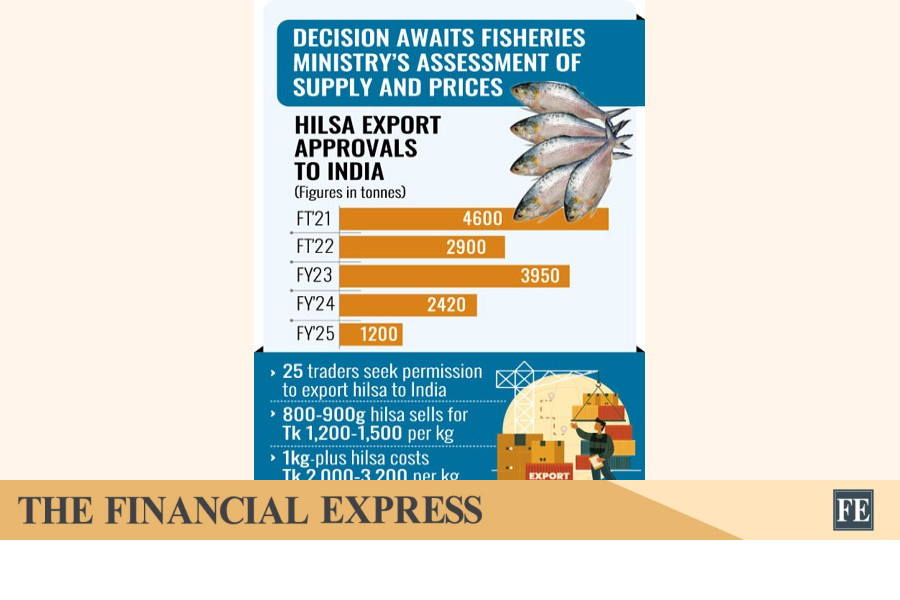
📊 The commerce ministry received 25 applications from commercial traders seeking permission to ship hilsa to India, according to a letter dated 9 September 2026. Before making a decision, the commerce ministry has sought an assessment from the Ministry of Fisheries and Livestock on the current domestic market situation and this season''s overall hilsa yield, sources said. The final export decision will depend on the fisheries ministry''s recommendation and subsequent approval from the competent authorities, according to an official government dispatch.
🏛 Annual ritual of hilsa export decisions
Every year, the Bangladesh government considers allowing hilsa exports to India ahead of Durga Puja, when demand for the fish rises sharply in West Bengal. Hilsa — known locally as "ilish" — is a cultural icon in both Bangladesh and West Bengal, and is considered an essential part of Durga Puja celebrations in the Bengali Hindu community. The annual export decision has therefore become as much a diplomatic and cultural gesture as a commercial trade matter.
The Fish Importers Association of India has separately written to the Prime Minister''s Office, the foreign ministry and the commerce ministry in Bangladesh seeking permission for hilsa imports. "We will take a decision after receiving an opinion from the fisheries and livestock ministry," a commerce ministry official said.
💰 Domestic prices remain elevated
Market experts and fish wholesalers fear that allowing exports could put further pressure on domestic prices, which remain high despite a recent improvement in supply. A midsize hilsa weighing 800-900 grammes is selling for around Tk 1,200-1,500 per kg, while fish weighing 1.0 kg or more costs Tk 2,000-3,200 per kg, according to market sources. Prices have eased by Tk 100-200 per kg in recent weeks following a slight improvement in supply, but they remain well above historical levels.
The elevated prices reflect a structural supply-demand imbalance in Bangladesh''s hilsa market. Bangladesh produces around 0.5 million tonnes of hilsa a year, according to a sector source, but production has declined in recent years due to overfishing, habitat destruction, and the impact of climate change on river flows and breeding patterns. Reports say Bangladesh has also started importing hilsa from India to address a domestic supply shortfall — a remarkable reversal of the traditional trade flow between the two countries.
📊 Historical export volumes
According to commerce ministry data, Bangladesh has repeatedly allowed hilsa exports to India ahead of Durga Puja in recent years, although actual shipments have often fallen well short of the permitted quantities:
- ✅ 2025: 1,200 tonnes permitted
- ✅ 2024: 2,420 tonnes permitted
- ✅ 2023: 3,950 tonnes permitted
- ✅ 2022: 2,900 tonnes permitted
- ✅ 2021: 4,600 tonnes permitted
- 📊 2020: 1,850 tonnes approved (full quantity not shipped)
- 📊 2019: 500 tonnes (first approval since 2012 suspension)
Hilsa exports had remained suspended since 2012 before the commerce ministry allowed 500 tonnes to be exported to neighbouring countries in 2019. In 2020, it approved exports of 1,850 tonnes, although the full quantity was not shipped. The 2025 quota of 1,200 tonnes was the lowest in five years, reflecting growing concerns about domestic supply constraints and the need to prioritise local consumers.
🌏 Diplomatic and cultural significance
The hilsa export decision has significant diplomatic and cultural dimensions beyond the commercial considerations. Bangladesh and India share deep cultural ties rooted in the Bengali language and traditions, and hilsa is a powerful symbol of that shared heritage. Allowing hilsa exports ahead of Durga Puja is seen as a goodwill gesture that strengthens bilateral relations — particularly with West Bengal, where the fish is a central part of the festival''s culinary traditions.
However, the export decision also has to balance the interests of Bangladeshi consumers, who face elevated hilsa prices during the peak festival season. The Tk 100-200 per kg price easing in recent weeks has been driven by improved domestic supply, but allowing significant exports could reverse this trend and push prices back up at a time when consumers are already feeling the pinch of broader inflationary pressures.
🤝 Trade dynamics between Bangladesh and India
The hilsa trade also reflects the broader trade dynamics between Bangladesh and India. Bangladesh has a significant trade deficit with India, and hilsa is one of the few products where Bangladesh has historically held a position as the dominant supplier. Allowing hilsa exports therefore has a modest positive impact on the bilateral trade balance, although the volumes are relatively small compared to overall trade between the two countries.
The decision also has implications for the livelihoods of Bangladeshi fishermen and the fishing communities along the country''s southern coast. Hilsa fishing is a major source of employment in districts such as Patuakhali, Barguna, Bhola, and Pirojpur, and the export market provides higher prices that can support these communities. However, overfishing driven by export demand has contributed to the decline in hilsa stocks, creating a sustainability challenge that policymakers must address.
👥 Sustainability concerns
The decline in Bangladesh''s hilsa production in recent years has raised sustainability concerns that go beyond the annual export decision. Hilsa is a migratory fish that breeds in the rivers of Bangladesh and India before returning to the Bay of Bengal, and its lifecycle is sensitive to disruptions from overfishing, river pollution, infrastructure development, and climate change. The Bangladesh government has implemented various measures to protect hilsa stocks, including bans on fishing during the breeding season, restrictions on nets that catch juvenile fish, and the establishment of hilsa sanctuaries in key rivers.
However, enforcement has been inconsistent and the measures have not been sufficient to reverse the decline in production. The annual export decision therefore has to be made in the context of a broader hilsa management strategy that addresses the structural challenges facing the fishery — including the need for better data on stocks, stronger enforcement of fishing regulations, and investments in habitat restoration and stock enhancement.
💰 What to watch
The commerce ministry''s decision on hilsa exports to India is expected in the coming days, ahead of Durga Puja which typically falls in October. Several factors will shape the decision:
- 📊 Fisheries ministry assessment: The fisheries ministry''s assessment of current domestic supply and this season''s overall hilsa yield will be the key input to the export decision.
- 📊 Domestic price trajectory: If prices continue to ease, the government may be more willing to allow exports. If prices remain elevated or rise further, the government may restrict or reject export applications.
- 📊 Diplomatic considerations: Bangladesh''s broader bilateral relationship with India, including trade and water-sharing negotiations, may influence the export decision.
- 📊 Sustainability concerns: The government may also factor in the long-term sustainability of hilsa stocks when deciding on export volumes.
For Bangladesh''s hilsa sector, the coming weeks will be a key test of the government''s ability to balance competing interests — diplomatic goodwill with India, consumer welfare at home, the livelihoods of fishermen and fishing communities, and the long-term sustainability of the fishery. The decision will be closely watched by all stakeholders, and will set the tone for hilsa trade policy in the years ahead.
This news was originally published by The Financial Express. For the full original report, please visit: https://thefinancialexpress.com.bd/trade/govt-weighs-hilsa-exports-to-india-amid-domestic-supply-concerns
📬 Get Bangladesh Trade News in your inbox
Weekly digest of export industry news, policy updates, and market analysis.
📰 Related Stories