Bangladesh Forms National Panel to Draft First Creative Economy Policy by December 2026
Dhaka, August 11, 2026 — The Bangladesh government has formed an 11-member inter-ministerial panel tasked with drafting the country’s first National Creative Economy Policy by December 2026 — a landmark initiative aimed at unlocking an estimated $5 billion in annual creative-sector exports by 2030 and formalising a segment of the economy that today operates almost entirely outside the policy and statistical framework.
🎨 The Panel’s Composition
The committee, notified by the Cabinet Division on August 9, is chaired by the Secretary of the Ministry of Cultural Affairs and includes representatives from:
- 🏛️ Ministry of Commerce — on export promotion and trade-fair strategy for creative goods
- 🏛️ Ministry of Information and Broadcasting — on film, television and digital content regulation
- 🏛️ ICT Division — on gaming, animation, software and platform policy
- 🏛️ Ministry of Posts and Telecommunications — on broadband and creator economy infrastructure
- 🏛️ Ministry of Youth and Sports — on esports, youth creative skills and creator training
- 🏛️ Ministry of Education — on creative curriculum in universities and vocational institutes
- 🏛️ Export Promotion Bureau (EPB) — on creative export statistics and HS-code mapping
- 🏛️ Bangladesh Bank — on fintech and payment rails for digital creators
- 🏛️ NBR — on tax treatment of creative income and IP royalties
- 🏛️ BSCIC — on SME support for crafts, handloom, and boutique creative enterprises
The panel has been given 120 days to produce a draft policy, which will then undergo a 60-day public consultation before final Cabinet approval targeted for February 2027.
📊 Why a Creative Economy Policy Now?
The move responds to a fast-growing but unrecognised sector. According to a UNESCO-commissioned mapping exercise completed in May 2026 by the Bangladesh University of Engineering and Technology (BUET) and the Centre for Policy Dialogue (CPD), Bangladesh’s creative economy comprises:
- 🎬 Film and television: ~$420 million annual market, employing 180,000 people, with 3,200 cinema screens and 38 active TV channels
- 🎵 Music and live performance: ~$95 million annual market, 22,000 registered artists, 400+ live music venues
- 🎮 Gaming and esports: ~$180 million annual market, 6 million active gamers, 400+ professional esports players, 12 studios employing 1,800 developers
- 🎨 Design, animation and VFX: ~$140 million annual market, 2,200 freelancers and 35 studios, with 60 per cent of work outsourced from US, UK and Australia
- 💻 Software and IT services (creative subset): ~$1.6 billion of total IT exports, with $480 million attributable to creative-adjacent work (UI/UX, design-led development, content platforms)
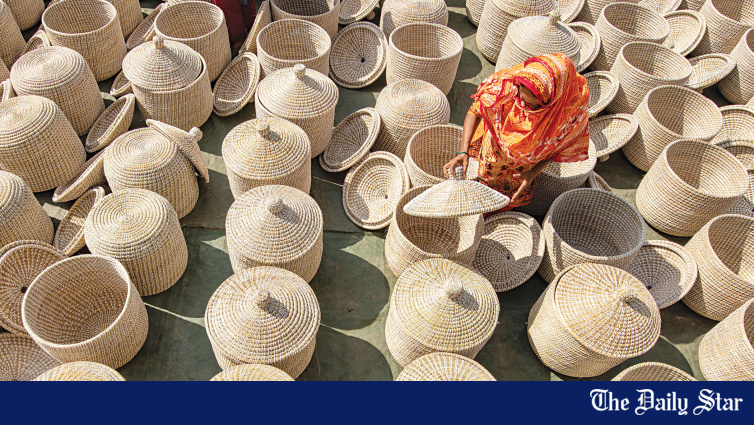
- 🧺 Crafts, handloom and jamdani: ~$310 million annual market, 1.2 million weavers and artisans (mostly women), with $58 million in exports
- 📚 Publishing and print: ~$240 million annual market, 4,100 publishers, 24,000 titles per year
Total estimated creative economy size: approximately $3.1 billion in 2025, employing around 3.8 million people directly and indirectly. The panel’s goal is to grow this to $5 billion in exports and $12 billion in domestic market value by 2030.
🌏 The Strategic Logic
The creative economy push is not just about culture — it is a deliberate diversification strategy. Bangladesh’s export basket is overwhelmingly concentrated in RMG (84 per cent of merchandise exports). LDC graduation in November 2026 will remove duty-free EU access for RMG under EBA, and the country urgently needs new export pillars. Creative exports — animation, gaming, software, design, music licensing, film distribution — do not require factory infrastructure, container shipping or raw-material imports. They require skilled people, broadband, and IP protection — all areas where targeted policy can move the needle quickly.
UNESCO’s 2025 Creative Economy Outlook noted that developing countries capturing even 1 per cent of the $2.2 trillion global creative market can generate more foreign exchange per worker than traditional manufacturing. Vietnam’s creative exports grew from $0.8 billion in 2018 to $3.4 billion in 2025; Bangladesh, with comparable population and a stronger English-language skill base in IT, has been held back only by the absence of a coherent policy framework.
📋 The Eight Policy Pillars Expected
Based on the panel’s preliminary scoping document and consultations with industry bodies including the Bangladesh IT&LOL Alliance, e-CAB, the Animation and Game Developers Association of Bangladesh (AGDAB), and the Federation of Film Societies, the draft policy is expected to address eight pillars:
- 📜 Legal framework for IP and copyright — modernise the Copyright Act 2000, establish a digital rights registry, and accede to the WIPO Internet Treaties
- 📜 Creative export incentives — 10 per cent cash incentive on animation, gaming, VFX and design exports; 5 per cent on film, music and publishing exports; duty drawback on imported equipment
- 📜 Creator financing — a Tk 500 crore Creative Economy Fund managed by Bangladesh Bank, providing concessional loans to studios, freelancers and creative SMEs
- 📜 Skills and education — creative tracks in 50 universities, dedicated creative polytechnics in Dhaka, Chattogram and Rajshahi, and a national creator skilling programme targeting 100,000 young people by 2030
- 📜 Infrastructure — creative parks in Dhaka (Agargaon), Chattogram and Sylhet offering studio space, render farms, sound stages and co-working for freelancers
- 📜 Digital platforms and payments — regulatory clarity on streaming, content licensing, creator payments, and integration of local payment rails with global platforms (YouTube, Spotify, Steam, Patreon)
- 📜 International promotion — Bangladesh Pavilions at Cannes, Berlinale, Gamescom, SIGGRAPH and the UNESCO Creative Cities Network; dedicated trade attaches in 12 priority embassies
- 📜 Statistics and evidence — BBS to publish annual Creative Economy Satellite Account, with EPB reporting creative exports as a separate line item from FY28 onward
💬 Industry Response
Industry leaders broadly welcomed the panel’s formation while cautioning that previous cultural-policy initiatives have stalled at implementation. “We have heard promises before — the 2019 Cultural Policy revision, the 2022 Digital Commerce Policy — but the creative sector remains invisible in export statistics, invisible in tax filing categories, and invisible in NBR’s duty-drawback schedule,” said the founder of one of Bangladesh’s largest animation studios, asking not to be named. “If this panel can fix those three things — statistics, tax categories, duty drawback — in the first 90 days, the rest of the policy can take longer. If it cannot, we will know it is another exercise in optics.”
The e-Commerce Association of Bangladesh (e-CAB), which represents 1,800+ digital businesses including many in the creator economy, has submitted a 14-point demand including: zero-rated VAT on creative digital services export, a freelance-creator tax regime capped at 10 per cent, and a sovereign creator-IP insurance fund to protect studios from international contract defaults.
🌏 The LDC-Graduation Angle
The creative economy push is also an explicit response to LDC graduation. The Ministry of Commerce estimates that Bangladesh will lose $5–$7 billion in export preferences within three years of graduation, with RMG bearing the brunt. The panel’s mandate is to ensure that at least $2 billion of new creative exports materialise by 2030 to partially offset the loss. Targets include: $1.2 billion in animation/VFX/design exports, $600 million in gaming and esports revenue, $300 million in IT and platform services, and $200 million in film and music licensing.
✅ What Comes Next
The panel will hold its inaugural meeting on August 18, 2026 at the Bangladesh Secretariat. It has been asked to deliver a concept note by September 15, a full draft by December 1, and a final policy after public consultation by February 28, 2027. The Ministry of Cultural Affairs has indicated that the policy will be backed by a separate Creative Economy Action Plan 2027–2030, with annual targets, budget allocations and an independent monitoring committee drawn from industry, academia and government.
For Bangladesh’s 3.8 million creative workers — from jamdani weavers in Narayanganj to animators in Banani to esports players in Chattogram — the next six months will determine whether their work finally moves from the margins of the economy to its strategic core. The policy is overdue. The talent is already here. The question is whether the government can match ambition with execution.
This news was originally published by The Daily Star. For the full original report, please visit: https://www.thedailystar.net/business/economy/news/panel-formed-steer-govts-creative-economy-policy-4244761
Related on BangladeshExport
📬 Get Bangladesh Trade News in your inbox
Weekly digest of export industry news, policy updates, and market analysis.
📰 Related Stories

✍️ More from System Administrator