Bangladesh Bank Tightens Rules For Bank Nominee Director Appointments: New Ownership Requirements
Bangladesh Bank issues new circular requiring nominee directors to own at least 2% of paid-up capital (listed) or 20% (unlisted) of shareholder company, and bars companies from holding bank shares exceeding their net worth. Rules effective immediately under Section 45 of Bank Company Act, 1991.
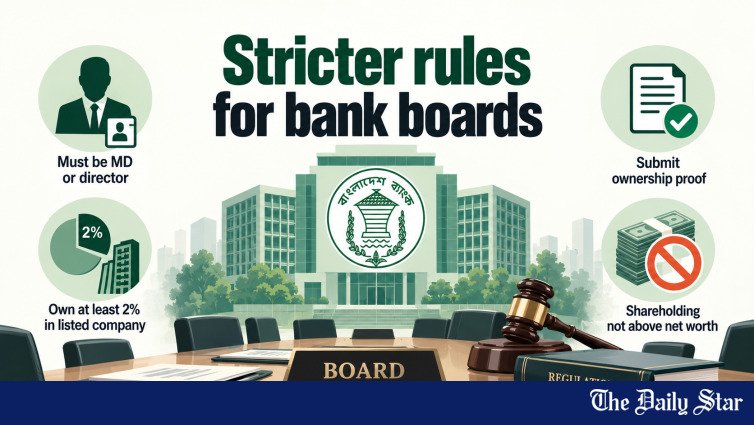
Dhaka, September 25, 2026 — Bangladesh Bank (BB) has tightened rules for appointing nominee or representative directors to banks' boards to tackle irregularities and bring greater transparency to the banking sector. The new rules, issued under Section 45 of the Bank Company Act, 1991, took effect immediately.
📋 Key Requirements Under New Rules
Under the new rules:
- 👥 A representative director must be the managing director or a director of the shareholder company.
- 💰 The nominee must own at least 2 per cent of the paid-up capital of a listed public limited company — in their own name and free from encumbrance.
- 💰 The nominee must own at least 20 per cent of the paid-up capital of other (unlisted) companies.
- 💰 The nominee must maintain the required ownership throughout their tenure as a representative director.
- 📜 Banks must submit documentary evidence of the nominee's ownership when seeking BB's prior approval for appointment, reappointment, or replacement.
- 📜 The same requirements apply to reappointment or replacement of representative directors appointed before the circular was issued.
🚫 Net Worth Restriction On Bank Shareholdings
Through the circular, the banking regulator has also barred companies from holding shares in one or more banks worth more than their net worth — aiming to ensure transparency and stability in bank ownership and protect depositors' interests.
Under the circular:
- 🚫 A company whose investment in bank shares exceeds its net worth will have to bring its holdings within the prescribed limit within six months of the circular's issuance.
- 🚫 This restriction prevents over-leveraged companies from exercising excessive influence over bank governance.
🏛 Implementation And Compliance
The central bank directed banks to:
- 📝 Place the circular before their boards for information and necessary action.
- 📝 Bring it to the attention of all officials and shareholders.
- 📝 Ensure compliance with the new ownership and director qualification requirements.
The instructions, issued under Section 45 of the Bank Company Act, 1991, took effect immediately.
💼 Why These Rules Matter For Bangladesh's Banking Sector
The tightened nominee director rules address several long-standing governance concerns in Bangladesh's banking sector:
- ⚠ Nominee director abuse — where nominee directors were appointed without meaningful ownership stakes, allowing them to act without accountability.
- ⚠ Over-leveraged shareholdings — where companies with limited net worth held disproportionate stakes in banks, creating systemic risk.
- ⚠ Lack of transparency — in the ownership and control structure of banks.
- ⚠ Conflicts of interest — where nominee directors prioritised shareholder company interests over bank and depositor interests.
- ⚠ Regulatory evasion — where complex ownership structures were used to circumvent banking regulations.
🏦 Bangladesh's Banking Sector Governance Reform Context
The new nominee director rules are part of a broader banking sector governance reform agenda that includes:
- 🏦 IMF programme conditions — banking sector reform is a key condition under Bangladesh's IMF credit programme.
- 🏦 NPL resolution — addressing the elevated non-performing loan levels across the sector.
- 🏦 Islami Bank governance crisis — with one-member board and MD vacuum highlighting governance weaknesses.
- 🏦 Bank recapitalisation — strengthening bank capital positions.
- 🏦 Corporate governance improvements — including board composition, audit committee independence, and risk management.
💰 The Net Worth Restriction: Why It Matters
The restriction on companies holding bank shares exceeding their net worth is particularly significant because:
- 💰 It prevents shell companies or thinly capitalised entities from controlling significant bank shares.
- 💰 It ensures that bank shareholders have real financial substance — not just paper structures.
- 💰 It reduces the risk of contagion from shareholder company distress to bank stability.
- 💰 It promotes transparency in bank ownership — by requiring verifiable net worth backing.
- 💰 It aligns with international banking governance standards — including Basel Committee guidance on bank ownership.
📜 Looking Ahead
For Bangladesh's banking sector, the tightened nominee director rules represent a meaningful step towards improved governance. The coming months will reveal:
- 📝 Whether banks can identify and regularise all nominee directors under the new rules.
- 📝 Whether companies with over-leveraged bank shareholdings can bring their holdings within the prescribed limit within six months.
- 📝 Whether the rules effectively improve board accountability and decision-making quality.
- 📝 Whether the rules support the broader banking sector reform agenda under the IMF programme.
For depositors and investors, the new rules provide reassurance that Bangladesh's banking sector governance is being strengthened — with regulators taking concrete steps to address long-standing weaknesses in bank ownership and board composition.
This news was originally published by The Daily Star. For the full original report, please visit: https://www.thedailystar.net/business/news/bb-tightens-rules-bank-nominee-director-appointments-4275576
📬 Get Bangladesh Trade News in your inbox
Weekly digest of export industry news, policy updates, and market analysis.
📰 Related Stories



✍️ More from System Administrator