Bangladesh Approves National Pay Scale 2026: Basic Salary Raised by Up to 142%
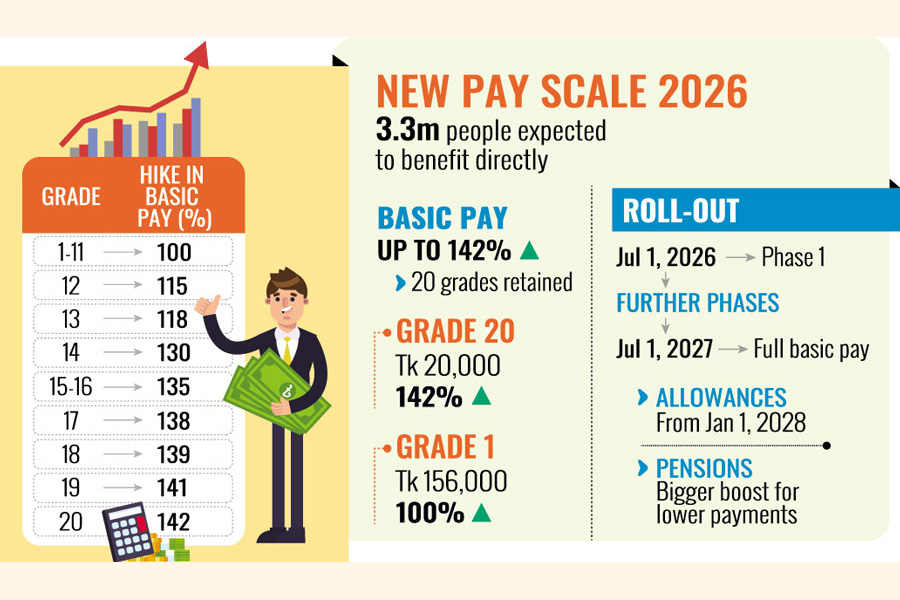
The Financial Express, Dhaka — Basic salaries of government service-holders in Bangladesh will rise by up to 142 percent as the government approved the National Pay Scale 2026 on Thursday, retaining the existing 20-grade pay structure — the most significant public sector pay revision in nearly 12 years.
The cabinet approved the National Pay Scale in its meeting on Monday, with Prime Minister Tarique Rahman in the chair. Cabinet Secretary Nasimul Gani disclosed the details at a press briefing after the meeting.
"The pay scale was approved by the cabinet today (Monday). Various parts of it will be clarified through several SROs (Statutory Regulatory Orders)," he told journalists. He said a new pay structure for government officials and employees was being introduced after nearly 12 years.
📅 Implementation Timeline
The new pay scale takes retrospective effect from July 1, 2026, but the revised basic salaries will be implemented in three phases through July 1, 2027, with priority given to employees in grades 10 to 20:
- 📅 July 1, 2026: retrospective effect begins
- 📅 Phased implementation: three phases through July 1, 2027
- 📅 Priority grades: grades 10 to 20 (lower-paid employees)
- 📅 Allowances: take effect from January 1, 2028
The phased implementation approach reflects the government's cautious management of the fiscal impact — with priority given to lower-paid employees who have been most affected by inflation and the rising cost of living.
📊 Pay Structure Details
The new structure was finalised after reviewing recommendations from:
- 🏛 Secretaries' committee formed on the basis of pay commission reports
- 🏛 National Pay Commission 2025 recommendations
- 🏛 Armed Forces Pay Committee 2025 recommendations
The government said the new structure took into account:
- 💰 Fiscal capacity of the government
- 📊 Overall economic situation
- 💰 Inflation trajectory
- 👥 Rising cost of living for public sector employees
⚠️ Economist's Cautionary Note
Economist Dr M Masrur Reaz urged the government to adopt a more cautious implementation schedule, warning that a rapid pay hike could:
- ⚠️ Fuel inflation — particularly in consumer goods and services
- ⚠️ Strain government's finances — already under pressure from bank borrowing
- ⚠️ Increase borrowing requirements to fund the pay hike
- ⚠️ Pressure FX reserves through imported inflation pass-through
The cautionary note is significant given Bangladesh's broader macroeconomic context — with the central bank having reported Q4 FY26 macroeconomic stabilisation signs but persistent inflationary pressure from the Iran war-driven petroleum import bill (up 107% YoY in FY26) and the gas crisis affecting industrial production.
🏛 Non-MPO Teachers Excluded
Meanwhile, the Cabinet Secretary said no decision had yet been taken on the pay-scale issue concerning non-MPO teachers — leaving a significant segment of the education sector workforce in continued uncertainty about their pay revision status. The non-MPO (Monthly Pay Order) teacher category includes teachers at privately-managed educational institutions that receive partial government support.
📊 Strategic Context: First Pay Scale in 12 Years
The National Pay Scale 2026 represents the first comprehensive public sector pay revision in nearly 12 years:
- 📊 Previous pay scale: implemented in 2015
- 📊 Year gap: nearly 12 years since last revision
- 📊 Inflation accumulation: significant real-wage erosion over the period
- 📊 Maximum basic salary increase: 142 percent
- 📊 Pay structure: 20 grades retained (no structural simplification)
The 12-year gap between pay scales has been a persistent source of public sector employee frustration — particularly given the high inflation Bangladesh experienced during the post-Covid period and the broader macroeconomic pressure through 2024-2026.
💰 Fiscal Implications
The 142 percent maximum salary increase carries significant fiscal implications:
- 💰 Government bank borrowing: already exceeded FY26 target by over Tk 47,500 crore
- 💰 Public sector wage bill: will expand substantially with new pay scale
- 💰 Revenue mobilisation: NBR needs to step up collection to fund pay hike
- 💰 Deficit financing: may require additional borrowing or deficit monetisation
- 💰 Treasury yields: have fallen into single digits, easing borrowing cost
The government will need to balance the pay scale implementation with broader fiscal discipline — particularly as the LDC graduation transition approaches in November 2026 and the country navigates the broader macroeconomic stabilisation narrative.
👥 Beneficiary Coverage
The pay scale will benefit a substantial public sector workforce:
- 👥 Direct government employees: civil servants across all 20 grades
- 👥 Armed forces personnel: covered by Armed Forces Pay Committee 2025 recommendations
- 👥 Priority grades 10-20: lower-paid employees receive phased implementation priority
- 👥 Non-MPO teachers: decision pending (not yet covered)
🌏 Strategic Implications
The National Pay Scale 2026 carries several strategic implications for Bangladesh's broader economic trajectory:
- ✅ Public sector wage competitiveness: addresses long-standing real wage erosion
- ✅ Inflation management priority: phased implementation reduces fiscal shock
- ✅ Lower-paid employee priority: equity orientation in pay revision
- ✅ Fiscal capacity acknowledgement: structure aligned with government's fiscal position
- ⚠️ Inflation risk: Dr Masrur Reaz's caution about rapid pay hike inflation impact
- ⚠️ Non-MPO exclusion: creates equity concern with teacher workforce
- ⚠️ Borrowing pressure: pay hike may exacerbate government bank borrowing trajectory
The implementation of the pay scale through July 2027 will be a critical test of the government's fiscal management capacity — particularly its ability to fund the expanded public sector wage bill without reigniting inflationary pressure or significantly increasing government borrowing. The next 12 months will reveal whether the phased approach successfully balances public sector wage recovery with broader macroeconomic stability through the LDC graduation transition period.
This news was originally published by The Financial Express / The Daily Star / The Business Standard. For the full original report, please visit: https://thefinancialexpress.com.bd/economy/govt-service-holders-basic-salary-raised-by-up-to-142pc
📬 Get Bangladesh Trade News in your inbox
Weekly digest of export industry news, policy updates, and market analysis.
📰 Related Stories