Bagerhat Farmer Grows Off-Season Watermelons On Saline Coastal Land
Entrepreneur Zakir Hossain uses mulching paper, bamboo frameworks and YouTube-learned techniques to cultivate watermelons 60 days from planting on fallow saline land in coastal Bangladesh
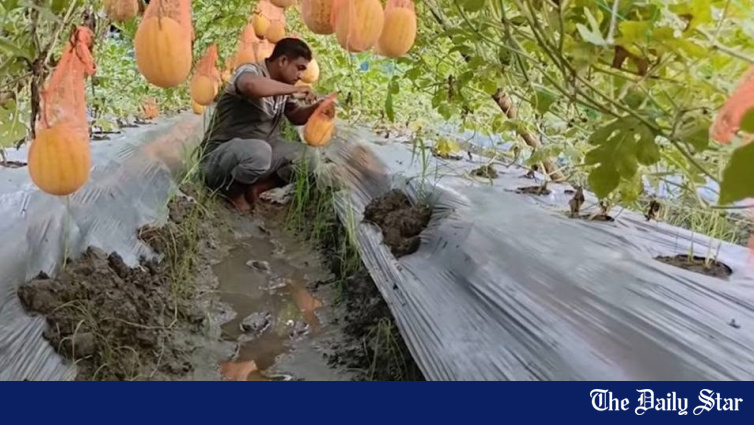
🍉 Near Bottola Bazar in Bemarta union, hundreds of ripe watermelons now hang from bamboo frameworks amid lush green vines, just 60 days after planting. The unusual sight in coastal Bagerhat — a district better known for shrimp farming than for fruit cultivation — is the result of an experiment by a local entrepreneur who has demonstrated that fallow saline land in Bangladesh's coastal belt can be productively converted into off-season watermelon fields using modern cultivation techniques.
🌾 Local businessman and agricultural entrepreneur Zakir Hossain started farming watermelons beside his shrimp enclosure without any formal agricultural training. He learned modern cultivation techniques by watching YouTube tutorials. To retain soil moisture and suppress weeds in the saline soil, Zakir used mulching paper for 1,200 seedlings. He cultivated high-yielding varieties including Smart Boy, Kania, and Surjodim — varieties selected for their adaptability to coastal soil conditions and their suitability for trellis-based vertical cultivation.
"It started as a hobby," Zakir said. "I used mulching paper and applied modern cultivation methods. Alhamdulillah, the yield has been very good." He also installed bamboo frameworks and specialised net bags to support and protect the hanging fruit as they matured. The vertical cultivation method — where watermelons are grown on trellises rather than on the ground — is particularly well-suited to saline coastal land, as it keeps the fruit off the soil and reduces contact with salt-affected ground.
📊 Production Economics
Md Motahar Hossain, deputy director of the Department of Agricultural Extension in Bagerhat, said the plot has around 400 to 450 planting pits. "If each pit produces even one watermelon, around 500 fruits can be harvested," he said. "Each watermelon weighs around two to two-and-a-half kgs and is being sold at Tk 50 to Tk 60 per kilogramme. Farmers have already expressed interest in expanding this cultivation in future."
At Tk 50-60 per kg and an average fruit weight of 2-2.5 kg, each watermelon commands Tk 100-150 at farm-gate prices. With 400-450 pits and an expected yield of 500 fruits, the revenue potential from a single 60-day cultivation cycle on a small plot exceeds Tk 50,000-75,000 — significantly higher than what could be earned from traditional shrimp farming on the same land area, particularly given the recurring disease outbreaks that have plagued Bangladesh's shrimp sector in recent years.
- 🍉 Time from planting to harvest: 60 days
- 🌾 Seedlings planted: 1,200
- 📜 Varieties: Smart Boy, Kania, Surjodim
- 📊 Planting pits: 400-450
- 📊 Expected yield: ~500 fruits per cycle
- 💰 Average fruit weight: 2-2.5 kg
- 💵 Farm-gate price: Tk 50-60 per kg
- 💰 Estimated revenue per cycle: Tk 50,000-75,000+
🌏 Coastal Saline Land: A Strategic Asset
Bangladesh's coastal belt — including Bagerhat, Khulna, Satkhira, Patuakhali and Barguna — contains hundreds of thousands of hectares of land that has historically been considered marginal for agriculture due to salinity intrusion from rising sea levels and reduced freshwater flows in coastal rivers. As climate change accelerates, the extent of salt-affected land is expected to expand further, displacing traditional rice cultivation and pushing coastal communities toward shrimp farming as the dominant land use.
Zakir Hossain's experiment demonstrates that saline land is not inherently unproductive — it can be put to commercial agricultural use with the right combination of crop selection, soil management techniques and cultivation methods. Mulching paper, which creates a barrier between the soil and the air, helps retain soil moisture and prevents weed growth while reducing direct salt contact with plant roots. Vertical trellis cultivation keeps fruit off the ground, eliminating the risk of soil-borne diseases and salt damage that would otherwise limit yields on saline soils.
🤝 Knowledge Transfer Through YouTube
The fact that Zakir Hossain learned the technique from YouTube tutorials — rather than from formal agricultural extension services — highlights both the democratization of agricultural knowledge through digital platforms and the gaps in traditional extension outreach. Bangladesh's Department of Agricultural Extension has a network of field officers across the country, but resource constraints and the diversity of local agro-ecological conditions mean that many innovative cultivation techniques are first tried by individual farmers before being formally validated and recommended by DAE.
For coastal Bangladesh, where climate adaptation needs are urgent and traditional rice-shrimp farming systems are under increasing stress, the YouTube-driven knowledge diffusion model offers a valuable complement to formal extension. Farmers can access tutorials from successful cultivators across Bangladesh and other South Asian countries, adapt the techniques to local conditions, and share their own results through community networks. The model also enables rapid diffusion — successful innovations can spread through coastal communities in a single growing season rather than the multi-year cycles typical of formal extension programmes.
📜 DAE Commitment To Scale The Model
He said the DAE would continue supporting interested farmers through courtyard meetings, specialised training and direct technical assistance. Agricultural officials said commercial off-season watermelon farming could help make better use of coastal fallow land while creating alternative livelihoods for communities affected by climate change. The DAE's commitment to scale the model through formal extension channels is critical — Zakir's success will remain a single data point unless the technique is systematically validated, refined and disseminated across the coastal belt.
The initiative has attracted neighbouring farmers and visitors who seemed interested in the technique. Fish farmer Shishir Kumar Das, visiting from Kachua, said the project inspired local growers to consider alternatives to fish farming. "We are mainly fish farmers," he said. "Seeing Zakir bhai's watermelon farm has inspired us. Many of us are now thinking of trying watermelon cultivation in the future." The peer-to-peer learning dynamic — where successful early adopters inspire neighbours — is typically the most effective channel for diffusion of agricultural innovations in Bangladesh's rural communities.
🌏 Strategic Context: Climate-Resilient Agriculture
For Bangladesh's broader agricultural and climate adaptation strategy, the Bagerhat watermelon experiment offers a template for converting climate vulnerability into climate-resilient opportunity. Coastal Bangladesh is among the world's most climate-vulnerable regions, with salinity intrusion, cyclone impacts and sea-level rise threatening traditional agricultural systems. The conventional narrative has been one of inevitable agricultural decline — but Zakir's success suggests that with the right crop selection and cultivation techniques, coastal land can support productive commercial agriculture even under saline conditions.
The off-season timing of the harvest is also strategically significant. Watermelon is traditionally a summer crop in Bangladesh, with peak supply hitting markets between March and May. Off-season production in September — when market supply is limited — commands premium pricing, improving the economics of coastal cultivation relative to traditional production regions. The 60-day cultivation cycle also allows multiple harvests per year, providing more regular income for farmers compared to the long cultivation cycles of traditional rice or shrimp farming.
🌿 What Comes Next
The coming seasons will reveal whether the Bagerhat model can be scaled across Bangladesh's coastal belt. Key questions include: whether the high-yielding varieties (Smart Boy, Kania, Surjodim) maintain their performance across different micro-climates and salinity levels; whether mulching paper and trellis cultivation prove economically viable at scale; and whether DAE's extension support can reach enough farmers fast enough to convert individual experiments into a regional agricultural transformation.
For coastal communities facing climate-driven livelihood transitions, the off-season watermelon model offers a tangible alternative to traditional shrimp farming — one that uses the same land but generates higher per-cycle revenue with shorter cultivation cycles. If successfully scaled, it could provide climate-resilient livelihoods for thousands of farming families across Bangladesh's coastal districts — and establish the country as a year-round supplier of watermelons to domestic and regional markets, including India, Sri Lanka and the Middle East.
The Bagerhat experiment is small in scale but large in implication. It demonstrates that climate adaptation does not necessarily require massive infrastructure investment or external technology transfer — sometimes, the right combination of crop selection, cultivation method and farmer knowledge can unlock productive potential in land that was previously considered marginal. The model deserves close attention from policymakers, agricultural researchers and climate adaptation funders as Bangladesh navigates its climate-resilient agriculture transition ahead of LDC graduation in November 2026.
This news was originally published by The Daily Star. For the full original report, please visit: https://www.thedailystar.net/business/agriculture/news/bagerhat-entrepreneur-turns-fallow-saline-land-season-watermelon-field-4270271
📬 Get Bangladesh Trade News in your inbox
Weekly digest of export industry news, policy updates, and market analysis.
📰 Related Stories