Rising Costs And Falling Prices Push Bangladesh Poultry Farmers To The Brink: Daily Star Investigation
Daily Star's Sukanta Halder documents the plight of Noakhali poultry farmer Mazedul Haq, whose feed, medicine and electricity costs have surged while broiler chicken prices have fallen — pushing small farmers towards shutting down operations.
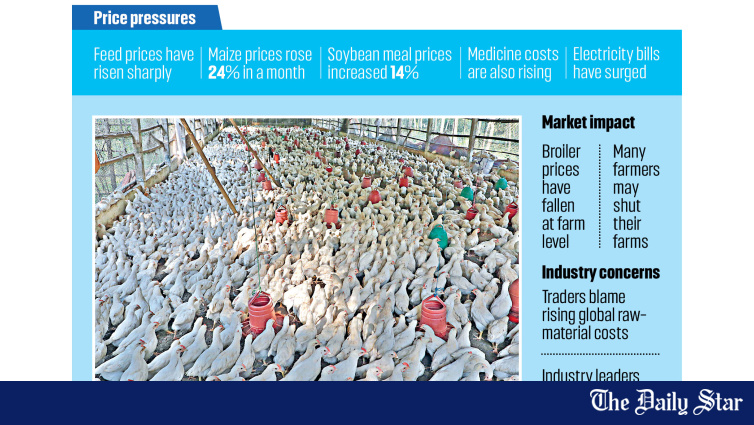
Noakhali/Dhaka, September 25, 2026 — Mazedul Haq has decided to leave poultry farming behind. The farmer from Nolua village in Noakhali's Kabirhat upazila plans to shut down his farm after selling his current batch of broiler chickens. For him, the numbers no longer add up.
🐔 The cost of running his farm has risen sharply, with feed, medicine and electricity becoming more expensive. At the same time, chicken prices have fallen, leaving him with mounting losses. His story is representative of a broader crisis sweeping Bangladesh's poultry industry — one that threatens rural livelihoods and the country's protein supply.
💰 Mazedul Haq's Cost Breakdown
💬 “A sack of feed that cost Tk 3,475 a month ago now sells for Tk 3,600 to Tk 3,650,” Mazedul said. Soybean feed has also become costlier, rising from Tk 950 to Tk 1,200 over the same period.
Medicine prices have increased too. A medicine that cost Tk 300 now sells for around Tk 360 to Tk 370.
Electricity has added to the burden. Mazedul paid about Tk 6,000 last month, but his bill has jumped to Tk 10,000 to Tk 11,000 this month — an increase of approximately 70-85 per cent.
Yet the price of his chickens has moved in the opposite direction. Mazedul, who has around 3,000 broilers, sold his birds for Tk 132 per kg three days ago, down from Tk 140 a month earlier.
With costs rising and returns falling, he sees little reason to continue. Once he sells the current batch, he plans to leave his sheds empty rather than risk another round of losses.
📊 Feed Ingredient Price Surge
Mazedul is not alone. Poultry farmers across the country are facing similar pressure. Over the past month, the price of key feed ingredients has surged dramatically, according to industry data:
- 🌿 Maize: +24 per cent — from Tk 31.30 to Tk 38.80 per kg
- 🌿 De-oiled rice bran: +27 per cent — from Tk 26 to Tk 33 per kg
- 🌿 Rice bran oil: +18 per cent — from Tk 33 to Tk 39 per kg
- 🌿 Mustard oil cake: +9 per cent — from Tk 36.50 to Tk 39.70 per kg
- 🌿 Soybean meal: +14 per cent — from Tk 58 to Tk 66 per kg
🏢 Bangladesh's Feed Industry At A Glance
According to the Feed Industries Association Bangladesh (FIAB) and the Bangladesh Poultry Industries Central Council:
- 🏭 Registered feed companies: around 150 companies.
- 🏭 Annual commercial feed production: approximately 75 lakh tonnes.
- 🏭 Unregistered feed production: an estimated 5 lakh tonnes more.
- 🏭 Poultry feed share: approximately 70 per cent of total output.
- 🏭 Aquaculture and cattle feed: the remaining 30 per cent.
💼 Industry Seeks Policy Support
Feed traders say prices of key raw materials are rising unchecked. Most of these ingredients are linked to international markets, leaving local producers with little control over price movements. They say the industry cannot tackle the problem on its own and are calling for targeted government support and policy measures to keep the poultry sector afloat.
Md Anwarul Haque, general secretary of FIAB, told The Daily Star that unchecked increases in feed raw material prices have sharply raised farmers' production costs. He warned that if the situation is not brought under control soon, raw material prices could rise further, putting more pressure on farmers and consumers.
Import costs have already risen sharply due to soaring global prices — a burden that no single company can bear alone, he added.
💬 FIAB's Specific Policy Asks
To ease pressure on the feed industry, FIAB has called for:
- 🔹 Tighter controls on exports of de-oiled rice bran and rice bran — keeping domestic supply available for feed production.
- 🔹 Review of VAT, tax and duty rates on imported raw materials — reducing import costs for feed producers.
- 🔹 Special support to the feed industry — recognising its strategic importance to food security.
- 🔹 Closer market monitoring — to prevent traders from creating artificial shortages.
- 🔹 Joint efforts by government and private sector — to boost local production of raw materials.
- 🔹 Ensuring steady supply — to ease pressure on the market.
📊 The Farmer-Consumer Price Gap
Bapon Dey, professor of poultry science at Bangladesh Agricultural University, said the poultry industry is facing rising fuel and transport costs, higher feed prices, raw material shortages and unstable market conditions.
He also highlighted the wide gap between farmer and consumer prices:
- 💰 Consumer price: approximately Tk 180 per kg of broiler chicken.
- 💰 Farmer price: approximately Tk 135-140 per kg.
- 💰 Gap: approximately Tk 40 per kg — about 22 per cent of the consumer price.
Professor Dey largely blamed this gap on the sector's unorganised marketing system — where multiple intermediaries between farmer and consumer each take a margin.
💬 Professor Dey's Recommendations
Bapon called on the government and private organisations to bring greater discipline to marketing and distribution through:
- 📋 Regular market monitoring and inspections
- 📋 Public display of prices — in markets across the country.
- 📋 Monitoring teams — with law enforcement agencies involved when necessary.
He also urged measures to ease farmers' rising costs, including:
- 📋 Lower import taxes on feed raw materials.
- 📋 Greater policy flexibility — to respond to global price volatility.
- 📋 Temporary subsidies on electricity and fuel — particularly for poultry farm operations.
🌏 The Broader Economic Context
The crisis facing Bangladesh's poultry farmers is part of a broader pattern of agricultural stress triggered by:
- 📡 September 20 fuel price hike — Tk 20 per litre increase across all petroleum products.
- 📡 West Asia conflict — disrupting global supply chains and pushing up commodity prices.
- 📡 Taka depreciation — making imported feed ingredients more expensive.
- 📡 Electricity price increases — with average tariffs up 17 per cent in June 2026.
- 📡 Global commodity price volatility — particularly for maize, soybean, and edible oils.
👥 Why The Poultry Sector Matters For Bangladesh
Bangladesh's poultry sector is a critical source of affordable protein for the country's 170 million people:
- 🐔 National commercial egg production: approximately 50 million eggs per day.
- 🐔 Daily broiler chicken production: several million birds.
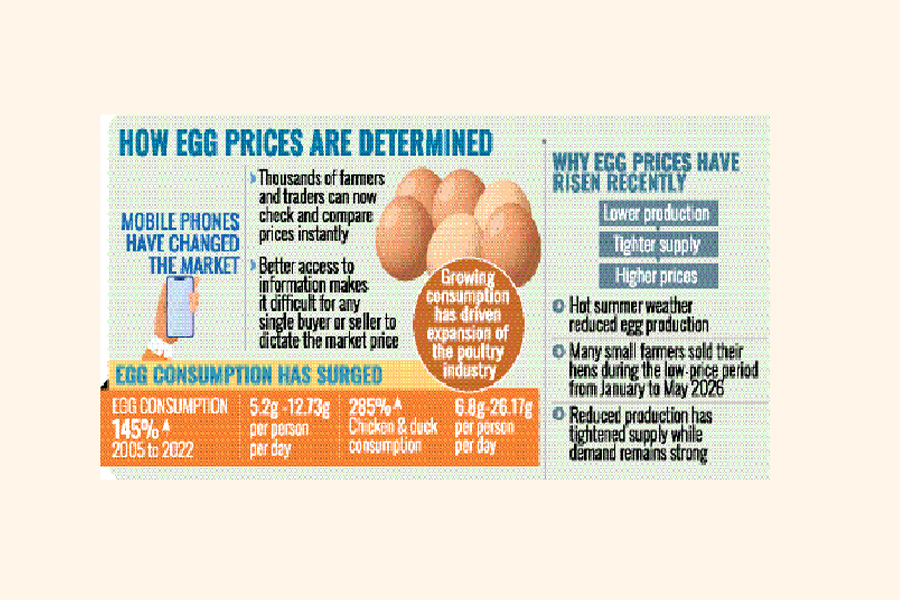
- 🐔 Per capita egg consumption: increased 145 per cent between 2005 and 2022.
- 🐔 Per capita chicken consumption: increased 285 per cent between 2005 and 2022.
- 🐔 Direct employment: millions of small and medium farmers.
- 🐔 Indirect employment:
💼 The Threat Of Small Farmer Exit
The most concerning aspect of the current crisis is the threat of small farmer exit. Farmers like Mazedul Haq — who operate with limited capital and thin margins — are the first to be forced out when input costs rise and output prices fall. If a significant number of small farmers exit:
- ⚠ National egg and chicken production could fall — creating supply shortages.
- ⚠ Consumer prices could rise sharply — due to reduced supply.
- ⚠ Rural employment could decline — with limited alternative livelihoods.
- ⚠ Nutritional outcomes could deteriorate — particularly for low-income households.
- ⚠ Import dependence could increase — for eggs, poultry meat, and feed ingredients.
🏛 Policy Response Options
To prevent a wider poultry sector crisis, the government has several policy options:
- 🔹 Reduce or eliminate import duties on key feed raw materials — particularly maize, soybean meal, and rice bran.
- 🔹 Provide targeted electricity subsidies for registered poultry farms — similar to those provided to export-oriented industries.
- 🔹 Establish a poultry stabilisation fund — providing emergency support to farmers during price downturns.
- 🔹 Strengthen market monitoring — to identify and address price manipulation by intermediaries.
- 🔹 Invest in cold chain infrastructure — to reduce post-harvest losses and improve farmer prices.
- 🔹 Promote direct farmer-to-consumer linkages — through digital platforms and farmers' markets.
- 🔹 Support domestic feed ingredient production — particularly for maize, soybean, and oilseed crops.
📜 Outlook
For farmers like Mazedul Haq, the decision to exit poultry farming is not just a personal economic choice — it is a symptom of a sector under severe strain. Without urgent policy intervention, Bangladesh risks losing a significant portion of its small-scale poultry farmers — with cascading effects on rural employment, food security, and consumer prices.
The coming weeks will be critical in determining whether the government responds with the kind of targeted support the industry is calling for — or whether more farmers will be forced to follow Mazedul Haq's path out of the sector.
For Bangladesh's broader food security strategy, the poultry crisis is a stark reminder that affordable protein depends on the viability of small farmers — and that viability is currently under threat from a perfect storm of cost pressures beyond their control.
This news was originally published by The Daily Star. For the full original report, please visit: https://www.thedailystar.net/business/economy/news/rising-costs-falling-prices-push-poultry-farmers-the-brink-4282301
📬 Get Bangladesh Trade News in your inbox
Weekly digest of export industry news, policy updates, and market analysis.
📰 Related Stories

✍️ More from System Administrator