LDCs Lag Behind In Global Trade In Services: UNCTAD Report
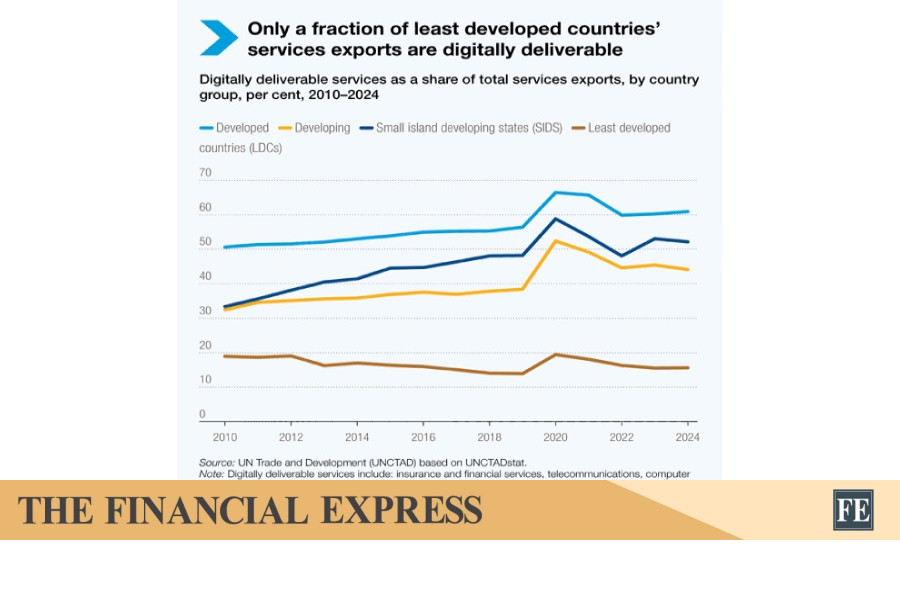
UNCTAD's latest global trade update reveals LDCs account for only 16% of digitally deliverable services exports versus 61% in developed economies, exposing a structural gap
🌏 A decade after the launch of the United Nations (UN) Sustainable Development Goals (SDGs), progress toward achieving them remains far from optimal. With less than four years to the 2030 deadline, the prospect looks gloomy. SDG target 17.11 calls for a significant increase in developing countries' exports, aiming to double the share of Least Developed Countries (LDCs) in global exports from 1.0 per cent in 2011 to 2.0 per cent by 2020. Still, the target was not achieved as the LDCs' combined share of global exports remained stubbornly low.
📊 The latest global trade update report from the UN Conference on Trade and Development (UNCTAD), released last week, focused on trade in services. It noted that although services are reshaping global trade, LDCs lag in digital exports, which make up a significant share of total commercial services exports. Commercial services are generally divided into four broad sectors: (i) transport, (ii) travel, (iii) goods-related services, and (iv) other commercial services. Trade in commercial services reflects the broader structural transformation of economies from goods-dominated to services-dominated value creation.
💰 Services Are Reshaping Global Trade
Although services are intangible by definition, sometimes they are embedded in commodities or goods. Due to the expansion of digital activities in recent years, services have become increasingly embedded in manufacturing, agriculture, and other economic activities. This means services are not limited to inputs but are transforming what firms make and sell. The UNCTAD report pointed out two related trends showing how services are becoming more central to production and trade. One is 'servicification' — where goods increasingly embed service components — and the other is the rise of digitally deliverable services that can be traded remotely over computer networks.
As inputs, services are now also traded indirectly. UNCTAD found that hidden services content is substantial but uneven. According to the UN agency's estimates, services represent 33 per cent of intermediate inputs in industrial goods exports in developed economies. The ratio is 27 per cent in developing economies and 13 per cent in LDCs. This is hardly surprising, as LDCs lag in the complex advancement of services, especially through digitalisation.
- 📊 LDC share of global exports target: 2% by 2020 (NOT achieved)
- 💰 Services as % of industrial inputs (developed): 33%
- 💰 Services as % of industrial inputs (developing): 27%
- 💰 Services as % of industrial inputs (LDCs): 13%
- 📈 Global services exports growth (last year): 8.3%
- 📈 DDS growth rate (annual avg): 7.1%
- 📊 DDS share of global services exports: 56%
- 📊 DDS share of LDC services exports: 16%
- 📊 DDS share of developed economy services exports: 61%
🏛 Bangladesh's Services Export Statistics
LDCs and many developing nations have yet to properly quantify trends in trade in commercial services. A lack of adequate statistical tools and deeper knowledge of the diverse nature of services makes it challenging to generate sufficient data on services activities and trade. As a result, data released by LDCs, including Bangladesh, on trade in services are often flawed or underestimated.
In fiscal year 2025-26 (FY26), Bangladesh's commercial services exports reached US$5.54 billion, up 5.50 per cent from the previous year. Statistics released by the Export Promotion Bureau (EPB) showed that total services exports stood at $7.24 billion in FY26. This includes inputs of manufacturing goods, commercial services, and government services. Exports of inputs of manufacturing services were estimated at around $0.90 million in the last fiscal year, while government services exports stood at $1.54 billion. Subtracting these two gives the value of traditional commercial services exports at $4.81 billion.
Although EPB uses central bank data to generate services export statistics, a significant gap remains with BoP data on services trade. This is not unusual, as a similar discrepancy has long existed in goods exports. The problem lies in weak national statistics. Instead of investing adequately in strengthening statistical capacity, many LDCs, including Bangladesh, tend to tinker with key national statistics to gain political advantage. The result is that policy decisions on services trade are made on the basis of incomplete or inaccurate data — undermining the effectiveness of services export promotion initiatives.
📜 Bangladesh In OECD TiVA Database
Nevertheless, Bangladesh is one of the seven LDCs whose services trade statistics are included in OECD TiVA databases covering 87 economies. The UNCTAD report used the dataset to analyse various dimensions of services trade. It also indicates that Bangladesh is generating reasonably acceptable services trade statistics, though they require further refinement and development to provide a clearer picture.
The inclusion in OECD TiVA represents meaningful recognition of Bangladesh's services trade data quality — but it also exposes the gap between Bangladesh's data and the standards applied in developed economies. For Bangladesh to leverage its TiVA inclusion for trade policy negotiation and export promotion, the underlying data collection and methodology will need continued investment.
💵 Digitally Deliverable Services: The New Growth Engine
At present, a significant portion of services trade is classified as digitally deliverable services (DDS), services that can be delivered remotely over computer or information technology networks. DDS is considered the key driver of the rapid expansion of global services exports, which registered 8.3 per cent growth last year. UNCTAD report added that DDS trade grew faster than total services, at an average annual rate of 7.1 per cent, and now represents 56 per cent of global services exports.
Insurance and pension services; financial services; charges for the use of intellectual property (IP); telecommunications, computer and information services; research and development services; professional and management consulting services; architectural, engineering, scientific and other technical services; audio-visual and related services; and health services and education services (excluding those consumed during international travel) are the major sub-sectors of DDS. The breadth of DDS sub-sectors underscores the strategic importance of building digital service capabilities — every knowledge-intensive industry falls within the DDS umbrella.
⚠ LDC Digital Divide: 16% Vs 61%
LDCs, including Bangladesh, are still far behind in DDS, accounting for only 16 per cent of total services exports, compared with 61 per cent in developed economies. UNCTAD pointed out that persistent digital divides in LDCs are a major factor, along with these countries' high reliance on traditional services such as transport and travel. So, these countries need to strengthen their efforts to increase the share of DDS in their total service exports so they can also gain from the fastest-growing segment of global trade.
The 45 percentage point gap between LDCs and developed economies in DDS share is not merely a statistical curiosity — it represents a structural shift in global value creation that LDCs are missing. As more of the world's economic activity becomes digitally deliverable, countries that lack DDS capabilities will find their share of global services trade shrinking, even if their absolute services exports grow. The relative decline carries significant implications for trade balance, foreign exchange earnings and the long-term competitiveness of LDC economies.
🌏 Implications For Bangladesh's Services Trade Strategy
For Bangladesh, the UNCTAD findings carry clear strategic implications. The country's IT and IT-enabled services (IT-ITES) export sector — currently estimated at $2-3 billion annually — represents the most promising avenue for scaling DDS exports. The sector has been growing 15-20% annually over recent years, supported by freelance platforms, offshore software development and business process outsourcing (BPO) services delivered to clients in North America, Europe and the Middle East.
However, scaling DDS exports requires addressing structural constraints: limited digital infrastructure outside Dhaka and Chattogram, shortage of skilled IT professionals with international-quality capabilities, weak IP protection that constrains high-value service exports, and absence of a comprehensive national digital trade strategy. Without targeted interventions across these areas, Bangladesh's DDS share is likely to remain stuck well below the developed economy average.
With LDC graduation approaching in November 2026, Bangladesh will lose access to certain preferential treatment and concessional financing — but will also gain the opportunity to negotiate more ambitious trade agreements that include digital trade provisions. The coming years will be decisive for whether Bangladesh can convert its DDS potential into measurable trade gains, or whether the country remains a peripheral player in the global digital services economy while competitors like Vietnam and the Philippines capture a larger share of the growing DDS market.
This news was originally published by The Financial Express. For the full original report, please visit: https://thefinancialexpress.com.bd/columns/ldcs-lag-behind-trade-in-services
Related on BangladeshExport
📬 Get Bangladesh Trade News in your inbox
Weekly digest of export industry news, policy updates, and market analysis.
📰 Related Stories