BRICS Delhi Declaration Signals Grudge Over Global Trade Rules: Implications For Bangladesh
BRICS nations representing 40% of global GDP and 26% of trade push for de-dollarisation, IMF/World Bank reform and WTO dispute restoration, with strategic implications for Bangladesh's trade
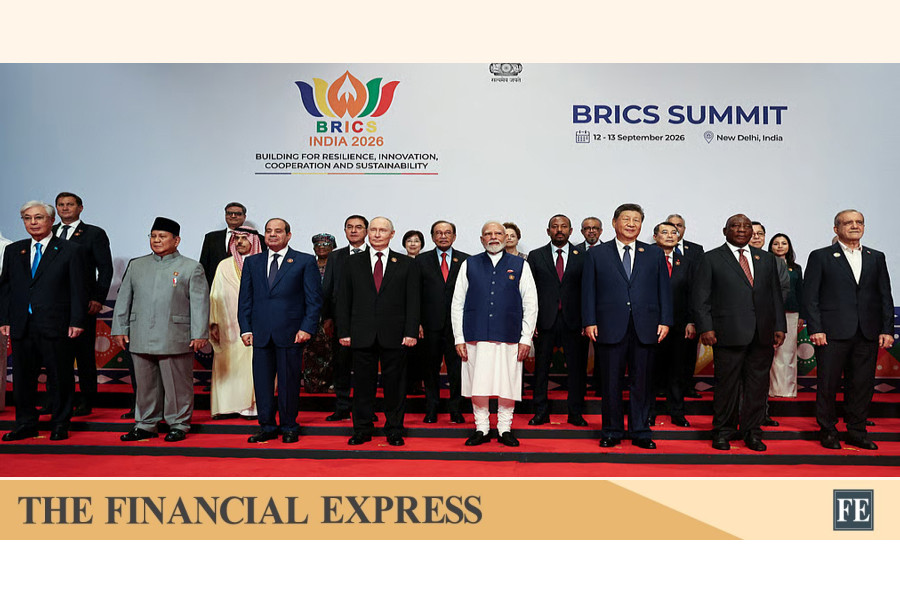
🌏 The most consequential message from the Delhi Declaration of the BRICS summit may not be found in any single paragraph. It lies in the sheer breadth of the document. Across 140 paragraphs, the grouping of Global South moves from war and terrorism to currencies, sanctions, tariffs, energy security, artificial intelligence and the future of multilateral institutions. Taken together, the declaration amounts to something more than a diplomatic communiqué: it is a statement of dissatisfaction with the existing architecture of global economic governance.
📊 That dissatisfaction matters because BRICS is no longer a marginal club. Its members collectively account for roughly half of the world's population, about 40 per cent of global GDP and 26 per cent of global trade. What they say about the future of trade therefore cannot easily be dismissed as rhetoric from the periphery. The question is whether BRICS can turn its growing economic weight into a coherent alternative to the existing system. The Delhi declaration suggests that it wants to try.
💰 De-Dollarisation: Practical Steps Over Symbolic Currency
Perhaps the clearest challenge is the dominance of the US dollar. The declaration stops short of endorsing a single BRICS currency — a proposal that has often attracted headlines but remains politically and economically unrealistic in the near term. Instead, it calls for continued work on cross-border payment interoperability and trade settlements and investment using BRICS members' local currencies.
That distinction is important. De-dollarisation, if it happens, is more likely to emerge through thousands of commercial transactions than through the launch of a spectacular new currency. If companies in Brazil, India, China, Russia or other BRICS economies can increasingly settle trade directly in their own currencies, demand for dollars could gradually decline. But the declaration itself acknowledges that there is no "one-size-fits-all approach". That phrase exposes the fundamental limitation of BRICS. Its members have different economic structures, monetary policies, strategic interests and relationships with the dollar. China and Russia may have stronger incentives to reduce dependence on the US financial system, while other members may see considerable advantages in continuing to use it.
- 👥 BRICS population share: ~50% of world
- 📊 BRICS GDP share: ~40% of global
- 📊 BRICS trade share: 26% of global
- 📜 Delhi Declaration paragraphs: 140
- 💰 Single BRICS currency: NOT endorsed
- 💵 Local currency settlement: Promoted
- 🏛 Targets: IMF, World Bank, WTO reform
- 🌏 Focus: Cross-border payment interoperability
📜 Sanctions, Tariffs And Geoeconomic Contest
The same tension appears in the declaration's treatment of sanctions and trade barriers. BRICS condemns unilateral sanctions and criticises carbon border adjustment mechanisms. Although no particular country is named, the target is clear enough: the growing use of economic power and regulatory standards as instruments of geopolitical policy.
This is becoming one of the central disputes in global trade. Tariffs are no longer simply about protecting domestic industries. Sanctions, export controls, investment restrictions, carbon standards and technology restrictions increasingly form part of a broader geopolitical contest. For developing countries, the concern is that rules designed in the name of security, climate or strategic autonomy can become new barriers to market access.
The BRICS position is therefore likely to resonate beyond its own membership. Many developing economies have long argued that the international trading system is formally multilateral but substantively unequal. A carbon border levy imposed by a rich economy, for example, may be presented as an environmental measure while imposing substantial adjustment costs on exporters in poorer countries.
🏛 IMF And World Bank Reform Demand
The declaration's strongest institutional message is directed at the IMF and World Bank. BRICS again calls for reform of quota and voting arrangements so that emerging and developing economies receive greater representation. It also demands that the 16th General Review of Quotas enter into force without further delay and that work begin on the 17th review. This is not merely about prestige. Voting power in global financial institutions influences whose economic interests shape crisis lending, development finance and the rules governing the international monetary system.
The reference to the 16th General Review of Quotas reflects ongoing frustration among emerging economies that the IMF's governance reform process — which should have produced meaningful quota rebalancing by 2025 — has stalled. Without governance reform, the IMF and World Bank continue to be dominated by the established powers (US, EU, Japan), limiting the institutional voice of emerging economies whose relative economic weight has grown substantially over the past two decades.
🤝 WTO Dispute Settlement Restoration
The WTO presents an even more immediate problem. BRICS strongly advocates the restoration of a fully functioning, two-tier binding dispute settlement system and the appointment of new members to the Appellate Body. Here the declaration touches the heart of the crisis in global trade. A rules-based trading system cannot function properly if countries cannot rely on an effective mechanism to settle disputes. The paralysis of the WTO's appellate system has weakened confidence in multilateral trade governance and encouraged countries to pursue bilateral and regional arrangements.
The WTO Appellate Body has been non-functional since 2019, when the United States blocked the appointment of new members. Without a functioning appellate body, WTO dispute settlement rulings cannot be enforced through appeal — undermining the credibility of the entire multilateral trade rules system. BRICS's call for restoration aligns with the position of most WTO members, though the United States has shown limited willingness to lift its blockade.
📜 Energy Security And Critical Minerals
Its language on energy security reinforces this point. BRICS calls for stable energy markets, uninterrupted flows from diverse sources and greater resilience in critical infrastructure. It also stresses diversified and sustainable critical-mineral supply chains while defending the sovereign rights of resource-rich countries. The energy security dimension is particularly relevant for Bangladesh, which depends heavily on imported energy — including LNG, crude oil and refined petroleum products — and has been repeatedly exposed to Middle East supply disruptions.
🌏 Implications For Bangladesh
For Bangladesh, the BRICS Delhi Declaration carries several strategic implications. First, the de-dollarisation agenda, if it translates into meaningful growth in local-currency trade settlement, could create opportunities for Bangladesh to diversify its trade settlement arrangements — particularly with major trading partners like China and India. Bangladesh currently settles the vast majority of its trade in US dollars, creating structural dependence on dollar liquidity and exposure to US monetary policy transmission. Increased local-currency settlement options would reduce this dependence, though the practical implementation would require bilateral agreements and banking infrastructure development.
Second, the BRICS push for WTO dispute settlement restoration aligns with Bangladesh's interest in a functioning multilateral trade system. As an export-oriented economy preparing for LDC graduation, Bangladesh benefits from predictable, enforceable trade rules — and the WTO dispute settlement system has historically been an important instrument for protecting Bangladesh's trade rights, particularly in anti-dumping and safeguard investigations affecting the RMG sector.
Third, the BRICS criticism of carbon border adjustment mechanisms (CBAM) is directly relevant to Bangladesh's export interests. The European Union's CBAM, which entered its transitional phase in 2023, will eventually impose carbon costs on imports of carbon-intensive goods — including potential future extension to textiles and apparel. Bangladesh's RMG sector, which currently benefits from EU GSP+ preferences, could face meaningful market access erosion if CBAM is extended to apparel without appropriate adjustment support for developing country exporters.
🤝 Multilateral Engagement Strategy
The Delhi Declaration also reinforces the case for Bangladesh to maintain active engagement with multiple multilateral platforms — BRICS, G20, WTO, IMF/World Bank — rather than aligning exclusively with any single bloc. Bangladesh's trade and development interests are best served by a multi-aligned foreign economic policy that engages with all major economic groupings without committing to the geopolitical agenda of any single one.
The coming years will reveal whether BRICS's evolving agenda translates into concrete institutional outcomes — meaningful local-currency trade settlement, IMF/World Bank governance reform, WTO dispute settlement restoration — or whether the declaration remains aspirational rhetoric. For Bangladesh, the strategic response should be active engagement with BRICS initiatives that align with national interests, while maintaining the broader multilateral engagement strategy that has historically served the country's development trajectory well.
This news was originally published by The Financial Express. For the full original report, please visit: https://thefinancialexpress.com.bd/columns/brics-delhi-declaration-signals-grudge-over-global-trade-rules
📬 Get Bangladesh Trade News in your inbox
Weekly digest of export industry news, policy updates, and market analysis.
📰 Related Stories