Christmas Apparel Shipments Slow on Weak Demand: Bangladesh RMG Faces Festive Season Slump
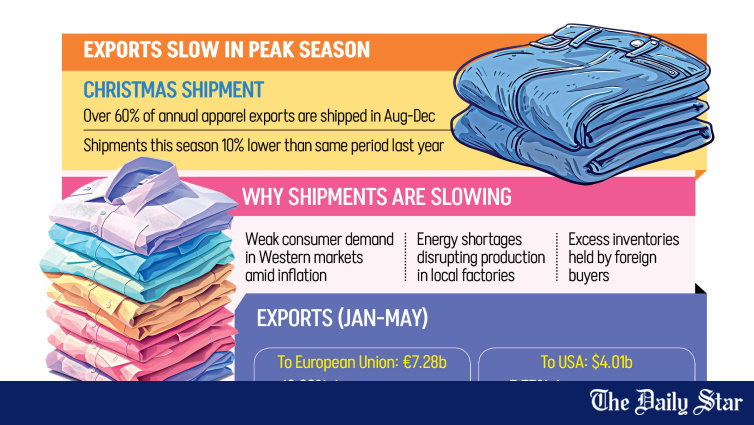
Dhaka, August 7, 2026 — Christmas season apparel shipments from Bangladesh are running at least 10 percent lower than the same period last year, as weak consumer demand in Western markets, excess buyer inventories and the domestic gas crisis combine to squeeze the festive season that typically accounts for over 60 percent of annual garment exports — raising fresh concerns about the trajectory of Bangladesh's ready-made garment (RMG) sector in the second half of 2026.
🎅 Why Christmas Matters for Bangladesh
The Christmas season is one of the busiest periods for the country's readymade garment industry, with more than 60 percent of annual apparel exports shipped between August and the first week of December. Western retailers place their festive season orders months in advance, with August and September being the critical production window for inventory that will hit shelves in October and November. Any disruption to this window — whether on the demand side (weak orders) or the supply side (factory production disruption) — has outsized impact on the full-year export number.
📉 The Slowdown in Numbers
The slowdown comes as garment exports to both Europe and the United States continue to decline. Christmas shipments are at least 10 percent lower than during the same period last year, according to a local exporter that mainly supplies the US market. The figure aligns with broader export trends showing sustained weakness across both of Bangladesh's two largest export destinations:
- 🇪🇺 EU garment exports (Jan-May 2026): −18.89% YoY to €7.28 billion (Eurostat)
- 🇪🇺 EU apparel exports (FY25-26): −3.31% to $19.06 billion (EPB)
- 🇺🇸 US garment exports (Jan-Jun 2026): −5.75% YoY to $4.01 billion (OTEXA)
- 🇺🇸 US exports (June 2026 alone): +5.74% YoY to $763.57 million (OTEXA)
- 🎅 Christmas shipment trend: −10% YoY (industry estimate)
- 📈 Festive share of annual exports: 60%+ shipped Aug–early Dec
🌏 Why Demand Is Weak
Exporters said high inflation in Western markets — fuelled by energy shocks linked to the Middle East conflict — has weakened consumer demand for discretionary goods, including apparel. They also blamed the export slowdown on excess inventories held by major international buyers, who over-ordered during the post-pandemic demand surge of 2022–2023 and have been working through that inventory ever since. The combination of weak consumer demand and bloated buyer inventory is a double blow: it reduces both the volume of new orders and the urgency with which buyers want those orders delivered.
At home, low gas pressure and frequent power outages are reducing production capacity at exactly the moment when factories need to be running at full tilt to meet the Christmas window. The long-running gas shortage worsened after the July 21 accident at the Excelerate Energy floating LNG terminal in Cox's Bazar. The disruption became so severe that many factories across the Gazipur garment belt sent workers on a four-day leave last week, with gas supply expected to improve around Monday, August 10.
💬 Industry Voices
Anwar-Ul Alam Chowdhury Parvez, chairman and managing director of Evince Group — whose major international buyers include Levi's, Armani, Zara, H&M and C&A — said the industry has been struggling with low gas pressure and the energy crisis for several months, severely affecting factory production. Parvez, a former president of the BGMEA, said buyers "were a bit cautious in placing the work orders as it happens in times of general elections in any country" — a reference to Bangladesh's February national election, which created political uncertainty that contributed to buyer caution.
Kutubuddin Ahmed, chairman of Envoy Legacy and Sheltech Group, said the slowdown is affecting all major garment-exporting countries because demand in Western markets has weakened. "Because of the slowdown in export trend, the Christmas shipment will also be low this season to some extent," he said — a sober assessment from one of the industry's most experienced voices. Sharif Zahir, chairman of Ananta Group, offered a more nuanced view: shipments of woven garments are normal this season, but demand for knitwear is lower — a sectoral divergence that reflects shifting consumer preferences in Western markets toward formal wear post-pandemic.
Ramzul Seraj, managing director of Elite Garments Ltd, which exports to the United States, said his company has been facing at least 10 percent lower exports this season than during the same period last year because buyers delayed placing work orders — a delay that compresses the production window and increases the risk of late delivery penalties.
🏛️ BGMEA President's Cautious Optimism
BGMEA President Mahmud Hasan Khan said he expects exports by the end of the current fiscal year to match or slightly exceed last year's level, although shipments have slowed in recent months. "Because it is expected that the gas supply situation will improve soon. And the factories will be able to go into production in full swing as the government has been taking measures. The government's stimulus package will also play a positive role in the business," said Mahmud — a reference to the Tk 60,000 crore private sector credit stimulus announced by Bangladesh Bank for September disbursement.
The BGMEA president's cautious optimism reflects a calculation that the second half of the fiscal year — when the FSRU is fully repaired, the LNG cargoes arrive, and the stimulus flows — will be stronger than the first half. Whether that bet pays off will determine whether the sector ends FY27 in growth or contraction territory.
👥 Structural Concern: Product Concentration
Requesting anonymity, a major European buyer recently suggested Bangladesh shift from producing basic garments to higher-value products and diversify its product range. The buyer said Bangladesh's top five products — T-shirts, trousers, formal shirts, sweaters and underwear — account for 78 percent of the country's garment exports. This heavy concentration in basic categories leaves Bangladesh exposed to competition from low-cost producers (Vietnam, India, Pakistan) while missing the higher margins available in fashion-forward and technical apparel.
Md Fazlul Hoque, managing director of Plummy Fashions Ltd — and recently appointed administrator of the FBCCI — said: "Following the Trump tariff, competition in the global supply chain has become more intense as all the major global players such as China, Vietnam, India and Pakistan are sending the same goods to the same markets." The comment underscores the structural challenge: Bangladesh's product basket overlaps almost completely with its main competitors, meaning any softness in Western demand hits all suppliers simultaneously, with limited opportunity for differentiation.
Mostafa Q Sobhan Rubel, chief executive officer of Dragon Group, said shipments to North American markets, including the United States and Canada, are normal, but exports to Europe have slowed this season — a regional divergence that mirrors the OTEXA data showing US exports up 5.74 percent in June while EU exports have been declining through the year.
🌏 Macro Implications
The Christmas shipment slowdown has implications far beyond the garment sector. The RMG industry accounts for over 80 percent of Bangladesh's merchandise exports and directly employs more than 4 million workers — predominantly women. A 10 percent reduction in Christmas shipments, if sustained through the festive window, would translate into roughly $1 billion in lost export revenue — worsening the current account deficit, putting pressure on the taka, and reducing the tax base at a time when the government is already struggling to meet its revenue target.
The slowdown also creates employment risk. With factories already operating at reduced capacity due to the gas crisis, weaker order books could trigger additional layoffs on top of the 565-worker layoff at Alliance Knit Composite announced on August 6. The Industrial Police have already reported that 17–18 percent of Gazipur factories have shut down temporarily, and any further weakening of demand could push that number higher.
✅ What Comes Next
Three indicators will determine whether the Christmas season ends in a soft landing or a hard one: (i) the pace of FSRU repair completion expected by August 10, which will determine whether factories can run at full capacity through September; (ii) the disbursement schedule for the Tk 60,000 crore stimulus, which could ease working-capital constraints for exporters; and (iii) whether Western consumer demand recovers in the September–October back-to-school and pre-holiday shopping windows. If all three break in Bangladesh's favour, the Christmas season may still deliver close to last year's export numbers. If any one of them disappoints, the festive season of 2026 may be remembered as the moment Bangladesh's RMG sector finally ran out of room to absorb external shocks.
This news was originally published by The Daily Star. For the full original report, please visit: https://www.thedailystar.net/business/economy/news/christmas-apparel-shipments-slow-weak-demand-4241811
Related on BangladeshExport
📬 Get Bangladesh Trade News in your inbox
Weekly digest of export industry news, policy updates, and market analysis.
📰 Related Stories