China Becomes Bangladesh's Second-Largest FDI Source as Industrial Footprint Widens
Chinese FDI reaches six-year high with nearly $2 billion cumulative investment, as focus shifts from infrastructure construction to industrial manufacturing including CEIZ at Anwara and Mongla Port Economic Zone
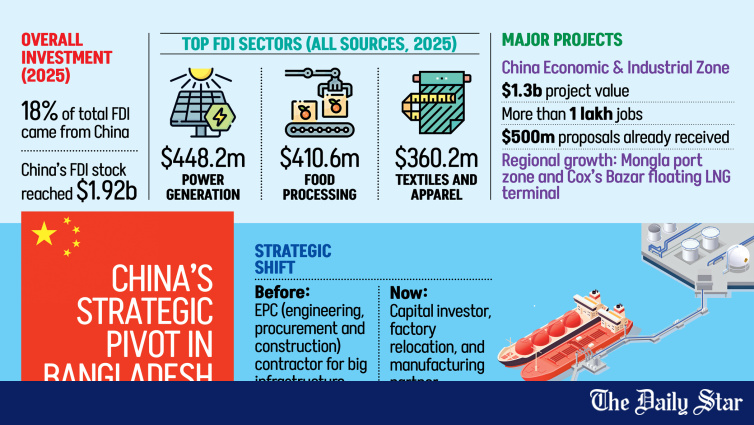
Dhaka, August 2, 2026 — China has become Bangladesh's second-largest source of net foreign direct investment (FDI), accounting for more than 18 percent of total inflows in 2025, according to Bangladesh Bank data. 🇨🇳 This means nearly one in every five investment dollars entering Bangladesh came from Chinese businesses, with Chinese FDI reaching a six-year high and cumulative investment approaching $2 billion last year. 📈
🏭 For years, Chinese companies were best known in Bangladesh as engineering, procurement, and construction (EPC) contractors rather than long-term investors. They built landmark projects such as the Padma Bridge Rail Link and the Karnaphuli Tunnel. Now, Bangladesh Bank data shows their role is changing — China is increasingly directing capital towards industrial investment, relocating manufacturing, and embedding itself more deeply in Bangladesh's production base. 🏗️
📊 Sector-Wise Chinese Investment in 2025
💰 In 2025, Chinese FDI flowed into multiple sectors of Bangladesh's economy:
- ⚡ Power sector — $448.18 million (largest share)
- 🍚 Food processing — $410.62 million
- 👕 Textiles and apparel — $360.16 million
- 🏦 Banking and telecommunications — substantial investment
- 🧪 Chemicals and pharmaceuticals — growing interest
- 🌾 Agriculture and leather — emerging sectors
- 💻 Information technology — expanding footprint
🏗️ China Economic and Industrial Zone (CEIZ) at Anwara
📍 The most significant development is the long-awaited start of construction of the China Economic and Industrial Zone (CEIZ) at Anwara in Chattogram. Key details:
- 📅 First proposed — during President Xi Jinping's visit to Bangladesh in 2016
- ⏱️ Remained dormant — for years despite land acquisition and planning
- 🔄 Regained momentum — following PM Tarique Rahman's first foreign visit to Beijing in June 2026
- 💰 Investment target — approximately $1.3 billion
- 👥 Employment — more than 1 lakh (100,000) jobs
- 🏭 Significance — China's first dedicated industrial zone in Bangladesh
📊 More importantly, CEIZ marks a shift from delivering infrastructure to establishing industrial production. This represents a fundamental change in the China-Bangladesh economic relationship. 🔄
🚢 Mongla Port Economic Zone and Beyond
🌐 Chinese interest is also expanding outside Chattogram. During the prime minister's visit to Beijing:
- 🚢 China-Bangladesh Mongla Port Economic Zone — agreement signed to develop
- 📦 Port infrastructure — Chinese involvement in logistics and industrial development
- ⚡ Third FSRU — Bangladesh approved in principle a Chinese-built FSRU at Maheshkhali
- 🤝 13 MoUs signed — covering trade expansion, CEIZ, Mongla Port modernization, Teesta cooperation
🏭 Chinese investment in textiles, apparel, furniture, plastics, chemicals, batteries, and other manufacturing industries shows this wider regional shift rather than an isolated bilateral development. 🌏
💡 Global Supply Chain Realignment
🔄 The timing is no coincidence. As labour costs rise in China and geopolitical tensions reshape global supply chains, Chinese manufacturers are increasingly relocating labour-intensive production overseas. 📊
- 🇻🇳 Vietnam and Cambodia — attracted much of that investment over the past decade
- 🇧🇩 Bangladesh — now positioning itself as another destination
- 💰 Competitive advantages — competitive labour costs, preferential access to Western markets, well-established garment industry
📋 BIDA's Dedicated Engagement for Chinese Investors
🏛️ The Bangladesh Investment Development Authority (BIDA) has introduced dedicated engagement mechanisms for Chinese investors. The agency says about 510 Chinese companies now run businesses in Bangladesh across:
- 🏭 Manufacturing — textiles, apparel, electronics
- ⚡ Power — energy generation projects
- 🧵 Textiles — backward linkage industries
- 🏗️ Construction — infrastructure development
- 📊 Trading — import-export businesses
💬 Expert Analysis: CPD Perspective
📊 Mustafizur Rahman, distinguished fellow at the Centre for Policy Dialogue (CPD), said China's growing investment reflects a convergence of trade ties, industrial familiarity, and changing global supply chains:
"China has been Bangladesh's largest source of imports for years. That has given Chinese businesses a deep understanding of the market. As China moves towards higher-value manufacturing and faces higher US tariffs, labour-intensive industries are relocating overseas."
🎯 He said the CEIZ in Anwara could become a major catalyst for industrialisation by attracting new manufacturers while increasing commercial use of the Karnaphuli Tunnel and Matarbari Port:
"Greater Chinese investment would create jobs, facilitate technology transfer, strengthen foreign exchange earnings, and diversify exports."
🔮 Looking Ahead: New Phase in China-Bangladesh Relations
🌐 Taken together, these developments point to a new phase in China-Bangladesh economic relations. China is looking to build industrial ecosystems rather than deliver individual projects. For Bangladesh, this shift represents an opportunity to:
- 👥 Create employment — thousands of manufacturing jobs
- 🔧 Technology transfer — advanced manufacturing techniques
- 💰 Strengthen forex earnings — export-oriented production
- 📊 Diversify exports — beyond traditional RMG sector
📈 However, as the FICCI report highlighted, Bangladesh must address policy uncertainty, logistics bottlenecks, and energy reliability to fully capitalize on this Chinese investment momentum. The coming years will determine whether Bangladesh can transform Chinese interest into sustained industrial development that benefits both nations. 🚀
This news was originally published by The Daily Star. For the full original report, please visit: https://www.thedailystar.net/business/economy/news/chinese-footprint-widens-bangladeshs-economic-landscape-4237796
Related on BangladeshExport
📬 Get Bangladesh Trade News in your inbox
Weekly digest of export industry news, policy updates, and market analysis.
📰 Related Stories