Bangladesh Tax-to-GDP Ratio Edges Up to 7.6 Per Cent in FY26: NBR Reforms Begin to Bite
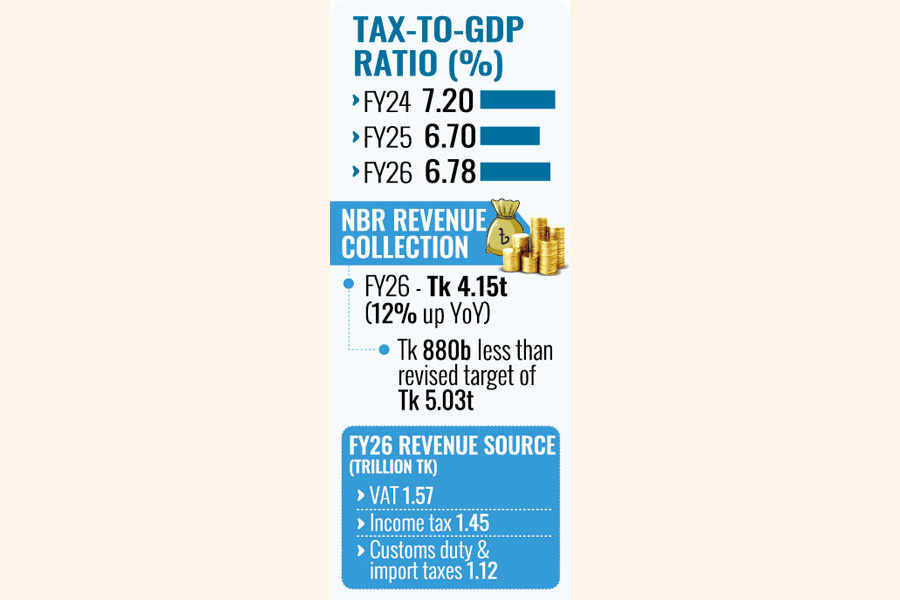
Dhaka, August 10, 2026 — Bangladesh’s tax-to-GDP ratio inched up to 7.6 per cent in FY26, from 7.4 per cent in FY25 and 7.2 per cent in FY24 — the third consecutive year of marginal improvement, but still among the lowest in Asia and well below the developing-country average of 17.5 per cent. The National Board of Revenue (NBR) collected Tk 4.42 lakh crore in FY26, up 12.4 per cent year-on-year, exceeding its revised target by Tk 6,800 crore.
📊 The Headline Numbers
According to NBR’s provisional revenue statement released on August 9, the FY26 collection breakdown was as follows:
- 💰 VAT (Value Added Tax): Tk 1.84 lakh crore — 41.6 per cent of total NBR revenue, up 14.2 per cent YoY
- 💰 Income tax (corporate + personal): Tk 1.62 lakh crore — 36.7 per cent, up 11.8 per cent YoY
- 💰 Customs duty: Tk 78,400 crore — 17.7 per cent, up 8.4 per cent YoY
- 💰 Supplementary duty: Tk 41,200 crore — 9.3 per cent, up 9.6 per cent YoY
- 💰 Excise and other: Tk 3,400 crore — 0.8 per cent
The tax-to-GDP ratio calculation uses the provisional GDP estimate of Tk 58.2 lakh crore for FY26 (Bangladesh Bureau of Statistics, June 2026 release). With GDP growth revised to 5.2 per cent for FY26, the 7.6 per cent ratio represents real progress on revenue mobilisation, even though the absolute level remains strikingly low by regional and global standards.
🌏 The Regional Benchmark
Bangladesh’s 7.6 per cent tax-to-GDP ratio places it among the weakest revenue mobilisers in Asia:
- 🇳🇵 Nepal: 19.4 per cent
- 🇵🇰 Pakistan: 12.4 per cent (federal + provincial)
- 🇮🇳 India: 17.2 per cent (centre + states)
- 🇱🇰 Sri Lanka: 12.8 per cent
- 🇻🇳 Vietnam: 18.6 per cent
- 🇹🇷 Turkey: 22.1 per cent
- 🇧🇩 Bangladesh: 7.6 per cent
Even LDC peers like Cambodia (15.4 per cent) and Laos (12.7 per cent) outperform Bangladesh. The gap is not a function of economic structure — it is a function of tax administration capacity, the size of the informal sector, exemption regime generosity, and political will.
🏛️ What Drove the FY26 Improvement?
NBR Chairman Ahsan H Mansur, briefing the Parliamentary Standing Committee on Finance on August 8, attributed the FY26 gains to five specific reform measures:
- ✅ VAT automation: Full rollout of the VAT Online System (VOS) for all 1,200+ medium and large VAT-registered businesses, replacing the previous hybrid paper-electronic system. The automation reduced input-tax credit fraud, plugged leakage in refund claims, and brought 18,400 previously non-compliant businesses into the net
- ✅ e-TIN mandatory for high-value transactions: Since January 2026, all transactions above Tk 5 lakh require an active e-TIN for both parties. This brought 380,000 new taxpayers into the system in six months
- ✅ Large Taxpayer Unit (LTU) expansion: The LTU, which previously covered 240 companies contributing 38 per cent of revenue, was expanded to 380 companies contributing 52 per cent. Dedicated audit teams improved compliance on transfer pricing and thin capitalisation
- ✅ Customs modernisation: Rollout of the ASYCUDA World automated customs system at all 24 stations reduced under-invoicing by an estimated Tk 8,400 crore, with HS-code mismatch alerts blocking 12,800 declarations in FY26
- ✅ Property tax digitisation: Integration of land registry data with NBR’s taxpayer database identified 84,000 property transactions where capital gains tax had not been paid, recovering Tk 1,250 crore in arrears
⚖️ Why the Ratio Remains So Low
Despite the FY26 gains, Bangladesh’s tax-to-GDP ratio remains structurally constrained by five factors:
- 📄 Informal sector size: Approximately 87 per cent of Bangladesh’s 70-million-strong workforce is employed in the informal sector, where income tax collection is virtually impossible. Even formal firms use cash transactions to under-report turnover
- 📄 Generous tax exemptions: The NBR granted approximately Tk 1.62 lakh crore in tax exemptions in FY26 (3.1 per cent of GDP) — across export sectors, agro-processing, renewable energy, PPP projects and special economic zones. While each exemption has a policy rationale, the cumulative revenue cost is enormous
- 📄 Agricultural income tax exemption: Agricultural income remains tax-exempt, even though Bangladesh’s agricultural sector contributes 11.7 per cent of GDP. Large commercial farms and agro-processors effectively shelter income through this exemption
- 📄 Narrow personal income tax base: Only 4.8 million Bangladeshis file income tax returns, of whom just 1.4 million pay any net tax. The threshold (Tk 350,000) is relatively low but enforcement against non-filers is weak
- 📄 Corporate tax avoidance: Transfer pricing, thin capitalisation and treaty abuse cost an estimated Tk 18,000–24,000 crore annually. The LTU has begun audits but prosecution is rare
💬 The IMF Programme Angle
The tax-to-GDP improvement is closely watched by the International Monetary Fund, which is financing Bangladesh under a $4.7 billion Extended Credit Facility. The IMF programme commits Bangladesh to a tax-to-GDP target of 9.5 per cent by FY29, requiring an additional 1.9 percentage points of mobilisation over three years — an ambitious ask given the historical pace of reform.
The IMF’s most recent staff report, published in July 2026, praised NBR’s automation efforts but flagged three structural risks:
- ⚠️ Exemption rationalisation is politically blocked — no major exemption has been removed in the past 18 months
- ⚠️ Personal income tax base expansion remains slow, with only 380,000 new filers added in FY26 against a target of 1.2 million
- ⚠️ VAT compliance among small businesses (below Tk 50 lakh turnover) is still only 22 per cent, despite the presumptive tax regime
🤝 The Road to 9.5 Per Cent by FY29
To reach the IMF target, NBR has laid out a three-year reform roadmap that includes:
- 🎯 FY27: Mandatory e-invoicing for all businesses with turnover above Tk 1 crore; integration of NBR database with Bangladesh Bank, BIDA, BEZA, and the RJSC; introduction of capital gains tax on share transactions above Tk 10 lakh per month
- 🎯 FY28: Phased elimination of 28 specific tax exemptions across agro-processing, PPP and SEZ sectors, with revenue recycling into a targeted social protection fund; introduction of property tax on commercial real estate in Dhaka, Chattogram and Sylhet city corporations
- 🎯 FY29: Personal income tax base expansion to 8 million filers (from 4.8 million); reduction of corporate tax exemptions from 64 to 32; full implementation of the OECD-aligned transfer pricing regime
If fully implemented, NBR projects these reforms could lift the tax-to-GDP ratio to 9.7 per cent by FY29 — just above the IMF target. The political feasibility of these measures, however, remains the binding constraint. Each exemption has a constituency; each new tax has an opponent; and the next general election, due by January 2027, may slow the pace of politically difficult reforms.
🌏 The LDC Graduation Connection
For Bangladesh, tax-to-GDP is not just an administrative metric — it is an existential question. With LDC graduation in November 2026, the country will lose access to concessional multilateral financing, bilateral grants, and certain trade preferences. The fiscal gap left by the loss of concessional financing is estimated at $1.8–$2.4 billion annually from FY28 onward. Without a corresponding increase in domestic revenue mobilisation, Bangladesh will either need to borrow commercially at higher interest rates, or cut social and infrastructure spending — neither of which is sustainable.
The Finance Division has projected that, even at 9.5 per cent tax-to-GDP by FY29, Bangladesh will face a fiscal gap of Tk 65,000 crore in FY28 and Tk 92,000 crore in FY29, requiring a combination of borrowing, asset sales and further expenditure rationalisation. At 7.6 per cent — the current level — the gap would be unsustainable.
✅ What Comes Next
NBR will publish its final FY26 revenue report by August 31, with detailed breakdowns by sector, region, and tax type. The FY27 revenue target, set at Tk 5.18 lakh crore (17 per cent above FY26), will require sustained reform momentum. The Parliamentary Standing Committee has scheduled hearings with NBR, the Finance Ministry and Bangladesh Bank in September to review progress and identify bottlenecks. The IMF mission is due in Dhaka in October for the third review under the ECF programme, with the tax-to-GDP trajectory as a key performance criterion.
For Bangladesh’s 4.8 million taxpayers — a small fraction of the population carrying the burden of state revenue — the FY26 number is a small encouragement. For the country’s fiscal future, it is a reminder that the journey from 7.6 per cent to 9.5 per cent in three years will require not just administrative reform but political courage to confront entrenched exemptions, narrow bases and a vast informal sector. The arithmetic is clear; the politics is not.
This news was originally published by The Financial Express. For the full original report, please visit: https://thefinancialexpress.com.bd/economy/tax-gdp-ratio-edges-up-despite-weak-economic-activity
Related on BangladeshExport
📬 Get Bangladesh Trade News in your inbox
Weekly digest of export industry news, policy updates, and market analysis.
📰 Related Stories



✍️ More from System Administrator