Bangladesh Needs Manmade Fiber Policy to Secure EU Market Access After 2029 LDC Graduation
As Bangladesh prepares to lose duty-free EU market access after LDC graduation in 2029, developing manmade fiber sector becomes critical for GSP+ qualification and export competitiveness
Dhaka, July 25, 2026 — Bangladesh is set to graduate from the Least Developed Country (LDC) category in 2029, ending its duty-free access to the European Union under the Everything But Arms (EBA) initiative. Maintaining preferential access under the GSP+ regime will require stronger compliance with Rules of Origin, higher domestic value addition, and greater industrial competitiveness, according to a policy framework paper published in Textile Today. 🌍
📄 The paper, authored by Abu Sufian Chowdhury, Managing Director of Modern Syntex Ltd., argues that Bangladesh's RMG industry remains heavily reliant on cotton-based apparel, while global demand is increasingly shifting toward man-made fibers (MMF), particularly polyester. Diversifying into MMF is therefore essential to sustain the country's position as the world's second-largest apparel exporter.
🌱 Sustainability Advantages of MMF
MMF offers significant sustainability advantages compared to cotton, the paper notes:
- 💧 Water consumption: Polyester production uses 84–143 L/kg vs cotton's 4,342–6,902 L/kg
- 🌍 Carbon emissions: Polyester can reduce carbon emissions by approximately 1.5 kg across the apparel life cycle
- 📊 Global trend: More than 65% of textile consumption is now based on MMF, with polyester dominating due to versatility, durability, and cost-effectiveness
🏭 Modern Syntex Investment — BDT 1,700 Crore
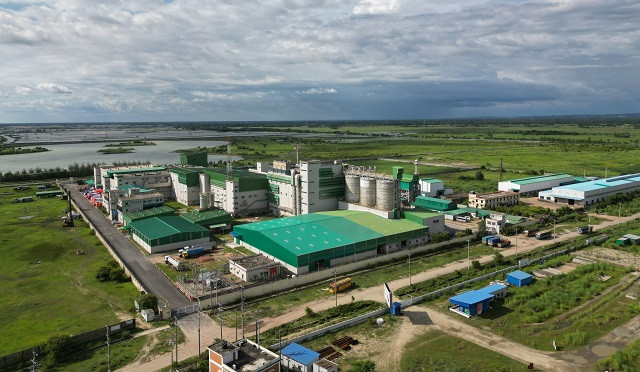
Responding to the post-2029 trade landscape, Modern Syntex Ltd. in Chattogram has invested BDT 1,700 crore to establish Bangladesh's only integrated polyester manufacturing facility. 🏭
- 📦 Products: Polyester Staple Fibre (PSF), PET chips, and Polyester Filament Yarn
- 📊 Production capacity: 550 MT per day
- 💰 Domestic value addition: Over 60%
- 💼 Employment: Around 2,000 jobs
- 💵 Import substitution: Reducing dependence on imported polyester raw materials
- 👟 Expansion potential: Creating opportunities in footwear and automotive sectors
📊 MMF Share Growth in Bangladesh
The share of MMF-based apparel in Bangladesh increased from 21.8% in 2021 to 28% in 2022, driven by growing global demand for sustainable and performance apparel. Manufacturers are increasingly producing higher-value MMF-based products such as blazers, denim wear, and activewear, which command premium prices. 📈
💰 Pricing Gap — Bangladesh vs Competitors
The paper highlights a significant pricing gap with competing countries:
- 👕 Peru earns 83% more for men's cotton shirts
- 🧥 Thailand secures 79% higher prices for women's cotton jackets
- 📊 This highlights the importance of shifting toward higher-value, MMF-based products
⚠️ Challenges for GSP+ Access After 2029
The paper identifies several challenges for achieving duty-free access under GSP+:
- 🏭 Very weak MMF industrial base
- 📦 Limited domestic production of polyester fiber and filament yarn
- 🌿 Excessive dependence on cotton-based products
- 💰 High dependence on imported PSF, polyester yarn and fabric
- 📊 Inadequate value addition — difficulty achieving 40% domestic value addition
- 📋 Rules of Origin not yet met for GSP+ double transformation requirement
- 🌱 Compliance and sustainability not fully achieved per social and environmental standards
- 🔍 Limited adoption of traceability and ESG systems
🌍 Competitor Benchmark
The paper provides a competitive comparison of MMF ecosystems:
- 🇮🇳 India: Fully integrated polyester value chain
- 🇵🇰 Pakistan: Already enjoying GSP+ with integrated value chain
- 🇻🇳 Vietnam: Benefiting from FTAs and growing MMF base
- 🇹🇷 Turkey: Advanced textile integration with proximity to EU
⚠️ Without similar development, Bangladesh will face losing market share to these competitors.
📋 Policy Framework — 7 Key Areas
The paper proposes a comprehensive policy framework across 7 areas:
A. Industrial Development
- 💰 Encourage investment in MMF — especially polyester PSF, chips, and filament yarn production
- 📅 Tax holidays (10–15 years) for MMF projects
- 🔧 Duty-free import of capital machinery
B. Backward Linkage Development
- 🏗️ Establish integrated textile industrial zones
- 🔗 Promote vertical integration (fiber → yarn → fabric → garment)
- ⚡ Develop infrastructure for utilities and logistics
C. Compliance and GSP+ Readiness
- 👥 Strengthen labor law enforcement
- 🌱 Ensure environmental compliance (ETP, chemical management)
- 🔍 Develop national traceability systems
D. Financial and Fiscal Support
- 💵 Low-interest financing for MMF investments
- 📦 Export financing support
- 🏦 Credit guarantees for large-scale projects
E. Technology and Innovation
- 🔬 Promote production of functional yarns (moisture-wicking, technical textiles)
- ♻️ Encourage recycled polyester production
- 🤖 Support automation and modernization
F. Sustainability and Green Transformation
- 💚 Incentivize green factory certification
- ☀️ Promote renewable energy use in textile sector
- 💧 Support water recycling and waste management
G. Import Substitution Strategy
- 📊 Gradual tariff rationalization on imported yarn
- 🏭 Encourage use of locally produced MMF
- 📦 Support domestic market development
📅 Implementation Roadmap
- 📅 Phase 1 (2025–2026): Policy approval and incentives
- 📅 Phase 2 (2026–2027): Investment mobilization
- 📅 Phase 3 (2027–2029): Capacity expansion
- 📅 Phase 4 (Post-2029): Full integration and competitiveness
🎯 Expected Outcomes
- 📈 Economic impact: Sustained export growth, increased FDI, enhanced industrial output
- 🏭 Industrial impact: Strong MMF ecosystem, reduced import dependency by 30–50%
- 🌍 Trade impact: Improved competitiveness in EU market, better positioning under GSP+
🔑 Key Recommendations
- 🏛️ Initiate immediate negotiations for GSP+ access
- 📋 Launch a dedicated MMF development policy
- 🏗️ Establish polyester-focused industrial zones
- 💰 Provide financial and fiscal incentives
- 🌱 Promote sustainable and compliant production systems
The development of the MMF sector, particularly polyester fiber and filament yarn, is essential for Bangladesh's continued competitiveness in the global textile market. Post-2029, export sustainability will depend not only on market access but also on the strength of domestic industrial capabilities, especially backward linkage. A coordinated policy approach is required to ensure that Bangladesh transitions successfully into a competitive, value-added, and sustainable textile economy. 🚀
This news was originally published by Textile Today. For the full original report, please visit: https://textiletoday.com.bd/policy-framework-on-development-of-manmade-fiber-sector-to-entering-into-gsp-tenure-after-2029-in-eu-market
📬 Get Bangladesh Trade News in your inbox
Weekly digest of export industry news, policy updates, and market analysis.
📰 Related Stories