Bangladesh Inflation Falls to 8.32% in July 2026: Eight-Month Low as Food Prices Ease
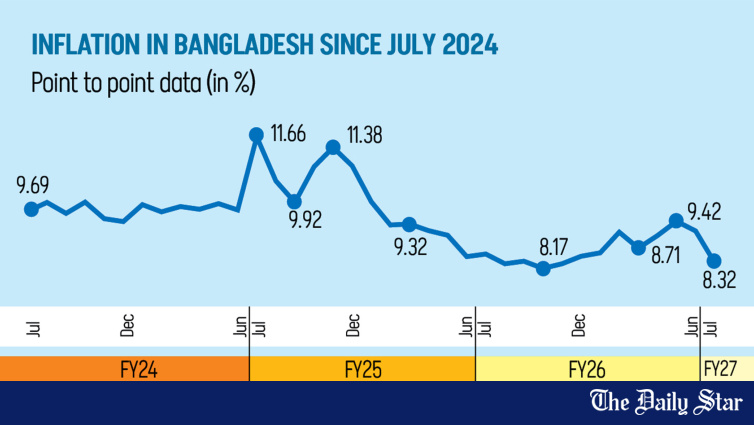
Dhaka, August 12, 2026 — Bangladesh’s overall inflation rate fell to 8.32 percent in July 2026, marking the lowest level in eight months, according to data released by the Bangladesh Bureau of Statistics (BBS). The decline from June’s 9.16 percent offers a glimmer of relief to households that have endured inflation above the 8 percent mark for more than three consecutive years.
📊 Key Inflation Figures for July 2026
- 🍔 Food inflation: Dropped to 7.16 percent from 8.60 percent in June — a significant 1.44 percentage point decline
- 🏢 Non-food inflation: Eased to 9.28 percent from 9.61 percent in June
- 🏘 Rural inflation: 8.36 percent (down from 9.23 percent in June)
- 🌆 Urban inflation: 8.24 percent (down from 9.01 percent in June)
- 📈 Last lower reading: November 2025, when inflation stood at 8.29 percent
🍖 Food Prices Drive the Decline
The sharp fall in food inflation provided the primary thrust behind the overall moderation. Food prices are particularly significant for Bangladesh because a large share of household income goes toward food purchases. The 1.44 percentage point drop in food inflation — from 8.60 percent to 7.16 percent — could offer immediate relief to consumers who have been struggling with the rising cost of essentials.
However, non-food inflation remained elevated at 9.28 percent, indicating persistent price pressures in areas such as housing, transport, clothing, healthcare, and other services. This divergence suggests that while food markets may be stabilising, broader structural inflationary forces continue to affect the economy.
⚠ Electricity Tariff Hikes: The Hidden Risk
Fahmida Khatun, executive director of the Centre for Policy Dialogue (CPD), cautioned that the latest figures may not fully reflect the impact of recent electricity tariff increases. “The moderation reflects declines in both food and non-food inflation. However, electricity tariffs were increased last month, and the full impact of the higher tariffs may not yet have been reflected in July’s inflation,” she said.
Khatun explained that energy costs often pass through gradually to production, transport, and other goods and services. “Therefore, one month’s decline in inflation should not be seen as a decisive easing of price pressures. The trend needs to be observed over the next few months to get a clearer picture,” she added.
💬 Economist Warnings: Do Not Declare Victory Yet
Mustafa K Mujeri, executive director of the Institute for Inclusive Finance and Development (InM), echoed similar caution. He noted that non-food inflation at 9.28 percent means price pressures on people’s living costs remain quite high.
“We have seen inflation move up and down in recent months without establishing a clear downward trend,” Mujeri said. “We would like to see the moderation continue for several months before concluding that inflation is on a sustained downward trajectory.”
Mujeri also pointed out that seasonal factors and the base effect may have contributed to the decline. Since point-to-point inflation compares prices in July 2026 with those in July 2025, temporary factors need to be considered when interpreting the figures.
“The latest decline can certainly be seen as a beginning or a positive sign. But it would be premature to conclude from one month’s data that the fundamental drivers of inflation have been brought under control. We may have to wait and see,” Mujeri concluded.
🌏 Rural-Urban Divide
The BBS data revealed a notable rural-urban inflation gap. Rural inflation stood at 8.36 percent compared to urban inflation of 8.24 percent — a difference of only 0.12 percentage points. Both saw significant declines from June levels, with rural inflation dropping 0.87 points and urban inflation falling 0.77 points. The convergence suggests that the factors driving the decline — primarily improved food supply chains and seasonal agricultural output — are affecting both rural and urban markets similarly.
For rural households, where food accounts for an even larger share of expenditure, the drop in food inflation to 7.16 percent is particularly meaningful. However, rural communities often face higher transportation costs and limited access to markets, which can sustain price pressures even when overall inflation moderates.
🏛️ Broader Economic Context and Export Implications
The inflation data arrives at a critical juncture for Bangladesh’s economy. The country is preparing for LDC graduation in November 2026, which will bring new trade challenges and the loss of preferential market access. Persistent inflation above 8 percent has eroded purchasing power, constrained consumer spending, and complicated the central bank’s monetary policy stance.
The Bangladesh Bank has been pursuing a contractionary monetary policy to rein in inflation, but the impact has been uneven. While food prices have responded to seasonal supply improvements and agricultural output, non-food inflation — driven by housing, healthcare, and transport costs — has proven more resistant to policy measures.
For Bangladesh’s export sector, lower inflation could eventually translate into reduced input costs, particularly for labour-intensive industries like RMG. However, the elevated non-food inflation suggests that production costs, including energy and logistics, remain a concern for manufacturers competing in global markets. The recent 21 percent hike in jet fuel prices and continued electricity tariff adjustments will likely exert upward pressure on non-food inflation in the coming months.
✅ What Comes Next
Economists agree that the next two to three months of inflation data will be critical in determining whether the July decline represents the beginning of a sustained downward trend or merely a temporary reprieve. The Bangladesh Bank’s monetary policy committee is expected to review rates in its next meeting, with the inflation trajectory being a key factor in its decision.
For businesses and exporters, the moderate inflation environment — if sustained — could improve cost competitiveness and support the government’s ambitious export target of $63.4 billion for FY2026-27. However, with electricity tariffs rising and global energy prices volatile, cost pressures are likely to remain a challenge for the foreseeable future.
This news was originally published by The Daily Star. For the full original report, please visit: https://www.thedailystar.net/business/economy/news/inflation-falls-eight-month-low-832-july-4245571
Related on BangladeshExport
📬 Get Bangladesh Trade News in your inbox
Weekly digest of export industry news, policy updates, and market analysis.
📰 Related Stories



✍️ More from System Administrator