Bangladesh Bureau Of Statistics Plans Annual Advance Calendar For Major Data Releases To Improve Transparency
BBS publishes draft Data and Microdata Dissemination and Access Policy, 2026 covering censuses, surveys, administrative data, key indicators, metadata and public-use microdata.
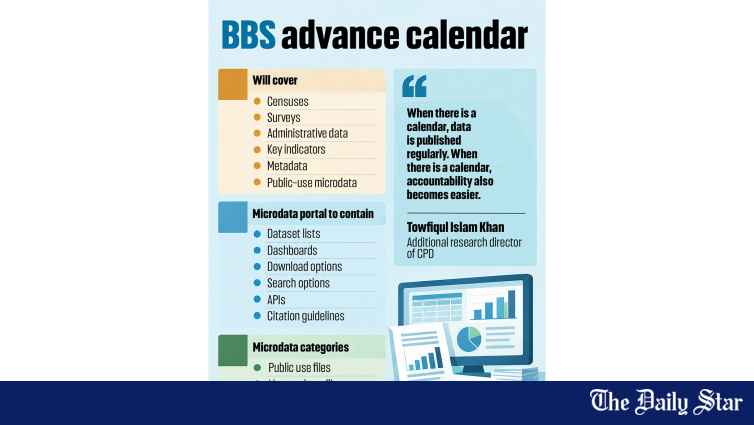
📊 The Bangladesh Bureau of Statistics (BBS) is set to introduce an annual advance calendar showing when it will publish major statistics, making data releases more predictable and transparent. The calendar will cover censuses, surveys, administrative data, key indicators, metadata and public-use microdata, according to BBS documents.
🏛 The BBS will publish the calendar under its Data and Microdata Dissemination and Access Policy, 2026, which aims to overhaul how the agency publishes and shares official statistics and microdata. The BBS is now seeking feedback from stakeholders after posting the draft policy on its website. The introduction of an advance release calendar is a significant modernisation step for Bangladesh''s official statistics system, aligning it with international best practice as promoted by the International Monetary Fund''s Special Data Dissemination Standard (SDDS) and the United Nations Fundamental Principles of Official Statistics.
👥 Why an advance release calendar matters
An advance release calendar matters because it addresses one of the long-standing weaknesses of Bangladesh''s official statistics system — the unpredictability of data release dates. Historically, BBS has released major statistical publications (such as GDP estimates, inflation figures, trade data, and labour force surveys) without prior notice of when the data would be published. This unpredictability has created challenges for policymakers, researchers, businesses and international organisations that rely on BBS data for decision-making, analysis and reporting.
By committing to an annual advance release calendar, BBS is providing its data users with the predictability they need to plan their work around official data releases. For businesses, this means being able to anticipate when key economic indicators will be published and plan their market analysis accordingly. For researchers, it means being able to plan research projects around the timing of data releases. For policymakers, it means being able to schedule policy reviews and decisions around the availability of fresh data.
"If the scheduled release date is changed due to unavoidable circumstances, the revised schedule, along with the reason for the change, shall be published as soon as possible," the draft policy says. This commitment to transparency around any changes to the release schedule is particularly important — it ensures that users are informed of delays and the reasons for them, rather than being left in the dark.
🌏 International best practice
The introduction of an advance release calendar aligns Bangladesh with international best practice in official statistics. The IMF''s Special Data Dissemination Standard (SDDS) — which is followed by most advanced and many emerging economies — requires subscribing countries to publish advance release calendars for key economic and financial statistics. The United Nations Fundamental Principles of Official Statistics, which BBS has committed to follow, also emphasises the importance of predictable and transparent data dissemination.
By adopting an advance release calendar, Bangladesh is moving closer to compliance with these international standards — a step that should improve the credibility and usability of its official statistics in the eyes of international organisations, investors and researchers. This is particularly important as Bangladesh prepares for LDC graduation and the associated scrutiny of its macroeconomic data and statistical capacity.
💰 The broader Data and Microdata Dissemination Policy
The advance release calendar is part of a broader Data and Microdata Dissemination and Access Policy, 2026 that BBS is developing. The policy aims to overhaul how the agency publishes and shares official statistics and microdata — a significant modernisation of Bangladesh''s statistical infrastructure. Microdata refers to the individual-level data records that underlie published statistics — for example, the household-level responses to a labour force survey that are used to calculate unemployment rates. Access to microdata allows researchers to conduct their own analysis and validate official statistics, but it must be balanced with privacy and confidentiality concerns.
The new policy is expected to address these issues by establishing clear rules for how microdata can be accessed, what levels of anonymisation are required, and what purposes the data can be used for. This is a significant step forward for Bangladesh''s research community, which has historically had limited access to official microdata — limiting the depth and quality of independent research on the country''s economy and society.
🤝 Implications for Bangladesh
For Bangladesh''s broader economic governance, the modernisation of BBS''s data dissemination practices is strategically significant. Reliable, timely and accessible official statistics are the foundation of evidence-based policymaking — and Bangladesh''s historical weaknesses in this area have been a constraint on the quality of economic decision-making.
The introduction of an advance release calendar and the broader data dissemination policy should help address these weaknesses over time. By making data releases more predictable and microdata more accessible, BBS is creating the conditions for better-informed policymaking, more rigorous academic research, and more informed business decision-making. The fact that the agency is seeking stakeholder feedback on the draft policy is also a positive signal — suggesting a more open and consultative approach to the modernisation of Bangladesh''s statistical system.
The coming months will show how the new policy is implemented in practice — and whether the commitment to predictable data releases translates into actual adherence to the published calendar. If successful, the modernisation of BBS''s data dissemination practices could be one of the most significant improvements in Bangladesh''s economic governance infrastructure in recent years.
This news was originally published by The Daily Star. For the full original report, please visit: https://www.thedailystar.net/business/economy/news/bbs-plans-advance-calendar-data-releases-4286296
📬 Get Bangladesh Trade News in your inbox
Weekly digest of export industry news, policy updates, and market analysis.
📰 Related Stories