Porabari Chomchom: Bangladesh Iconic GI Sweet — Buyer's Guide (2026)
Porabari Chomchom — Bangladesh's 2024 GI sweet, 200-year heritage from Tangail district. Deep-fried caramel-brown chhana sweet soaked in sugar syrup. HS 21069090, 7-point authenticity, 435 food suppliers.
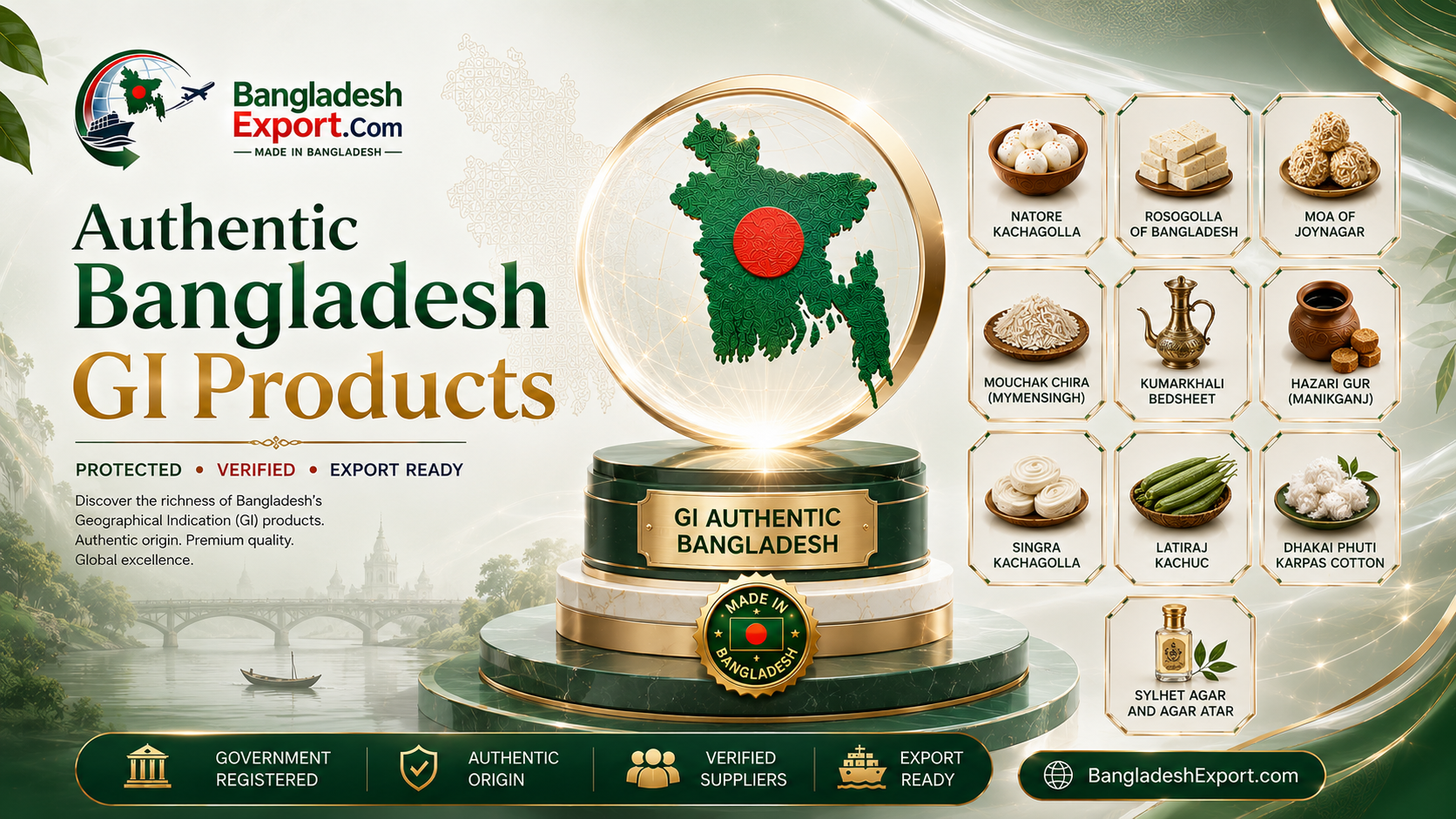
Porabari Chomchom — registered as a Bangladesh GI product in 2024 — is one of the most iconic traditional sweets of Bangladesh, originating from the village of Porabari in Tangail district. This distinctive oval-shaped chhana-based (Indian cottage cheese) sweet is characterized by its deep reddish-brown or caramel-brown color, dense and slightly chewy texture, and its aromatic sugar syrup infused with cardamom and rose water. Unlike the lighter-colored chomchom varieties produced elsewhere in South Asia, the Porabari Chomchom has a characteristic dark mahogany color that comes from the slow caramelization of the sugar syrup during the traditional 4–6 hour cooking process. For international buyers in the diaspora-sweets, ethnic-foods, and South Asian grocery segments, Porabori Chomchom offers a genuinely authentic Bangladeshi sweet with strong cultural recognition and growing demand among the global Bangladeshi diaspora.
This guide is for international food importers, diaspora-grocery distributors, ethnic-food retailers, and HORECA (Hotel/Restaurant/Café) buyers sourcing authentic Porabari Chomchom directly from verified sweet manufacturers in Tangail. We cover the sweet's history, the 2024 GI registration, the Porabari production region, the traditional manufacturing technique, quality characteristics, export markets, HS codes, packaging and cold-chain logistics, authenticity verification, certifications, and direct sourcing from verified food suppliers on BangladeshExport.com.
📜 History and the Porabari Sweet-Making Heritage
Buyers can verify the official list of Bangladesh's registered Geographical Indication (GI) products through the Bangladesh Trade Portal: bangladeshtradeportal.gov.bd — GI Products Page
The village of Porabari, located in Tangail district approximately 80 km northwest of Dhaka, has been a renowned center of sweet-making for over 150 years. The oral tradition traces the origin of Porabari Chomchom to the mid-19th century, when a local sweet-maker (moira) named Dasarath Ghorai developed the distinctive dark-colored chomchom by accident — a batch of chomchom was left simmering in sugar syrup longer than intended, and the resulting caramelization produced a sweet with deeper color and richer flavor that quickly became popular. The Ghorai family (and later several other Porabari sweet-maker families, including the Das, Pal, and Sarkar families) refined the technique over generations, and by the early 20th century Porabari had become a destination for sweet-lovers across Bengal, with travelers on the Dhaka-Tangail highway stopping specifically to buy fresh chomchom directly from the village shops.
The unique character of Porabari Chomchom comes from four factors that are difficult to replicate elsewhere: (1) the local water — drawn from the Modhupur tract aquifer, with a specific mineral composition that affects the chhana coagulation and the syrup caramelization; (2) the chhana-making technique — using full-fat cow's milk curdled with lemon-juice or whey acid, drained in muslin cloth, and pressed to a specific moisture content; (3) the slow-cooking process — the chomchom balls are simmered in sugar syrup for 4–6 hours at 95–100°C, allowing gradual caramelization and deep color development; (4) the finishing — after cooking, each chomchom is hand-rolled in mawa (reduced dried milk) or grated coconut, giving the characteristic dry exterior. The 2024 GI registration protected the "Porabari Chomchom" name and tied it to the Porabari production region. See our complete 60-product GI list and our Rasmalai of Cumilla guide, Rosogolla of Gopalganj guide, and Chanar Payesh of Sherpur guide for other Bangladeshi GI sweets.
🏛️ GI Registration and Production Region
Porabari Chomchom was registered by the Department of Patents, Designs and Trademarks (DPDT) under the Ministry of Industries in 2024. The GI registration protects the name "Porabari Chomchom" or "Chomchom of Porabari" for the traditional caramel-brown chhana-based sweet produced in Porabari village and the surrounding Tangail district using the traditional slow-cooking technique. The protected production region covers the village of Porabari in Tangail Sadar upazila, with extension to the broader Tangail district for sweets produced using the traditional Porabari technique and ingredients. Approximately 25–30 sweet manufacturers operate in Porabari village itself, with another 80–100 in the broader Tangail district using the Porabari name and technique.
Buyers should request a GI registration certificate from the supplier and verify the production location. The GI protection does not extend to chomchom produced in Dhaka, Cumilla, or other districts even when those products use the "Porabari style" marketing term. Verification follows the methodology in our GI verification guide.
🍬 Manufacturing Technique and Production Workflow
The authentic Porabari Chomchom is produced using a traditional multi-stage manufacturing process that requires 6–8 hours from milk to finished product. The complete workflow involves seven stages: (1) Milk preparation — full-fat cow's milk (4–5% fat) is brought to a rolling boil in a stainless steel or copper vat; (2) Chhana coagulation — food-grade lemon juice or traditional whey acid is added slowly while stirring, causing the milk proteins to coagulate into soft chhana curds; (3) Draining and pressing — the chhana is drained through muslin cloth for 30–45 minutes, then pressed under a weighted board for 1–2 hours to remove excess moisture; the final chhana should have approximately 50–55% moisture content; (4) Kneading and shaping — the pressed chhana is hand-kneaded for 10–15 minutes until smooth and pliable, then shaped into small oval balls (approximately 4–5 cm long, 25–30g each); (5) Sugar syrup preparation — a sugar syrup of 60–65% concentration is prepared with cardamom pods and a small amount of rose water; (6) Slow cooking — the chhana balls are added to the simmering syrup (95–100°C) and cooked for 4–6 hours, during which the syrup gradually caramelizes and the chomchom develops its characteristic dark mahogany color; (7) Finishing — the cooked chomchom is removed from the syrup, drained, and hand-rolled in mawa (reduced dried milk) or grated coconut, then allowed to cool before packaging.
The slow-cooking stage is the most critical and the most difficult to replicate outside Porabari. The 4–6 hour simmering at 95–100°C (just below boiling) allows two parallel processes: (a) gradual Maillard browning and sugar caramelization that develop the dark color and complex flavor; (b) slow moisture migration from the chhana to the syrup, producing the dense, slightly chewy texture that distinguishes Porabari Chomchom from lighter-colored varieties. The traditional copper kadai (wok) used in Porabari is also believed to contribute — copper's high thermal conductivity and slight reactivity with sugar syrups produce a more even caramelization than stainless steel. Modern manufacturers often use stainless steel for food safety compliance, with a small copper insert to maintain the traditional flavor profile.
The finished Porabari Chomchom has a shelf life of 5–7 days under refrigeration (4–8°C) without preservatives, extended to 15–20 days with permitted preservatives (potassium sorbate, sodium benzoate) and modified-atmosphere packaging. For export, the chilled supply chain is essential — Porabari Chomchom cannot be frozen (freezing damages the chhana texture) and cannot be stored at room temperature for more than 24–36 hours.
📊 Quality Characteristics and Grading
| Grade | Color | Weight per piece | Texture | Syrup Content | Shelf Life | Retail Range (USD/kg) |
|---|---|---|---|---|---|---|
| A Premium (Mawa-finished) | Dark mahogany brown | 30–35g | Dense, slightly chewy | Light syrup coating | 5–7 days chilled | 8–14 |
| A Standard (Coconut-finished) | Dark caramel brown | 25–30g | Dense, chewy | Light syrup coating | 5–7 days chilled | 6–10 |
| B Grade | Medium caramel brown | 20–25g | Standard chomchom texture | Standard syrup | 3–5 days chilled | 3–6 |
| Export Grade (Vacuum-packed) | Dark mahogany | 30–35g | Dense, slightly chewy | Light syrup, vacuum-packed | 15–20 days chilled | 10–16 |
Authentic Porabari Chomchom has six distinguishing physical characteristics: (1) deep reddish-brown to mahogany color (versus the light-yellow to caramel color of chomchom produced elsewhere); (2) dense, slightly chewy texture that holds its shape when sliced; (3) aromatic cardamom and rose-water fragrance from the syrup infusion; (4) thin coating of mawa or grated coconut on the exterior; (5) oval shape (4–5 cm long, 25–35g per piece); (6) complex caramelized-sugar flavor with a subtle smoky undertone from the slow-cooking process. The sweet is best consumed within 24–48 hours of production for optimal flavor and texture.
🌍 Export Markets and Buyer Segments
- Middle East (UAE, Saudi Arabia, Qatar, Kuwait, Oman): Largest diaspora market — Bangladeshi expatriates (over 4 million workers) buy Porabari Chomchom for personal consumption and as gifts during Eid festivals. Retail USD 8–14/kg in Bangladeshi grocery stores in Dubai, Abu Dhabi, Doha, Riyadh. Peak demand during Ramadan and Eid al-Fitr (30-day period). Annual estimated demand: 1,500–2,500 metric tons.
- EU & UK (UK, Germany, France, Netherlands, Italy): Diaspora and ethnic-food retail segment. Bangladeshi diaspora in Birmingham, Tower Hamlets (London), Manchester, and Bradford are core buyers. Retail EUR 8–14/kg. EU buyers require full HACCP and often BRC certification.
- USA & Canada: Diaspora demand concentrated in New York (Jackson Heights), Detroit (Hamtramck), Toronto (East End), Los Angeles. Retail USD 9–16/kg in Bangladeshi grocery stores. Air freight essential due to short shelf life.
- Australia, New Zealand: Niche diaspora market — Bangladeshi community in Sydney, Melbourne, Auckland. Retail AUD 18–28 / NZD 20–30/kg. Strict quarantine requirements for dairy-based sweets.
- Southeast Asia (Malaysia, Singapore): Diaspora demand — Bangladeshi workers and expatriates in Kuala Lumpur and Singapore. Retail MYR 35–60 / SGD 12–22/kg.
- India (especially West Bengal): Cultural affinity market — chomchom is also a traditional Bengali Indian sweet (with the famous "Chomchom of Bardhaman" being a related variety). Cross-border informal trade is significant. Retail INR 350–700/kg in border markets.
🏷️ HS Codes and Customs Classification
| HS Code | Description | Typical Use |
|---|---|---|
| 21069020 | Food preparations containing mawa (dairy-based sweets) | Primary classification for Porabari Chomchom export |
| 04069000 | Cheese and curd, nes | When classified as chhana-based cheese product |
| 21069099 | Food preparations, nes | Generic food preparation classification |
| 22029000 | Beverages nes (incl. sweetened syrup-based) | When classified as syrup-based confectionery |
Most Bangladesh Customs entries for Porabari Chomchom exports use HS 21069020 (mawa-based food preparations). Buyers should consult their customs broker and request that the supplier declare the HS code that matches the destination country's tariff schedule. Many destination markets impose specific dairy import requirements that buyers should verify before placing an order.
📦 Packaging, Cold Chain, and Shipping
Porabari Chomchom is highly perishable — the chhana-based sweet has a shelf life of 5–7 days under refrigeration without preservatives, and freezing damages the chhana texture irreversibly. Fresh export packaging: food-grade plastic trays (250g, 500g, or 1kg capacity) with snap-on lids, each tray holding 8–12 chomchom pieces arranged in a single layer to prevent sticking. For premium retail, vacuum-packing in modified-atmosphere packaging (MAP) with nitrogen flush extends shelf life to 15–20 days chilled. Cold chain: 4–8°C throughout transit and storage — Porabari Chomchom should never be frozen, and should never be stored above 10°C for more than 4 hours. Relative humidity 70–80% to prevent the mawa or coconut coating from drying out.
Shipping options: (1) Air freight — essential for export to Middle East, EU, UK, USA, Canada, and Australia due to short shelf life, transit time 1–3 days, cost USD 2.5–5.0/kg; (2) Land route to India via Benapole-Petrapole border — 6–12 hour transit, used for fresh supply to Kolkata and West Bengal markets. Required documentation includes: Phytosanitary Certificate (issued by the Department of Agricultural Extension for the coconut or cardamom components), Health Certificate (issued by the Department of Livestock Services for the dairy components), Certificate of Origin (Tangail Chamber of Commerce & Industry), DPDT GI registration certificate copy, HACCP / BRC certification (for EU and major retail buyers), Halal certification (for Middle East buyers). See our export documentation guide for the complete document checklist.
✅ Authenticity Verification — Seven-Point Checklist
To verify that chomchom marketed as "Porabari Chomchom" is authentic, perform the following seven-point inspection:
- Color inspection: Deep reddish-brown to mahogany color throughout (not just on the surface) — lighter-colored chomchom (light yellow or pale caramel) indicates shorter cooking time and is not authentic Porabari.
- Texture inspection: Dense, slightly chewy texture that holds its shape when sliced; the interior should be uniformly dark with no light-colored core; light, spongy texture indicates mass-production technique, not Porabari slow-cooking.
- Aroma inspection: Aromatic cardamom and rose-water fragrance from the syrup infusion, with a subtle smoky undertone from the slow caramelization; absence of cardamom/rose aroma indicates shortcut flavoring, not traditional syrup infusion.
- Exterior finish: Thin coating of mawa (reduced dried milk) or grated coconut on the exterior; complete absence of coating or thick coating indicates non-Porabari production.
- Shape and weight: Oval shape (4–5 cm long, 25–35g per piece); perfectly round or oversized pieces indicate non-traditional shaping.
- DPDT GI registration: Supplier provides a copy of the DPDT GI registration certificate; for bulk orders, request the manufacturer's GI usage authorization letter.
- Porabari production documentation: BSTI (Bangladesh Standards and Testing Institution) certification, manufacturer's production address in Porabari village or broader Tangail district, and Tangail Chamber of Commerce membership.
🏛️ Certifications and Institutional Support
The Porabari Chomchom supply chain is supported by multiple institutional certifications and agencies. The Bangladesh Standards and Testing Institution (BSTI), under the Ministry of Industries, issues product certification under BDS 1705 (Dairy-based sweets standard) — buyers should request the supplier's BSTI certification number. The Department of Livestock Services (DLS), under the Ministry of Fisheries and Livestock, issues health certificates for dairy-product export. The Department of Agricultural Extension (DAE) issues phytosanitary certificates for any plant-derived ingredients (coconut, cardamom). For EU export, full HACCP certification is required; the British Retail Consortium (BRC) Global Standard for Food Safety is required by major UK retailers and is increasingly required by EU retailers as well. For Middle East export, Halal certification from a recognized Halal authority (such as the Islamic Foundation Bangladesh or a GCC-recognized Halal certifier) is required. For organic claims, the EU Organic or USDA NOP certification applies.
Institutional support for export comes from the Export Promotion Bureau (EPB) for market intelligence and trade-fair participation; the Bangladesh Sweet Manufacturers' Association for industry coordination; and the Bangladesh Food Safety Authority (BFSA) for regulatory compliance. Buyers seeking institutional supplier referrals can contact the Tangail Chamber of Commerce & Industry directly or browse the broader Bangladesh exporters' association directory on BangladeshExport.com.
🤝 Sourcing Verified Porabari Chomchom Manufacturers — Five-Step Process
- Browse verified food suppliers: Start with our verified Food & Beverage suppliers — filter by district (Tangail) and subcategory (Sweets / Confectionery / Dairy) to shortlist 8–12 suppliers.
- Post a free RFQ: Submit a Request for Quotation specifying "Porabari Chomchom" with grade (A Premium Mawa / A Standard Coconut / Export Vacuum-packed), quantity, packaging (tray size, count per master carton), destination, and required certifications (BSTI, HACCP, BRC, Halal). Verified suppliers respond within 24–72 hours.
- Check credentials: For each shortlisted supplier, verify (a) BSTI certification under BDS 1705, (b) DPDT GI registration copy, (c) HACCP / BRC certification (for EU/UK buyers), (d) Halal certification (for Middle East buyers), (e) Tangail Chamber of Commerce membership, (f) BFSA registration, (g) EPB export track record.
- Order a trial shipment: Request 5–20 kg trial shipment by air freight. Pay via L/C or escrow. Evaluate against the seven-point authenticity checklist. Conduct lab testing (sugar content, fat content, microbial load) at a recognized laboratory. Visit the production facility in Porabari village in person if bulk order exceeds USD 30,000.
- Finalize directly: For orders over USD 3,000, use irrevocable L/C at sight from a top-50 international bank; for smaller orders, advance payment with 50% deposit and 50% against shipping documents is standard. BangladeshExport.com does not charge commission.
If you are a Porabari Chomchom manufacturer: register as a supplier on BangladeshExport.com (free). The platform connects you directly with verified international buyers without intermediary margins.
🚀 Source Authentic Porabari Chomchom — Free RFQ
Post a free RFQ for authentic Porabari Chomchom from verified manufacturers in Tangail. Specify grade, quantity, packaging, destination, and required certifications. Verified suppliers respond within 24–72 hours. No commission, no middleman, direct supplier contact.
🚀 Post a Free RFQ → 🔍 Browse Verified Food & Beverage Suppliers🎯 Conclusion
Porabari Chomchom is one of Bangladesh's most iconic GI sweets — the 150-year-old slow-cooking tradition, the deep mahogany color, the dense chewy texture, and the cardamom-rose syrup infusion create a product that mass-produced chomchom cannot replicate. For buyers serving Bangladeshi diaspora, ethnic-food, or South Asian grocery segments, authentic Porabari Chomchom offers strong cultural recognition and growing demand, with peak demand during Eid festivals in Middle Eastern markets. The chilled cold-chain requirements (4–8°C, air freight essential) are demanding but well-established in the global dairy-sweets trade, and Porabari manufacturers are increasingly investing in modified-atmosphere packaging technology to extend shelf life for export markets. BangladeshExport.com makes sourcing free and transparent — start with a free RFQ today.
For the complete catalog of 60+ Bangladesh GI products, see our complete GI products list. For other Bangladeshi GI sweets, see our Rasmalai of Cumilla guide, Rosogolla of Gopalganj guide, Chanar Payesh of Sherpur guide, Sandesh of Tangail's Jamurki guide, and Balish Misti guide. For broader context on Bangladesh food-export trends, see our 2026 global demand analysis. For step-by-step verification methodology, see our GI verification guide.
❓ Frequently Asked Questions
What makes Porabari Chomchom a GI product?
Porabari Chomchom was registered as a Bangladesh GI product by DPDT in 2024. The registration protects the name "Porabari Chomchom" for the traditional caramel-brown chhana-based sweet produced in Porabari village and broader Tangail district using the 4–6 hour slow-cooking technique that produces the characteristic deep mahogany color and dense chewy texture. The GI registration legally distinguishes authentic Porabari Chomchom from chomchom produced elsewhere in Bangladesh or India.
How is Porabari Chomchom different from regular chomchom?
Three main differences. First, color: Porabari Chomchom has a deep reddish-brown to mahogany color throughout (from the 4–6 hour slow caramelization), versus the light yellow or pale caramel of regular chomchom (which is cooked for only 30–60 minutes). Second, texture: Porabari Chomchom is dense and slightly chewy, holding its shape when sliced; regular chomchom is lighter and spongier. Third, flavor: Porabari Chomchom has a complex caramelized-sugar flavor with a subtle smoky undertone, versus the simpler sweet flavor of regular chomchom.
What is the HS code for Porabari Chomchom exports?
Porabari Chomchom uses HS codes 21069020 (food preparations containing mawa — primary classification), 04069000 (chhana-based cheese product), or 21069099 (generic food preparation). Most Bangladesh Customs entries use 21069020.
How do I verify that the chomchom is authentic Porabari Chomchom?
Use the seven-point checklist: (1) deep mahogany color throughout; (2) dense, chewy texture with uniform interior color; (3) cardamom and rose-water aroma with smoky undertone; (4) thin mawa or coconut exterior coating; (5) oval shape (4–5 cm, 25–35g per piece); (6) DPDT GI registration certificate; (7) Porabari production documentation (BSTI certification, Tangail Chamber membership).
What is the MOQ for Porabari Chomchom?
Typical MOQ is 20–100 kg for first-time buyers (1–4 master cartons). Trial shipments of 5–20 kg are available. Bulk orders for festival seasons (Eid, Durga Puja) can reach 500–2,000 kg per shipment via dedicated air freight charter. Air freight is essential for all export shipments due to the short shelf life.
What is the shelf life and how should it be stored?
Shelf life is 5–7 days under refrigeration (4–8°C) without preservatives, extended to 15–20 days with permitted preservatives and modified-atmosphere packaging (MAP). Porabari Chomchom must never be frozen (freezing damages the chhana texture irreversibly) and must never be stored above 10°C for more than 4 hours. Maintain 70–80% relative humidity to prevent the mawa or coconut coating from drying out.
Where can I find verified Porabari Chomchom suppliers?
BangladeshExport.com hosts verified Food & Beverage suppliers. Post a free RFQ specifying "Porabari Chomchom" with your grade, quantity, packaging, destination, and required certifications — verified manufacturers will respond within 24–72 hours.