How to Verify Bangladesh GI Products Before Importing
The 4-layer verification framework for Bangladesh GI products: government registration, DPDT certificate, exporter licence, and multi-source cross-verification. Avoid GI fraud.
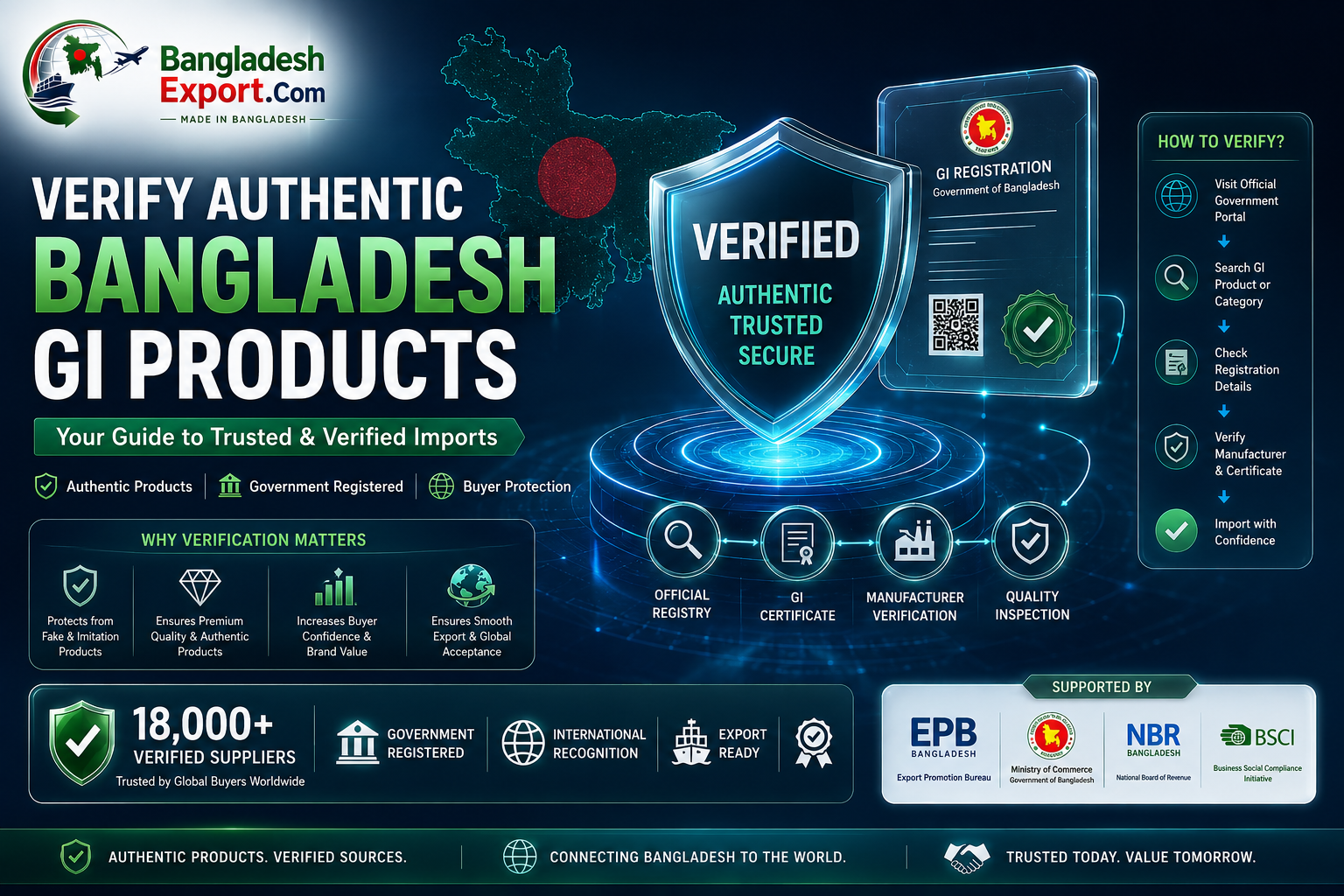
Verifying the authenticity of a Bangladesh GI product before you import it is the single highest-ROI step in your sourcing process. A genuine GI-tagged Jamdani saree commands a 3–5× retail premium over a power-loom imitation, and customs authorities in WTO member states can seize counterfeit GI shipments under TRIPS enforcement provisions. Yet most first-time buyers skip verification — relying on supplier websites, trade-show conversations, or sample photos — and discover only when the shipment reaches their warehouse that the "Jamdani" is a Surat imitation, the "Hilsa" is Myanmar-origin, or the "Muslin" is a polyester blend. By then, the money has been paid and the legal recourse is expensive and slow.
This guide explains the four-layer verification framework that international buyers, importers and sourcing agencies should apply before placing any order for a Bangladesh GI product. It covers what can go wrong without verification, the four layers of due diligence, a step-by-step verification workflow, the exact questions buyers should ask suppliers, the red flags that signal a fake, and how BangladeshExport.com's multi-source cross-verification saves you from the most common traps.
⚠️ Why Verification Matters — What Can Go Wrong
Buyers can verify the official list of Bangladesh's registered Geographical Indication (GI) products through the Bangladesh Trade Portal maintained by the Government of Bangladesh. Refer to the official GI products page for the latest registrations and updates:
bangladeshtradeportal.gov.bd — GI Products Page
GI fraud is a global problem, not a Bangladesh-specific one. The European Union Intellectual Property Office estimates that counterfeit GI products cost the European economy €4.3 billion annually. The same dynamic exists in every GI market: where a registered product commands a price premium, someone will try to sell a counterfeit under that name. Bangladesh's GI market is no exception.
The most common fraud patterns buyers encounter are:
- Geographic fraud: A product is sold as "Jamdani" or "Hilsa of the Padma" but is actually produced in another region (India, Myanmar, Vietnam) using non-traditional methods. The buyer pays a GI premium for a non-GI product.
- Material fraud: A "Jamdani saree" sold as handloom cotton-mixed with gold thread is actually a power-loom polyester blend. Visually similar to an untrained eye, but materially different — and unable to command the resale price the buyer expected.
- Manufacturer fraud: A supplier claims to be the registered GI manufacturer but is actually a trading company buying from a third-party workshop. The GI certificate shown is real but belongs to a different manufacturer; the goods shipped are not from the registered production unit.
- Certificate fraud: A forged or expired DPDT certificate is presented as proof of GI registration. Without independent verification against the DPDT registry, the buyer has no way to distinguish a real certificate from a fabricated one.
The financial consequence of any of these is the same: you pay a GI premium, you receive a non-GI product, and your downstream retail customer either rejects the shipment or demands a discount that wipes out your margin. The reputational consequence is worse: a single counterfeit-GI incident can permanently damage a buyer's standing with their retail customers.
🛡️ The Four-Layer Verification Framework
Robust GI verification is not a single check — it is a layered defense. Each layer catches a different class of fraud. Skip any layer and you leave a gap that experienced fraudsters know how to exploit.
Layer 1 — Government GI Registration
The first and most fundamental check: confirm the product appears on the official Bangladesh Trade Portal GI Products page, maintained by the Ministry of Commerce. This page lists every product registered under the Geographical Indication of Goods (Registration and Protection) Act 2013 by the Department of Patents, Designs and Trade Marks (DPDT).
If a product is not on this list, it is not a registered Bangladeshi GI product — regardless of what a supplier claims. A supplier may legitimately sell "traditional Bangladeshi products" or "heritage crafts," but only products on the Trade Portal list can be sold as "GI-registered." This is a legal distinction, not a marketing one. As of July 2026, the list contains 60+ products across five categories (Textile, Handicraft, Food, Agriculture, Natural) — see our complete catalog for the full breakdown.
Layer 2 — Manufacturer GI Certificate
Once you confirm the product is GI-registered, the second layer is to verify that the specific manufacturer you are dealing with holds a valid GI registration certificate issued by DPDT. The certificate includes:
- Manufacturer name — must match the supplier's registered company name exactly (not a trading-name variant).
- Registration number — a unique DPDT-issued identifier, traceable on the DPDT portal or via direct DPDT inquiry.
- Product name — must match the registered GI product name (e.g. "Jamdani Shari," not just "saree").
- Registration date and validity — GI registrations are valid for 10 years and renewable. An expired registration is a red flag.
- Authorized production region — must match the registered region (e.g. Narayanganj for Jamdani).
Ask the supplier for a scanned copy of the certificate, then verify the registration number independently with DPDT or via BangladeshExport.com's supplier profile verification (Layer 4). Never accept a supplier's self-claim of GI registration without documentary proof.
Layer 3 — Exporter Licence Verification
The third layer is to confirm that the supplier is a legitimate exporter with active association memberships and government registrations. This is separate from the GI certificate — a supplier may hold a GI certificate for a product but lack the export infrastructure to ship it legally. The four key verifications are:
| Verification | Issuing Authority | What It Proves |
|---|---|---|
| BGMEA membership | Bangladesh Garment Manufacturers and Exporters Association | Active garment manufacturer (4,271 active members in 2026) |
| BKMEA membership | Bangladesh Knitwear Manufacturers and Exporters Association | Active knitwear manufacturer (2,781 active members) |
| EPB registration | Export Promotion Bureau | Registered exporter with export licence (5,910 active) |
| CBCCTG bonded licence | Customs Bond Commissionerate | Bonded warehouse operator — required for duty-free import of raw materials |
Each of these is publicly verifiable on the respective association's website, and cross-referenced on BangladeshExport.com supplier profiles. For a step-by-step supplier verification checklist, see our companion guide: How to Verify a Bangladesh Supplier: 7-Point Checklist.
Layer 4 — BangladeshExport.com Multi-Source Cross-Verification
The fourth and strongest layer is the cross-verification we perform at BangladeshExport.com. We do not rely on a single source. Instead, we cross-check every supplier's claims against multiple independent databases:
- BGMEA — 4,271 garment manufacturer members
- BKMEA — 2,781 knitwear manufacturer members
- EPB — 5,910 registered exporters
- CBCCTG — 1,733 bonded warehouse licensees
- BayXBengal — bonded warehouse cross-reference data
When a supplier profile on BangladeshExport.com displays a "Verified" badge, it means at least two of these independent sources confirm the supplier's stated memberships, licences and operational status. This is not a marketing badge — it is a structured data pipeline that runs against the live association databases. Suppliers cannot self-assign this badge; it is granted only when our automated cross-check passes.
For higher-value orders, we also offer paid third-party factory audits through partnered inspection firms — covering physical factory visits, production capacity verification, and sample testing. Contact us via the in-platform messaging system after registering as a buyer to arrange an audit.
📋 Step-by-Step: How to Verify a GI Product Before Ordering
Here is the concrete verification workflow a buyer should follow for every new GI product order, in order. Skipping any step saves you 10 minutes now and costs you 10,000 dollars later.
- Check the product on the official Trade Portal GI list. Open the official GI Products page and confirm the product is registered. If not, the conversation stops here — this is not a GI product, regardless of any other claim.
- Request the supplier's DPDT GI registration certificate. Ask for a scanned copy of the original certificate, not a screenshot of a website claim. Note the manufacturer name, registration number, product name, and registration date.
- Verify the registration number independently. Email DPDT at [email protected] with the registration number and ask for confirmation. Allow 3–7 business days for response. If the supplier claims DPDT verification is "not necessary" or "too slow," treat this as a red flag.
- Verify the supplier's BGMEA/BKMEA/EPB/CBCCTG memberships. Look up the membership numbers on the respective association websites. If the supplier is on BangladeshExport.com, their profile already shows this data pre-verified — see our verified exporters guide for the full directory.
- Confirm the supplier is in the registered production region. A Jamdani weaver must be in Narayanganj. A Khirsapat mango producer must be in Chapainawabganj. A Bogurar Doi producer must be in Bogura. The factory address on the supplier's profile should match the registered GI region — if it does not, ask the supplier to explain the discrepancy before placing an order.
- Order a small sample before placing the bulk order. A genuine supplier will accept a sample order at a reasonable price (often slightly above per-unit bulk price). Inspect the sample for material quality, workmanship, packaging and labelling. For textiles, request a fibre-composition test report. For food, request a lab analysis certificate.
- Document the verification chain. Keep copies of: the DPDT certificate, the association membership proofs, the supplier's factory address, the sample inspection report, and all communication. This documentation is your legal protection if a downstream customer challenges the GI authenticity.
❓ Questions Buyers Should Ask Suppliers
Before placing any GI product order, ask the supplier these questions in writing via the BangladeshExport.com messaging system. The answers — or the supplier's willingness to answer — are themselves verification signals:
- "Is this product registered as a GI product in Bangladesh? Please share the DPDT registration number and a scanned copy of the certificate."
- "What is your factory address, and how long has your company been producing this product?"
- "Are you a member of BGMEA, BKMEA, EPB or any other relevant association? Please share your membership number and validity period."
- "Do you hold a CBCCTG bonded warehouse licence? If so, what is the licence number?"
- "What is your minimum order quantity (MOQ) for this product, and what is your typical lead time?"
- "Can you provide 2–3 references from international buyers you have previously supplied this product to?"
- "What packaging and labelling do you use to indicate GI authenticity on the product? Does it include a DPDT-issued GI logo or registration number?"
- "What is your sample policy — sample cost, lead time, and whether it is refundable against a bulk order?"
- "What payment terms do you accept for the first order — Letter of Credit, advance payment, or escrow?"
- "What quality certifications does your facility hold — WRAP, BSCI, OEKO-TEX, GOTS, ISO 9001, FSSC 22000, HACCP?"
A legitimate, well-established GI manufacturer will answer these questions promptly and transparently. A supplier who hesitates, deflects, or refuses to share documentation is a fraud risk — move on.
🚩 Red Flags That Signal a Fake
Certain supplier behaviors are reliable fraud indicators. Any one of these is reason to pause and investigate further; two or more should terminate the conversation.
- GI price that is "too good to be true": If a Jamdani saree is quoted at 30–50% below the market rate, the product is almost certainly a power-loom imitation. Real Jamdani requires 2–4 weeks of weaver time per saree; the cost structure has a floor.
- Refusal to share DPDT certificate: A genuine GI manufacturer is proud of their registration and will share the certificate readily. "We don't share certificates" is a fraud signal.
- Generic product photos: If the supplier's product photos are stock images or appear on multiple competing supplier websites, the supplier is likely a trading company with no production capacity.
- Factory address outside the registered GI region: A "Jamdani manufacturer" with a factory in Chittagong (not Narayanganj) cannot legally produce authentic Jamdani.
- Pressure to skip samples: "Samples are not necessary for serious buyers" or "We don't have sample stock right now" almost always means the supplier knows the sample will not match the bulk order.
- Unverifiable membership claims: If the supplier claims BGMEA membership but the membership number does not appear in the BGMEA member directory, the claim is fabricated.
- Payment-only-by-crypto or wire-transfer-only: Legitimate Bangladeshi exporters accept standard trade payment methods — Letter of Credit, documentary collection, or bank-to-bank wire. Refusal to accept LC is a major red flag.
- Newly-registered domain or company with no online footprint: A genuine GI manufacturer has typically been operating for years and has association records, social media presence, and trade-show history. A supplier with no verifiable history is high-risk.
🤝 How BangladeshExport.com Helps with Verification
BangladeshExport.com is built specifically to make GI verification easier for buyers. Our platform provides three structural advantages over sourcing through generic B2B marketplaces or direct Google searches.
First, every supplier profile displays pre-verified association data. When you view a supplier on BangladeshExport.com, you see their BGMEA membership number (if applicable), BKMEA membership number, EPB registration number, CBCCTG bonded licence number, and any third-party certifications — all cross-checked against the issuing authorities before the profile goes live. You don't have to ask the supplier for this data; it is already on the profile. See our guide to why verified suppliers matter for the full rationale.
Second, the "Verified" badge requires multi-source cross-confirmation. As described in Layer 4 above, our platform runs automated cross-checks against BGMEA, BKMEA, EPB, CBCCTG and BayXBengal databases. A supplier displaying the Verified badge has been confirmed by at least two independent sources — meaning a single fraudulent database entry cannot game the system.
Third, the RFQ system lets you request quotes from multiple verified suppliers simultaneously. When you post a free RFQ specifying a GI product, multiple verified suppliers respond — and you can compare their DPDT certificate numbers, factory addresses, MOQs, lead times and prices side by side. Outliers (suspiciously low price, missing documentation, region mismatch) become obvious. Post a free RFQ now.
For Bangladeshi GI manufacturers reading this: if you hold a valid DPDT GI certificate, register as a supplier on BangladeshExport.com and upload your certificate. Our verification team will validate it at no cost, and your profile will display the Verified badge — making you discoverable to the global buyers searching for your specific GI product.
🚀 Verify Before You Buy — Post a Free RFQ
Post a free Request for Quotation on BangladeshExport.com and receive quotes from multiple verified GI suppliers. Compare DPDT certificate numbers, factory addresses, MOQs and prices side by side — verification built into the sourcing process. No middlemen, no commission, completely free for buyers.
🚀 Post a Free RFQ → 🔍 Browse Verified Suppliers🎯 Conclusion
Verification is the highest-ROI step in GI sourcing. A 30-minute verification check — confirming the product is on the Trade Portal GI list, requesting the DPDT certificate, verifying association memberships, and ordering a sample — can save you from a $10,000+ counterfeit mistake. The four-layer framework (Government GI registration → Manufacturer GI certificate → Exporter licence verification → BangladeshExport.com multi-source cross-verification) catches every common fraud pattern.
The buyers who succeed in the Bangladesh GI market long-term are not the ones who skip verification to save time — they are the ones who verify rigorously, document everything, and build relationships only with suppliers who pass the four-layer test. BangladeshExport.com exists to make that process free, transparent, and structurally built into the sourcing workflow.
Your next step: Browse our verified GI supplier directory to see which manufacturers have already passed multi-source verification — or post a free RFQ for any of the 60+ registered GI products and let verified suppliers come to you.
❓ Frequently Asked Questions
How do I verify a Bangladesh GI product is authentic?
Verify via four layers: (1) confirm the product appears on the official Bangladesh Trade Portal GI list at bangladeshtradeportal.gov.bd; (2) request the supplier's DPDT-issued GI registration certificate and verify the registration number independently with DPDT; (3) verify the supplier's BGMEA/BKMEA/EPB/CBCCTG memberships on the respective association websites; (4) prefer suppliers with the "Verified" badge on BangladeshExport.com, which means our platform has cross-checked the supplier against at least two independent data sources. See the full four-layer framework above.
What is a DPDT GI registration certificate?
A DPDT GI registration certificate is a legal document issued by the Department of Patents, Designs and Trade Marks (DPDT), the Bangladeshi government authority responsible for GI registration under the Geographical Indication of Goods (Registration and Protection) Act 2013. The certificate includes the manufacturer's name, a unique registration number, the registered product name, the authorized production region, and the registration date with validity period. GI registrations are valid for 10 years and renewable.
How can I check if a Bangladesh GI product is officially registered?
The official source of truth is the Bangladesh Trade Portal GI Products page at bangladeshtradeportal.gov.bd, maintained by the Ministry of Commerce. This page lists every product registered by DPDT under the 2013 Act. As of July 2026, the list contains 60+ products across Textile, Handicraft, Food, Agriculture and Natural categories. See our complete GI products list for a categorized buyer-friendly version.
What questions should I ask a Bangladesh GI supplier before ordering?
Ask for: (1) DPDT GI registration number and certificate copy; (2) factory address and years in production; (3) BGMEA/BKMEA/EPB/CBCCTG membership numbers; (4) MOQ and lead time; (5) international buyer references; (6) GI packaging and labelling details; (7) sample policy; (8) payment terms for first order; (9) quality certifications (WRAP, BSCI, OEKO-TEX, GOTS, ISO). The full 10-question list is in the section above. A legitimate supplier will answer promptly and transparently.
What are the red flags that signal a fake GI product?
The most reliable red flags are: GI price 30–50% below market rate; refusal to share DPDT certificate; generic stock photos instead of real factory images; factory address outside the registered GI region; pressure to skip samples; unverifiable association membership claims; refusal to accept Letter of Credit; newly-registered company with no online footprint. Any one of these warrants further investigation; two or more should terminate the conversation.
Does BangladeshExport.com verify GI suppliers?
Yes. BangladeshExport.com cross-checks every supplier's claims against multiple independent databases — BGMEA (4,271 members), BKMEA (2,781 members), EPB (5,910 registered exporters), CBCCTG (1,733 bonded licensees), and BayXBengal. A supplier displaying the "Verified" badge has been confirmed by at least two independent sources. For higher-value orders, we also arrange paid third-party factory audits through partnered inspection firms. Register as a buyer (free) to access full supplier profiles and verification data.