Why Bangladesh GI Products Are Globally Popular (2026)
Why Bangladesh GI products are gaining global demand in 2026 — regional breakdown (Middle East, EU, USA, Japan, South Asia), premium categories, eco-friendly positioning, future opportunities. Diaspora-driven + craft-authenticity demand.
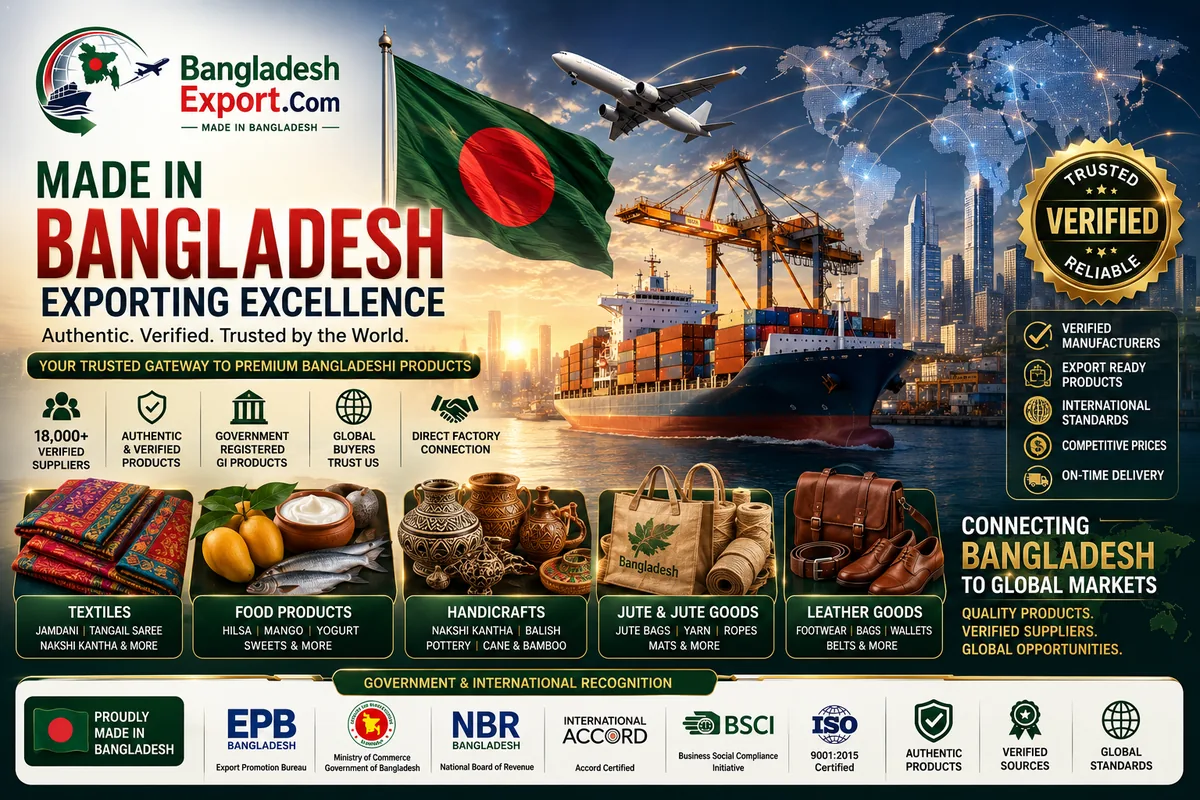
The global market for authentic, story-backed, region-specific products is growing faster than overall B2B trade — and Bangladesh's Geographical Indication (GI) portfolio is uniquely positioned to capture a disproportionate share of this growth. From the 13-million-strong Bangladeshi diaspora driving Hilsa demand across the Middle East, to European luxury boutiques stocking Jamdani sarees at USD 500–5,000 per piece, to Japanese perfumers sourcing Moulvibazar Agar Attar for premium oudh fragrances, the demand signals are converging from multiple directions. Yet most international buyers still think of Bangladesh primarily as a low-cost garment sourcing destination — missing the deeper opportunity in the country's 60+ registered GI products.
This guide explains why Bangladesh GI products are gaining global attention in 2026 — by region, by category, and by underlying consumer trend. It traces the history of Bangladesh's GI movement from the 2016 Jamdani registration through the 2024 wave of 40+ new registrations, breaks down which regions are importing what, identifies the premium food, handicraft, and natural-product categories driving the next phase of growth, and outlines where the future opportunities lie for early-moving buyers and importers.
📜 A Brief History of GI in Bangladesh
Buyers can verify the official list of Bangladesh's registered Geographical Indication (GI) products through the Bangladesh Trade Portal maintained by the Government of Bangladesh. Refer to the official GI products page for the latest registrations and updates:
bangladeshtradeportal.gov.bd — GI Products Page
Bangladesh enacted the Geographical Indication of Goods (Registration and Protection) Act in 2013, fulfilling its TRIPS commitment and creating the legal framework for GI protection. The first registration came in 2016 — Jamdani Shari, the iconic handloom saree from Narayanganj, became Bangladesh's first legally protected GI product. This was a landmark moment: it signaled that Bangladesh was serious about protecting its cultural and manufacturing heritage, not just exporting generic commodities.
The registration pace accelerated slowly through 2017–2020: Hilsa fish and Rajshahi Silk in 2017, Khirsapat Mango and Shotoronji of Rangpur in 2018, Kalijira Rice in 2019, and the revived Dhakai Muslin in 2020. By 2023, Bangladesh had roughly 20 registered GI products — modest compared to India's 500+ but a solid foundation. Then in 2024, the largest single-year expansion in Bangladesh's GI history added more than 40 new products in one year — including Tangail Saree, Khadi of Comilla, Nakshi Kantha of Jamalpur, Bogurar Doi, Kachagolla of Natore, Sweet Betel Leaf of Rajshahi, Sundarbans Honey, Agar of Moulvibazar, and dozens of regional fruits, sweets, and handicrafts. As of July 2026, the registry stands at 60+ products, with more pending DPDT review.
This rapid 2024 expansion was the result of a deliberate government-private push to identify, document, and register Bangladesh's heritage products before they were claimed by other countries or lost to industrial homogenization. For international buyers, it transformed Bangladesh from a single-product GI origin (Jamdani) into a multi-category GI sourcing destination — and created the commercial opportunity this guide explores.
🌍 Growing Export Demand — by Region
International demand for Bangladeshi GI products is concentrated in five buyer regions, each with its own demand pattern, buyer profile, and seasonal cycle. Understanding these regional dynamics is essential for any importer building a multi-year sourcing strategy.
Middle East — diaspora-driven, peak-season demand
The Middle East (Saudi Arabia, UAE, Qatar, Oman, Kuwait, Bahrain) is the largest single regional market for Bangladeshi GI food products, driven by the 13-million-strong Bangladeshi diaspora working across the Gulf. Demand peaks during Ramadan (Hilsa fish for iftar tables), Eid (Jamdani and silk sarees for celebration), and the November–March wedding season. Beyond diaspora demand, Middle Eastern perfumers are major buyers of Agar Attar from Moulvibazar — a key ingredient in oudh-based luxury fragrances that retail for USD 100–1,000 per 10ml in Dubai, Riyadh, and Doha boutiques.
European Union — luxury textile and craft buyers
The EU (Germany, France, Netherlands, UK, Italy, Spain) leads in textile GI products — Jamdani, Muslin, Nakshi Kantha, Rajshahi Silk. European buyers value provenance, heritage storytelling, and craft authenticity; fair-trade and organic certifications add a further premium. The UK is a particularly strong market because of the 600,000-strong British-Bangladeshi community concentrated in London (especially Brick Lane), Birmingham, and Manchester. Germany and France are the largest continental-EU markets, with boutiques in Berlin, Paris, and Amsterdam stocking Bangladeshi textile GI products alongside Indian and Pakistani heritage textiles.
USA and Canada — growing diaspora + millennial craft appreciation
The USA and Canada are growing markets for both textile and handicraft GI products, driven by two forces: the 500,000+ Bangladeshi-American diaspora (concentrated in New York, New Jersey, Washington DC, Los Angeles, and Toronto), and a broader millennial appreciation for artisan-made, story-backed products. Premium Jamdani pieces retail in US boutiques at USD 500–5,000; Nakshi Kantha quilts sell at USD 200–800; Sundarbans honey retails at premium gourmet stores at USD 25–40 per 250g.
Japan — premium niche for craft authenticity
Japan is a premium niche market for Rajshahi Silk and revived Dhakai Muslin. Japanese buyers pay top dollar for craft authenticity and traditional techniques — the same cultural logic that drives Japanese appreciation for kasuri (ikat), yuki tsumugi silk, and other Japanese heritage textiles extends to Bangladeshi equivalents. The Muslin revival project, which brought back the nearly-extinct Phuti Karpas cotton and the traditional 300+ thread-count weaving technique, has generated strong interest from Japanese luxury textile buyers. Volumes are small but per-unit values are the highest in the world.
South Asia — regional trade with policy friction
India, Pakistan, Nepal, Bhutan, and Sri Lanka represent a regional demand center for premium rice varieties (Kalijira, Kataribhog), Sweet Betel Leaf of Rajshahi, and textile GI products. India is the largest market — driven by the Bengali diaspora in West Bengal, Tripura, and Assam — but trade flows are influenced by bilateral trade policies, tariff structures, and political relations. Bangladesh-India GI trade has potential for significant growth if bilateral recognition agreements are finalized.
🥭 Premium Food — Hilsa, Khirsapat, Lalbagh Yogurt
Bangladesh's GI food category is the largest by count (32 products) and includes several items with strong and growing international demand. Three stand out as premium export categories.
Hilsa (Ilish) fish — the second Bangladeshi GI product (registered 2017) — is the iconic Padma-Meghna river fish beloved by Bengali communities worldwide. Annual exports exceed USD 200 million, with peaks during Ramadan and Durga Puja. The Middle East is the largest market; India is the second-largest (legal exports plus a substantial grey-market flow). Demand consistently exceeds legal supply, making Hilsa one of the highest-demand GI food products in Asia.
Khirsapat Mango of Chapainawabganj (registered 2018) is Bangladesh's premium mango variety — known for its distinctive aroma, fiberless flesh, and high sugar content. Export demand is growing rapidly in the EU and Middle East, with air-freight shipments of 1–5 tons per order common during the May–July harvest season. Khirsapat competes with India's Alphonso mango in international markets but commands a comparable premium among buyers familiar with Bangladeshi mango varieties.
Bogurar Doi (Bogura Yogurt) — registered in 2024 — is a heritage fermented yogurt from Bogura district in northern Bangladesh, known for its distinctive sweet taste and creamy texture. While perishability limits long-distance export, demand from the Bangladeshi diaspora in the Middle East and UK is strong enough to support dedicated cold-chain air freight. Premium Middle Eastern grocers stock Bogurar Doi at USD 8–15 per 500g — a 4–6× premium over standard yogurt.
🧵 Luxury Handicrafts — Jamdani, Nakshi Kantha, Muslin
Bangladesh's textile and handicraft GI products are the country's highest-value-per-unit exports, driven by international demand for authentic, story-backed luxury textiles. Three products anchor this category.
Jamdani Saree — the original 2016 GI registration — remains the most internationally recognized Bangladeshi GI product. A genuine handloom Jamdani requires 2–4 weeks of weaver time per saree, using a supplementary-weft technique that dates to the Mughal era. Premium pieces retail in EU and US boutiques at USD 500–5,000. The market is mature but growing as global consumer appreciation for handloom textiles expands. See our complete GI products list for the full textile category.
Nakshi Kantha of Jamalpur — registered in 2024 — is the iconic embroidered quilt tradition of Bengal, with motifs depicting folk stories, floral patterns, and geometric designs. Each Kantha is hand-stitched by artisan women over weeks or months, making every piece unique. European and Japanese boutique buyers prize Nakshi Kantha for fair-trade credentials, artisan provenance, and the story behind each piece. Retail prices range from USD 200 for small pieces to USD 2,000+ for large, intricately-stitched quilts.
Dhakai Muslin — registered in 2020 — is the most remarkable revival story in Bangladesh's GI portfolio. Muslin, woven from the indigenous Phuti Karpas cotton grown only in the Dhaka region, was nearly extinct by the 1990s. A government-and-private revival project brought back both the cotton cultivar and the traditional 300+ thread-count weaving technique. The revived Muslin has generated strong interest from EU luxury textile buyers and Japanese craft connoisseurs. Production is limited and per-piece prices are the highest in the Bangladeshi textile category.
🌿 Eco-Friendly and Organic Positioning
Modern consumers — particularly in the EU, USA, and Japan — increasingly factor environmental sustainability into purchase decisions. Bangladesh's GI portfolio is structurally well-positioned for this shift because the traditional production methods behind most GI products are inherently low-impact: handloom weaving (no factory emissions), traditional agricultural methods (limited synthetic inputs), small-batch artisanal production (low waste), and biodegradable materials (cotton, silk, jute, natural dyes).
Several Bangladeshi GI products have natural eco-friendly positioning that requires only formal certification to unlock premium EU and US markets. Sundarbans Honey is wild-harvested by traditional honey hunters from the world's largest mangrove forest — organic by default, with no agricultural inputs. Jute of Faridpur is the original "golden fiber" — biodegradable, renewable, and a sustainable alternative to synthetic fibers. Kalijira Rice and Kataribhog Rice of Dinajpur are traditional aromatic varieties grown by smallholder farmers using low-input methods. With organic certification (USDA Organic, EU Organic, or JAS), these products can command 30–80% price premiums in eco-conscious markets.
For buyers building sustainable sourcing portfolios, Bangladesh GI products offer a rare combination: verifiable heritage, traditional low-impact production, and government-backed legal protection of origin. This combination is difficult for competing suppliers in India, Vietnam, or China to replicate.
🚀 Future Opportunities — Where the Next Growth Is
Looking ahead to 2027–2030, five trends will shape the next phase of Bangladesh GI product export growth.
First, bilateral GI recognition agreements. Bangladesh is negotiating with the EU and India to formalize mutual GI recognition. Once finalized, this will dramatically simplify customs enforcement and unlock preferential tariff treatment for GI products — potentially doubling export volumes for affected categories within 2–3 years.
Second, organic and fair-trade certification expansion. Multiple Bangladeshi GI product associations are pursuing organic certification (USDA, EU, JAS) and fair-trade certification (FLO, WFTO). Once obtained, these certifications unlock 30–80% price premiums and access to premium retail chains (Whole Foods, Waitrose, Carrefour Bio).
Third, premium retail brand partnerships. European luxury houses and US premium home-decor brands are beginning to source Bangladeshi GI textiles for limited-edition collections. Early-stage partnerships exist with several Italian and French luxury houses for Jamdani and Muslin; broader expansion is expected as the 2024 GI wave becomes internationally known.
Fourth, direct-to-consumer e-commerce. Bangladeshi GI manufacturers are increasingly able to sell directly to global consumers via Shopify, Etsy, and social-commerce platforms — bypassing traditional importers. This creates new partnership models where importers add value through curation, certification, and logistics rather than pure distribution.
Fifth, investment in production capacity. Several GI categories — particularly Muslin, Agar Attar, and premium silk — are supply-constrained rather than demand-constrained. Investment in expanding production capacity (more weavers, more Agar plantations, more silk reeling facilities) will unlock significant export growth. Investors who understand the GI framework can build positions in these categories before competitors arrive.
For a deeper look at Bangladesh's overall export trajectory and how the manufacturing sector is evolving, see our top export products guide and the analysis of why Bangladesh is Asia's fastest-growing manufacturing hub.
🚀 Source Premium Bangladesh GI Products — Free RFQ
Post a free Request for Quotation on BangladeshExport.com for any of the 60+ registered Bangladesh GI products. Verified manufacturers respond with quotations within 24–72 hours. Whether you are sourcing premium Jamdani for a European boutique, Hilsa for Middle Eastern Ramadan demand, or Agar Attar for perfumery — connect directly with verified suppliers. No middlemen, no commission, free for buyers.
🚀 Post a Free RFQ → 🔍 Browse Verified GI Suppliers🎯 Conclusion — The Window Is Now
Bangladesh's GI portfolio has matured from a single-product listing in 2016 to a 60+ product multi-category catalog in 2026, spanning textiles, handicrafts, food, agriculture, and natural products. International demand is rising across five buyer regions, driven by diaspora communities, premium consumer trends, eco-conscious purchasing, and growing appreciation for craft authenticity. The 2024 wave of 40+ new registrations has created a commercial window that did not exist five years ago.
For global buyers and importers, the strategic question is no longer whether Bangladesh GI products have international demand — they demonstrably do. The question is whether to move now, while supplier relationships are still being formed and pricing is still advantageous, or wait until competitors have locked in the best suppliers and the price premiums have been bid up.
BangladeshExport.com exists to make that move free, transparent, and verifiable. Post a free RFQ for any of the 60+ registered GI products today, or browse our verified GI supplier directory to see who is already registered and ready to quote. For buyers who want to understand the complete product catalog first, see our 60-product GI list. For buyers who want to understand sourcing logistics, see our direct sourcing guide. And for buyers concerned about verification, see our 4-layer verification framework.
❓ Frequently Asked Questions
Why are Bangladesh GI products becoming popular worldwide?
Three converging forces: (1) global consumer shift toward provenance — 65–75% of affluent EU, US, and Japanese consumers now consider product origin a top-three purchase factor; (2) Bangladeshi diaspora demand — 13 million Bangladeshis in the Middle East, UK, and USA actively seek authentic products for cultural, religious, and familial reasons; (3) the 2024 GI registration wave that expanded Bangladesh's catalog from 20 to 60+ products, making the country a multi-category GI sourcing destination rather than a single-product origin.
Which countries import the most Bangladesh GI products?
The Middle East (Saudi Arabia, UAE, Qatar, Oman, Kuwait) is the largest market by volume, driven by diaspora demand for Hilsa, Bogurar Doi, and Agar Attar. The EU (Germany, France, Netherlands, UK) leads in textile GI products — Jamdani, Muslin, Nakshi Kantha. The USA and Canada are growing markets for both textiles and handicrafts. Japan is a premium niche for Rajshahi Silk and Muslin. South Asia (especially India) is a regional market for rice, betel leaf, and textiles.
What is the most exported Bangladesh GI product?
By export value, Hilsa fish and Jamdani saree are the two most exported GI products. Hilsa exports exceed USD 200 million annually, with peaks during Ramadan in the Middle East and Durga Puja in India. Jamdani exports are smaller in volume but higher in per-unit value, with premium pieces retailing for USD 500–5,000 in European and North American boutiques. See our complete GI products list for the full ranking by export potential.
When did Bangladesh start registering GI products?
Bangladesh enacted the Geographical Indication of Goods (Registration and Protection) Act in 2013, fulfilling its TRIPS commitment. The first product registration — Jamdani Shari — was granted by DPDT in 2016. The registration pace accelerated through 2017–2023, then expanded dramatically in 2024 with more than 40 new products registered in a single year — the largest expansion in Bangladesh's GI history. As of July 2026, the registry contains 60+ products across five categories.
Are Bangladesh GI products eco-friendly?
Most Bangladesh GI products are inherently eco-friendly because they use traditional low-impact production methods: handloom weaving (no factory emissions), traditional agriculture (limited synthetic inputs), small-batch artisanal production (low waste), and biodegradable materials (cotton, silk, jute, natural dyes). Sundarbans Honey is wild-harvested, Jute of Faridpur is a renewable biodegradable fiber, and traditional rice varieties use low-input farming. With formal organic or fair-trade certification, these products command 30–80% price premiums in EU and US eco-conscious markets.
What is the future of Bangladesh GI product exports?
Five trends will drive the next phase: (1) bilateral GI recognition agreements with the EU and India, simplifying customs enforcement and unlocking preferential tariffs; (2) organic and fair-trade certification expansion enabling 30–80% price premiums; (3) premium retail brand partnerships with European luxury houses; (4) direct-to-consumer e-commerce via Shopify, Etsy, and social commerce; (5) investment in production capacity for supply-constrained categories like Muslin, Agar Attar, and premium silk. Early-moving buyers will lock in supplier relationships before competitors arrive.