Top Export Products from Bangladesh in 2026: Complete Industry Guide
Explore Bangladesh's top export products in 2026 — from RMG and textiles to jute, leather, pharmaceuticals, and IT services. Real EPB data, industry insights, and supplier connections.
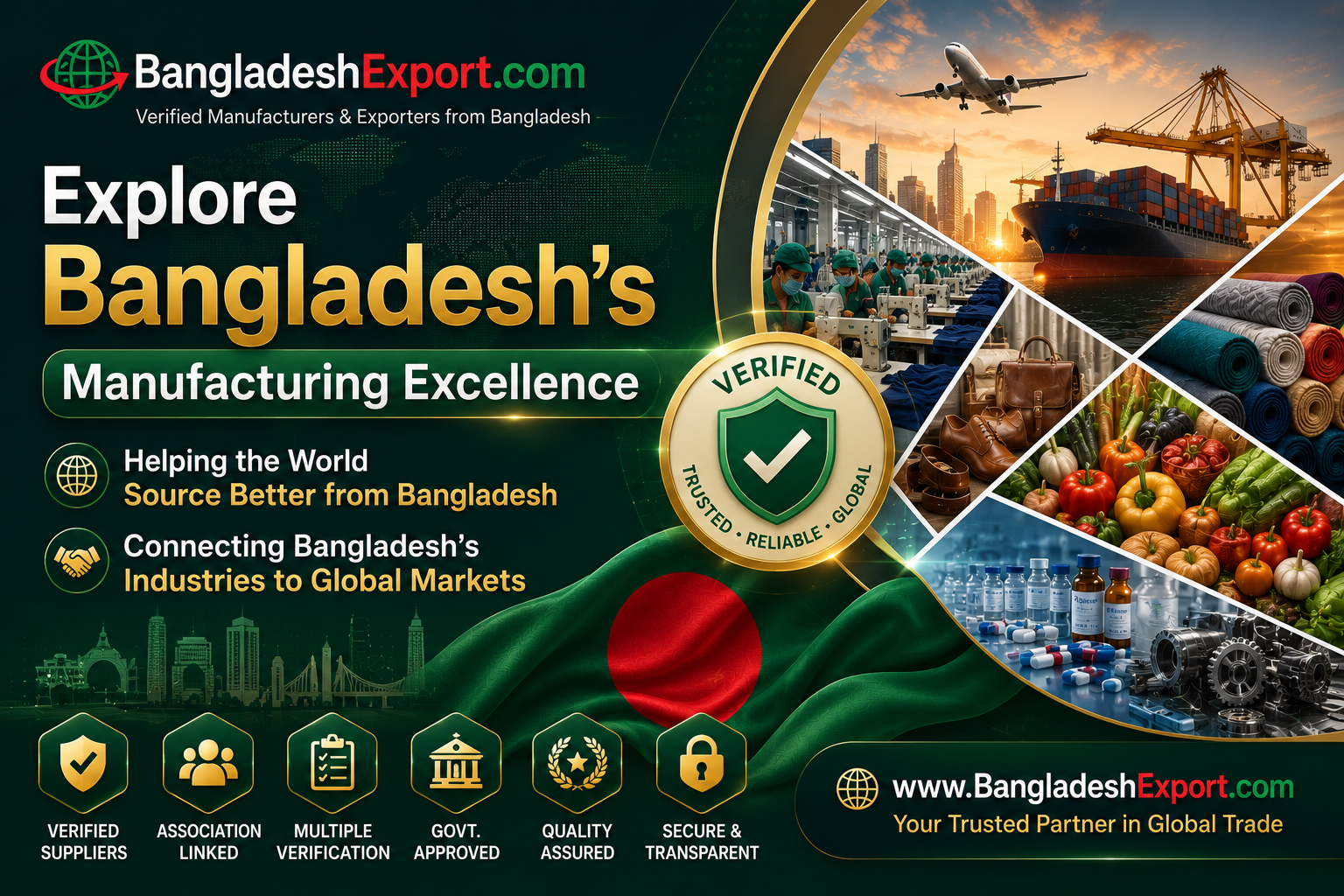
Bangladesh's export portfolio has evolved dramatically over the past decade. While ready-made garments remain the dominant force at $38.70 billion in FY2025-26, the country is rapidly diversifying into pharmaceuticals, IT services, leather goods, and agricultural products. Total exports reached $48.00 billion in FY2025-26, according to the Export Promotion Bureau (EPB).
This guide examines Bangladesh's top export products, their market dynamics, growth trajectories, and how international buyers can connect with verified suppliers in each sector.
Table of Contents
- Ready-Made Garments (RMG)
- Textile and Fabrics
- Jute and Jute Products
- Leather and Leather Goods
- Frozen Foods and Seafood
- Agricultural Products
- Software and IT Services
- Pharmaceuticals
- Future Export Industries
- Frequently Asked Questions
Ready-Made Garments (RMG) — $38.70 Billion
The RMG sector is the backbone of Bangladesh's export economy, accounting for approximately 80% of total exports. Despite a slight 1.64% decline in FY2025-26 (from $39.35 billion to $38.70 billion), Bangladesh remains the world's second-largest apparel exporter after China.
Sub-Sectors
- Knitwear — T-shirts, polo shirts, underwear, sweaters ($19.50+ billion). Bangladesh is the world's largest knitwear exporter.
- Woven garments — shirts, trousers, jackets, suits ($19.20+ billion)
- Denim — Bangladesh supplies over 30% of EU denim imports
- Sweaters — world's second-largest sweater exporter
Key Markets
The EU absorbs approximately 60% of Bangladesh's garment exports, followed by the US (18%), UK (10%), and Canada (5%). Duty-free access under the EU's Everything But Arms (EBA) initiative gives Bangladeshi garments a significant price advantage in European markets.
Find verified apparel and RMG manufacturers →
Textile and Fabrics — Growing Sector
Bangladesh's textile sector supports the RMG industry with backward linkage in yarn, fabric, and dyeing. The country has over 430 spinning mills, 800 weaving mills, and 240 dyeing and finishing mills. While much of the fabric is consumed domestically for garment production, specialized textiles are exported directly:
- Denim fabric — exported to Turkey, Egypt, and other garment-producing countries
- Terry towel — Bangladesh is a major terry towel exporter
- Home textiles — bed sheets, curtains, kitchen textiles
- Technical textiles — growing segment for industrial applications
Explore textile and fabric manufacturers on our platform.
Jute and Jute Products — $884 Million
Known as the "golden fiber," jute is one of Bangladesh's most iconic exports. FY2025-26 saw a 7.75% recovery to $884 million, driven by growing global demand for sustainable, biodegradable alternatives to plastic.
Major Jute Products
- Jute bags — shopping bags, promotional bags, wine bags
- Jute sacks — for packaging rice, coffee, cocoa, and other commodities
- Jute carpets — floor coverings and rugs
- Geo-textiles — for road construction and erosion control
- Raw jute fiber — exported to other manufacturing countries
Sustainability Advantage
Jute is 100% biodegradable, consumes 20x less water than cotton, and absorbs more CO2 than most plants. As global brands seek sustainable packaging alternatives, Bangladesh jute is positioned for significant growth. The EU's Single-Use Plastics Directive has particularly boosted demand for jute shopping bags.
Browse jute product manufacturers →
Leather and Leather Goods — $1.22 Billion
Bangladesh's leather industry has undergone significant transformation, shifting from raw hide exports to value-added finished products. The sector earned $1.22 billion in FY2025-26, with footwear accounting for over 60% of leather exports.
Industry Overview
Bangladesh produces approximately 2-3% of the world's leather, with the industry concentrated in Savar and Hemayetpur (near Dhaka). The country has 220+ tanneries (relocated to the Savar Tannery Industrial Estate) and 2,500+ footwear manufacturing units.
Key Products
- Footwear — leather shoes, boots, sandals (largest segment)
- Leather bags — handbags, backpacks, briefcases
- Leather garments — jackets, coats
- Small leather goods — wallets, belts, gloves
Major Markets
The EU is the largest market (50%+), followed by Japan, USA, and Canada. Bangladesh leather goods are particularly valued in the mid-to-premium segment, supplying brands like Clarks, Hush Puppies, and various Japanese retailers.
Find leather and footwear manufacturers →
Frozen Foods and Seafood — $500+ Million
Bangladesh is one of the world's largest producers of freshwater shrimp (golda) and marine shrimp (bagda). The frozen foods sector earned approximately $500+ million in FY2025-26.
Key Products
- Freshwater shrimp (Golda) — premium product for EU and Asian markets
- Marine shrimp (Bagda) — exported to USA and EU
- Fish fillets — pangasius, tilapia processing
- Processed seafood — value-added seafood products
Quality Standards
Bangladesh shrimp processing plants must meet EU and US FDA standards. The Department of Fisheries issues health certificates, and processing plants are HACCP-certified. Major importers include the EU (40%), USA (25%), and Japan (15%).
Browse seafood and fisheries suppliers →
Agricultural Products
Bangladesh's agricultural exports are diverse and growing, including:
Tea
Bangladesh produces approximately 85-95 million kg of tea annually, with 2-3 million kg exported to Pakistan, UAE, and Russia. The tea industry employs over 150,000 workers across 163+ tea gardens in Sylhet and Chittagong regions.
Vegetables and Fruits
Fresh vegetables (okra, bitter gourd, pointed gourd) and fruits (mango, jackfruit, pineapple) are exported to Middle Eastern and European markets, particularly to Bangladeshi diaspora communities. The sector earned $100+ million in FY2025-26.
Spices
Bangladesh produces turmeric, chili, ginger, and garlic. While most is consumed domestically, premium organic spices are exported to EU and North American markets.
Browse agricultural product exporters →
Software and IT Services — $2+ Billion
Bangladesh's IT sector is the fastest-growing export industry, generating over $2 billion annually. With 2,497+ BASIS member companies and 500,000+ IT professionals, the country has become a significant outsourcing destination.
Key IT Export Segments
- Software development — custom enterprise software, web and mobile applications
- IT-enabled services (ITeS) — BPO, customer support, data entry
- Freelance tech services — Bangladesh has the 2nd largest freelancer population globally
- Fintech solutions — mobile financial services, digital payment platforms
- Game development — growing segment with international clients
Competitive Advantages
- English-speaking workforce (medium to high proficiency)
- Competitive rates ($20-40/hour vs $80-150 in US/EU)
- Time zone advantage for European clients (4-6 hour overlap)
- Government IT parks with tax incentives
Find IT and software companies →
Pharmaceuticals — $1.30+ Billion
Bangladesh's pharmaceutical industry is one of the most advanced in South Asia, exporting to 150+ countries including highly regulated markets. The sector earned approximately $1.30 billion in FY2025-26.
Industry Overview
The country has 300+ pharmaceutical manufacturers, with the top 10 companies accounting for 70% of production. Leading exporters include:
- Beximco Pharmaceuticals — FDA-approved, exports to 50+ countries
- Square Pharmaceuticals — largest pharma company in Bangladesh
- Incepta Pharmaceuticals — major generic medicine exporter
- ACI Limited — diversified healthcare company
- ACME Laboratories — EU GMP certified
TRIPS Exemption Advantage
Bangladesh benefits from the WTO TRIPS exemption (valid until 2033), allowing local manufacturers to produce generic versions of patented medicines. This makes Bangladesh a key supplier of affordable generic medicines to developing countries, particularly in Africa and Southeast Asia.
Regulatory Approvals
Major Bangladeshi pharma companies hold approvals from:
- US FDA (Beximco, Square)
- EU GMP (multiple companies)
- WHO GMP (most manufacturers)
- UK MHRA (Beximco)
- Thailand FDA, Philippines FDA, etc.
Browse pharmaceutical manufacturers →
Future Export Industries
Beyond the established sectors, several emerging industries show strong potential:
Light Engineering
Bangladesh's light engineering sector produces bicycle parts, agricultural machinery, and auto components. The country is the world's 3rd largest bicycle exporter to the EU, with companies like Meghna Group leading the way.
Plastics and Chemicals
The plastics industry has grown to serve both domestic and export markets, with products including PVC pipes, packaging materials, and household items. Explore plastics and chemical manufacturers.
Electronics
With companies like Walton and Vision producing home appliances, Bangladesh is developing an electronics manufacturing base. The government's "Made in Bangladesh" campaign supports this growth.
Ceramics
Bangladesh ceramics (tableware, tiles, sanitary ware) are exported to EU and Middle Eastern markets. Companies like Shinepukur Ceramics (Beximco) produce high-quality bone china and porcelain.
Browse ceramics manufacturers →
Frequently Asked Questions
1. What is Bangladesh's largest export product?
Ready-made garments (RMG) are by far Bangladesh's largest export, accounting for approximately 80% of total exports ($38.70 billion in FY2025-26). This includes knitwear ($19.50B+) and woven garments ($19.20B+).
2. How much did Bangladesh export in FY2025-26?
Bangladesh's total exports reached $48.00 billion in FY2025-26 (July 2025 - June 2026), according to the Export Promotion Bureau. This was a slight 0.58% decline from $48.28 billion in FY2024-25, but June 2026 saw a strong 25.91% surge.
3. Which countries import the most from Bangladesh?
The EU is the largest market (approximately 50% of exports, with Germany, France, Netherlands, and Spain as top destinations), followed by the USA (18%), UK (10%), and Canada (3-4%). Bangladesh benefits from duty-free access to EU markets under the Everything But Arms (EBA) initiative.
4. What is Bangladesh's fastest-growing export sector?
IT and software services are the fastest-growing export sector, generating over $2 billion annually with 20%+ year-on-year growth. Pharmaceuticals are also growing rapidly at 10-15% annually, reaching $1.30+ billion in FY2025-26.
5. How can I find verified suppliers for specific Bangladeshi products?
Use BangladeshExport.com's supplier directory to search by industry category, location, and verification level. You can also search by HS code to find suppliers for specific products. All suppliers are cross-referenced against BGMEA, EPB, NBR, and DIFE databases.
6. Does Bangladesh have duty-free export agreements?
Yes. Bangladesh enjoys duty-free access to EU markets (Everything But Arms), Canada, Australia, and several other developed markets under GSP+ preferences. This gives Bangladeshi products a significant price advantage over competitors in these markets.
7. What is the TRIPS exemption and how does it benefit Bangladesh pharma exports?
The WTO TRIPS exemption allows least-developed countries like Bangladesh to produce generic versions of patented medicines until 2033. This makes Bangladesh a key supplier of affordable generic medicines to 150+ countries, particularly in Africa and Southeast Asia.
Ready to source from Bangladesh? Register as a buyer (free) and connect with verified manufacturers across all export industries. Browse our 17 industry categories to find suppliers for your specific product needs.